
Why Matsya is spelled that way — and what it costs to get it right
There is a version of this name the early internet had to settle for: matsya. This is the file on how Matsya replaced it.
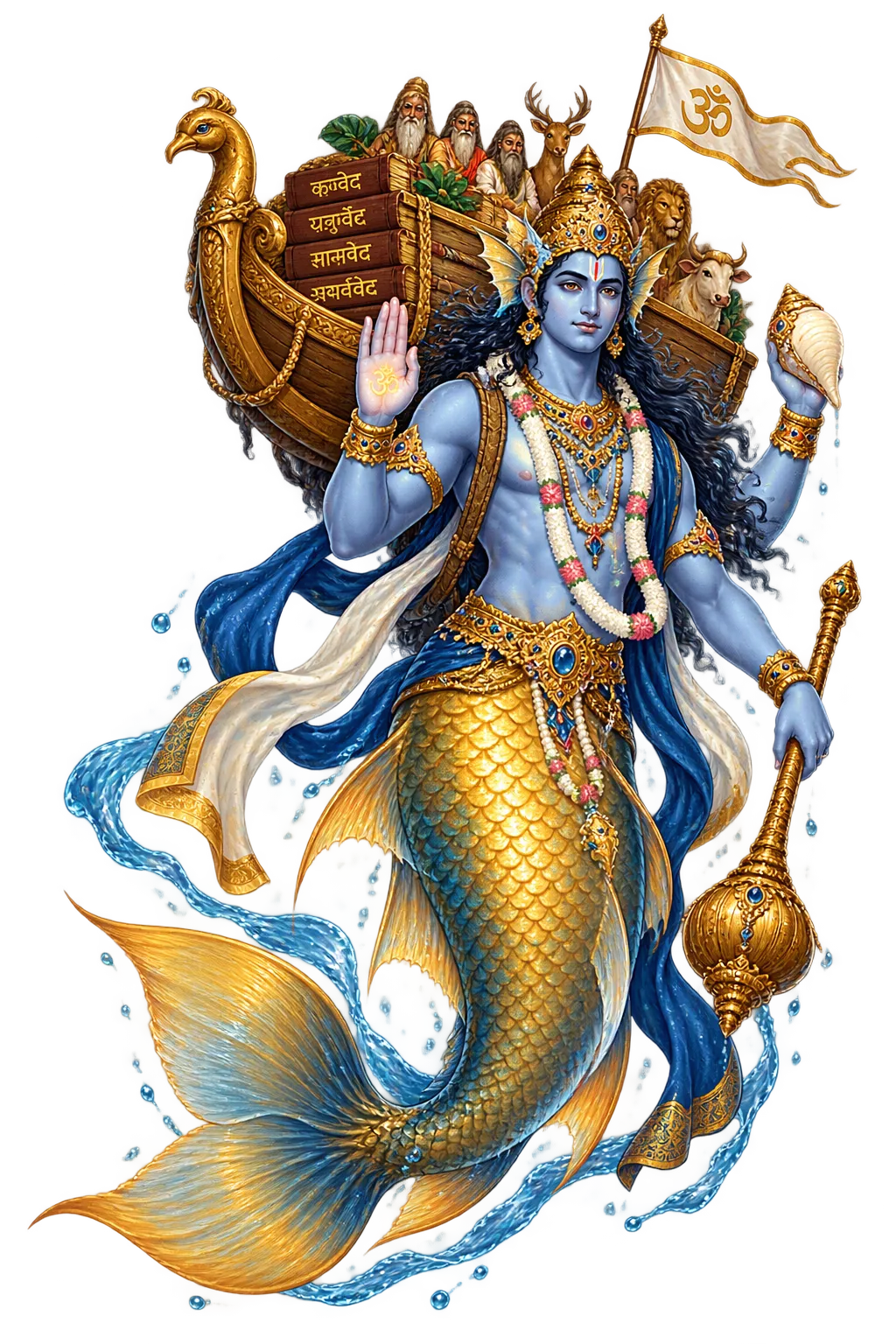
The Matsya myth is India’s flood-saga: the warning, the ark, the world’s drowning, and the mooring at the one remaining peak — with the added theology of the avatāra, Vishnu descending to preserve both species and scripture. The telling grows from a brief Vedic episode to one of the Purāṇas’ most beloved complete narratives.
At a Glance
- Restored name: Matsya
- ASCII form: matsya
- Meaning: "'The Fish' — the first avatāra of Viṣṇu, who saved Manu and the Vedas from the great deluge"
- Domain of influence: Fish Avatar of Vishnu
- Pantheon: Sanskrit
- Restoration: ASCII-equivalent form
- Original script: मत्स्य
- Series: The Restoration Files, No. 329 of 597
The Name Before the Marks
Spoken, the name runs `/ˈmɑːtsyə/` — “MAHT-chyuh”
The Temple That Stands Now
The restored name is not a plaque; it is an address. The temple of Matsya lives at /matsya/, with its mythology in the lore halls, its peer-reviewed record in the Scholarly Edition, and its place in the pattern atlas on the patterns floor.
aSCII-equivalent form
Where the Name Stood First
Matsya rides the first panel of every daśāvatāra frieze — from the Gupta reliefs of Deogarh to the great sequence-walls of Angkor. The fish-torso Vishnu of the early medieval images is his monumental form. The temple on the web is the newest of these addresses — the first one that fits in a pocket.
The Archetype at Work
The pattern atlas seats this temple in 3 industries, each match argued and weighted: Disaster Resilience & Recovery (the flood survived by ark — the species' resilience plan, executed by a fish.); Maritime, Shipping & Ocean Industries (the great fish that bore the ark through the deluge — the flood survived by boat is his myth.); Insurance & Protection Services (the one who insured the species — the ark against the deluge, the policy that paid out in full.). The Resonance File reads those seats through the myths themselves.
In the Sacred Texts
The Sanskrit tradition is not a vibe; it is a library. The Sacred Texts collection holds Rig Veda and Ramayana — the primary sources the temple's scholarship is built on. The temple is the argument; the texts are the evidence.
The File Continues
The temple's founding dispatch tells the name's story; its Resonance File reads the myths into the industries; the blog index holds the whole archive.
Continue the series — previous file: Matholwch (read it here) · next file: Māzǔ (read it here).
The Restoration Files are written from the same canonical record as the temples themselves: the lexicon, the lore catalog, the pattern atlas, and the cited scholarly sources. If a file ever disagrees with its temple, the temple is right — tell us, and the file will be corrected.