
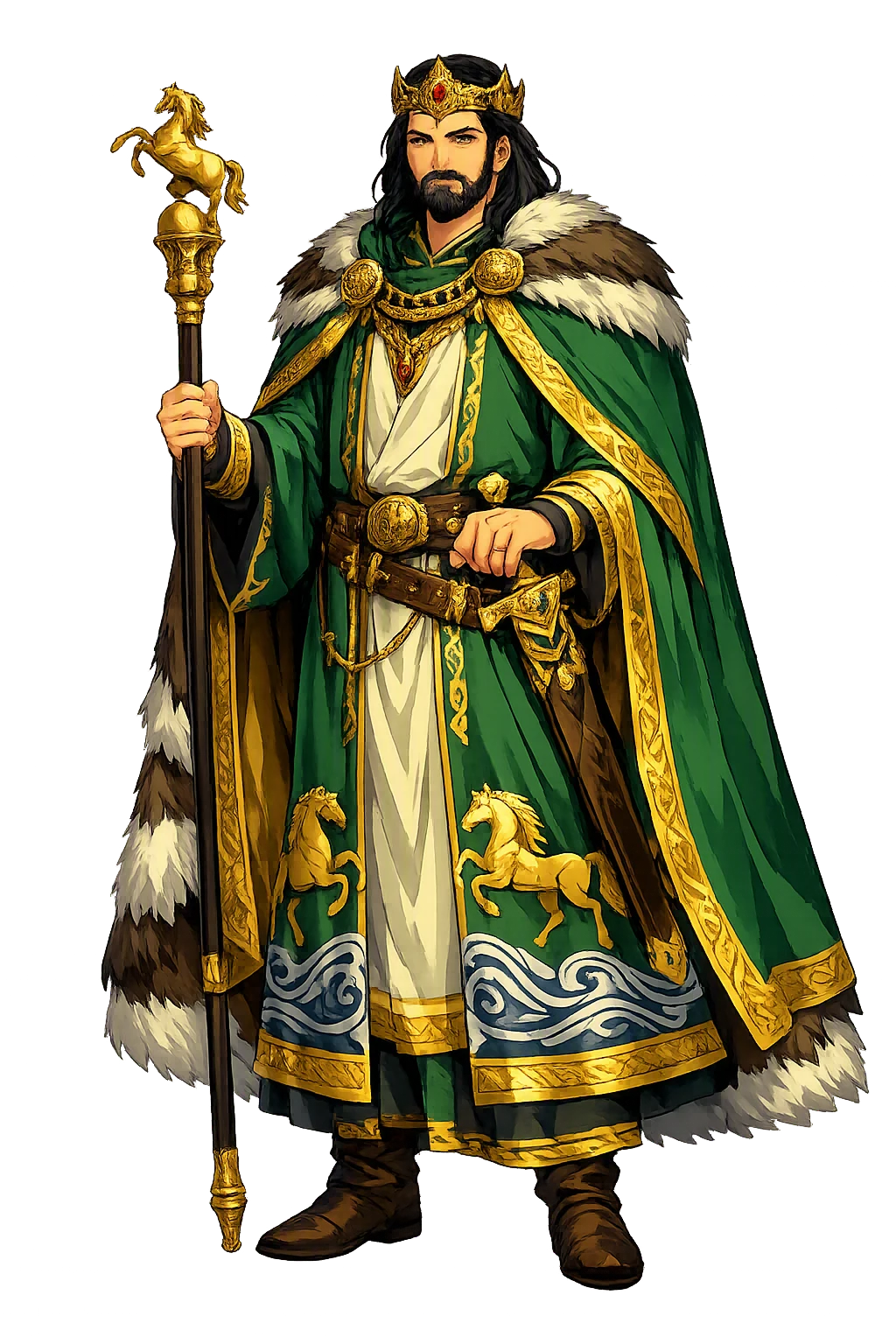
How Matholwch was rebuilt, mark by mark
Bench notes, Matholwch: what we found, what we rejected, and what we finally set down. Kept in the open, because a restoration you cannot audit is just a spelling with confidence.
What We Found
The attestation runs through the tradition's own sources: —. Meaning: "Good bear".
The figure behind the name: Matholwch has essentially one story — but it is the Second Branch of the Mabinogi, Branwen ferch Llŷr, the tale medieval Welsh literature remembers as its national tragedy: a marriage between the two islands that ends with the hosts of both destroyed.
What the Name Carried In
The Thirteen Ships at Harlech. Bendigeidfran — Brân the Blessed, crowned king of Britain — was seated on the rock of Harlech above the sea, with his brother Manawydan and his half-brothers Nisien and Efnisien, when they saw thirteen ships coming from the south of Ireland, fair and swift, their shields above their gunwales. It was Matholwch, king of Ireland, come to ask for Branwen, Brân's sister, fairest maiden in the world, so that Ireland and the Island of the Mighty might be joined by marriage and grow stronger together.
The Maiming of the Horses. Efnisien, the half-brother whose gift was quarreling, had not been consulted, and he took the omission as an insult to his honor. Coming on Matholwch's horses stabled apart, he asked whose they were, and hearing, he fell on them in a rage: he cut their lips back to the teeth, their ears back to their heads, their tails to the skin, and their eyelids back to the bone.
A spelling that has to carry stories like these is not a label. It is equipment.
Where It Stood Before Us
Matholwch is a textual figure: no inscription, ogham stone, or place-name in Ireland names him, and his kingship exists entirely within the Welsh tale. His manuscript witnesses are exact — the Second Branch survives complete in the White Book of Rhydderch (Aberystwyth, National Library of Wales, Peniarth MS 4, c. 1350) and the Red Book of Hergest (Oxford, Jesus College MS 111, c. 1375–1425), the two great codices on which Williams's edition rests. The tale's one fixed point in the landscape is Welsh: Bedd Branwen, the cairn beside the river Alaw on Anglesey where the branch says Branwen was buried, is a genuine Bronze Age burial monument — cremation urns were recovered when the cairn was opened in the early nineteenth century, and later excavations confirmed its prehistoric date. The name attached to it is medieval folklore, not prehistory — but it proves the story was already rooted in Welsh ground centuries ago. The nearest epigraphic kin of his name-element are the Gaulish personal names in Matu- (Matugenos and kin): comparative evidence only, never identification. The bench inherits all of it — the web temple is the newest site, not the first.
What We Rejected
Any form invented for availability. The rule on the bench: if the evidence does not carry it, the domain does not get it — whatever the registrar has in stock.
What We Set Down
Matholwch — One decisive feature survives — a single, honest mark — which places the restoration in Tier-2: exact, and exactly labeled.
For the voice: ma-THOL-ukh — stress the middle syllable; 'th' as in 'thin'; the w is a short 'oo'-like vowel; the final ch is the rough, breathy ch of Scottish 'loch', as in modern Welsh.
The temple stands at /matholwch/ — the notes above are public in its Scholarly Edition, sources and all.
At a Glance
- Restored name: Matholwch
- ASCII form: matholwch
- Meaning: "Good bear"
- Domain of influence: King of Ireland
- Pantheon: Celtic
- Classification: Tier 2
- Original script: —
- Series: The Restoration Files, No. 306 of 548
The File Continues
The temple's founding dispatch tells the name's story; its Resonance File reads the myths into the industries; the blog index holds the whole archive.
Continue the series — previous file: Math (read it here) · next file: Māzǔ (read it here).
The Restoration Files are written from the same canonical record as the temples themselves: the lexicon, the lore catalog, the pattern atlas, and the cited scholarly sources. If a file ever disagrees with its temple, the temple is right — tell us, and the file will be corrected.