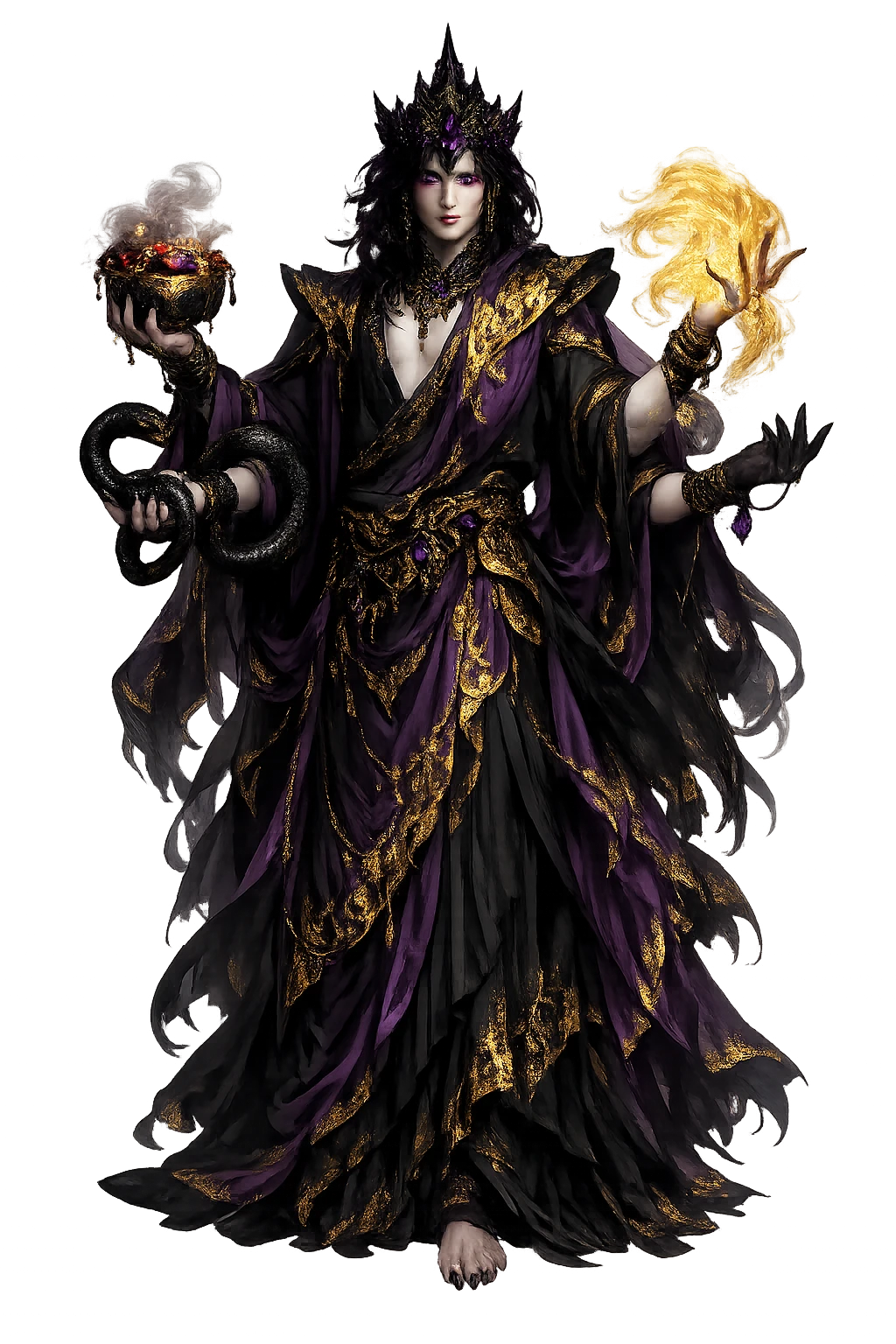
Stories of Māra
Māra's mythology is the dark half of the Buddhist biography: wherever the teaching advances, the texts station him at the next bend — and his defeats chart the whole path from striving to parinibbāna.
The Sutta Nipāta's Padhāna Sutta gives his order of battle, and it is a psychology textbook disguised as an epic: sensual pleasure is the first army, discontent the second, hunger and thirst the third, craving the fourth, sloth and torpor the fifth, fear the sixth, doubt the seventh, hypocrisy and obstinacy the eighth, gains, fame, and honor the ninth, and the tenth — the general's own guard — is self-exaltation joined with contempt for others. Māra rides the elephant Girimekhala, a hundred leagues tall, and boasts that not even a thousand Sakyans together could escape him. The Buddha's answer opens the whole tradition's arsenal: 'I see your army, Kāma, arrayed all around; I shall go forth against it, and it shall not shake me.' He names each battalion as it advances and walks through the camp untouched. The catalog is Buddhism's map of the inner war, and its thesis is exact: every assault on resolve is a known quantity — recognition is resistance, and resistance is victory. No sūtra equips the Buddha with a weapon; none has ever been needed.
The full assault is told in the Nidānakathā and versified in Aśvaghoṣa's Buddhacarita, whose thirteenth canto — the Defeat of Māra — is Sanskrit poetry's great set-piece: whirlwinds that cannot stir the bodhisattva's robe, a rain of rocks that falls as garlands, darkness that will not spread, a flight of arrows that turns to flowers before it lands. Mounted on Girimekhala, Māra advances his final claim — the seat of awakening is his by right of lineage and merit — and calls his army as witness. The bodhisattva answers with the gesture that defines Buddhist art: he reaches down and touches the earth, and the earth itself, summoned as witness to his perfections, thunders back. The elephant kneels; the host scatters; the dawn comes up on an undefeated man. The scene's theology is the entire soteriology in one image: truth is not argued into being but ratified by reality, and evil's weapons decompose on contact with a mind that has stopped debating and simply knows.
Force having failed, Māra sent subtlety: his three daughters, Taṇhā (Craving), Aratī (Aversion), and Rāgā (Passion), came to the newly-awakened Buddha in every guise beauty can wear — maiden, mother, worker, queen — and made their offer one after another. He regarded each in turn and dismissed her with the calm of a man reading names off a list: 'I have done with craving; go, daughters, find your husbands elsewhere.' The Saṃyutta Nikāya's whole Māra cycle ends nearly every one of these duels the same way — with the Tempter's signature lament: 'The Blessed One knows me; the Fortunate One knows me.' It is the most repeated sentence of defeat in any scripture: to be seen is to be beaten. His daughters never stop being born — every desire the mind produces wears their three faces in rotation — but the text's point stands untouched: the disguise is the only power temptation has, and recognition strips it bare.
Māra keeps one appointment to the very end. In the Mahāparinibbāna Sutta he comes to the aged Buddha at Beluvagāmaka, and — the text is deliciously precise — he comes not with armies but with a calendar: reminding the Blessed One of his ancient promise, that he would not pass away into final nirvana until the four assemblies — monks, nuns, laymen, laywomen — were well established in the practice. That work is done now; it is time. And the Buddha, who once broke his army by seeing him, grants the request without resistance: in three months, at Vesālī, the Tathāgata will pass away. The tradition's point is exact and unsettling — the tempter's only final success is the world's impermanence keeping its schedule. Māra did not win; he was merely the messenger of a deadline that includes him. Even the lord of death is a mortal god, and his three months' notice is the sūtra's last joke at his expense.
The Ten Armies, the Three Daughters, and the Defeat of Being Seen
Māra is Death wearing every disguise the mind can manufacture: the lord of the desire-realm who marched his ten armies against the Buddha under the Bodhi tree, sent his three daughters when the armies broke, and lost — not to a weapon, but to being recognized.
Lust, discontent, hunger, craving, sloth, fear, doubt, obstinacy, glory, and self-praise — the Sutta Nipāta's catalog.
Taṇhā, Aratī, Rāgā: Craving, Aversion, Passion — the last seduction, sent when the army fled.
His war-elephant, Mountain-high — which knelt, the commentaries say, when the earth itself bore witness.
Borrowed from Kāma, the love-god: the weapons of desire — beautiful, flowered, and aimed.
From the original script to the living URL
मार
The name in its original Buddhist form. Māra (मार) is attested in the source tradition — “‘death, the tempter’, the personification of death and desire who assailed the Buddha under the Bodhi tree (from √mṛ ‘to die’), MW.”. Its macron-length vowels carry the full phonetic and orthographic weight of the source tradition.
mara
Reduced to plain mara, the name loses everything that made it specific: macron-length vowels. What remains is an ASCII string that machines can parse but that no longer speaks with its original voice.
Māra
The Unicode restoration recovers what ASCII flattened. Māra restores macron-length vowels, returning the name to its original written dignity. The domain encodes to Punycode, but the browser displays the truth.
Māra.com → xn--mra-1oa.com
The non-ASCII characters in Māra are encoded while the ASCII remains visible. To the DNS, it is Punycode. To humanity, it is Māra.
Owned, ideal, and ASCII forms of Māra
Māra
Restores मार. The live temple domain — māra.com.
mara
Flattens मार. The plain ASCII fallback — what DNS and legacy systems see.
How Māra was spoken
How Māra travels from ancient script to the modern URL
The lore you have read is the living myth. Extended Lore opens the scholarly vault beneath it: the cult and its material remains, a history of the image, the name after antiquity, a meditation on what the name still means, and the full scholarly apparatus — etymology, orthography, sources.
Enter Extended Lore