
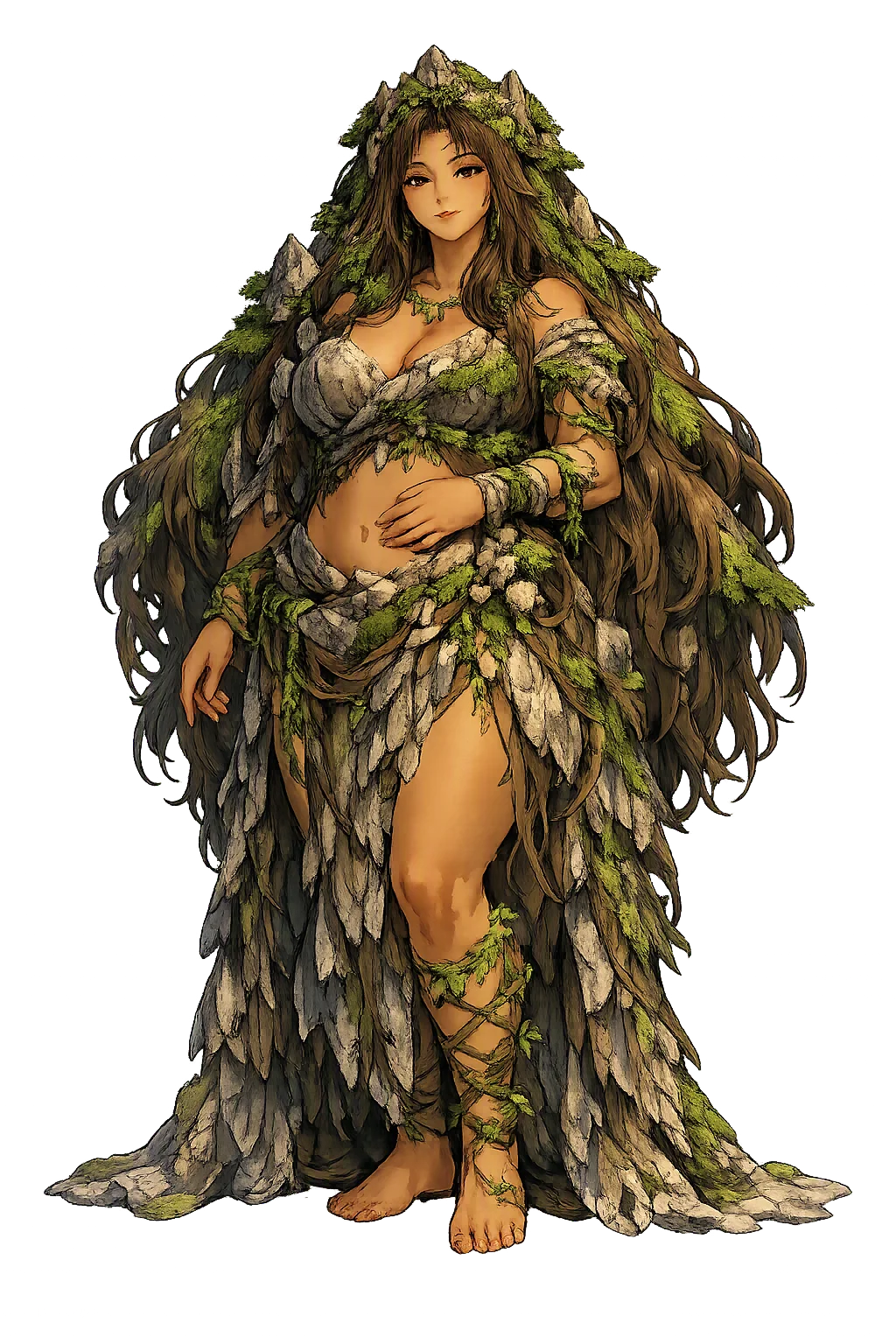
Mago: the stories first, then the spelling
Before the spelling, the story. Mago earns its restoration the old way — through what was actually told.
The Stories That Carry the Name
The Grandmother Makes the World. In the Jeju Island creation epic known as the changsega, “Song of Creation,” preserved orally by shamans and recorded only in the twentieth century, the work of making the world falls to a grandmother. Mago Halmi — “Grandmother Mago” — takes up the labour of creation with her own body: she urinates, and her water cuts the courses of rivers; she stamps and pushes, and the earth rises into ridges and peaks; her sighs turn to wind. The song's most startling gesture is its scale: this creator is not a distant sky-father but a working woman whose bodily functions are the very tools of cosmogony.
The Skirt That Covered the Mountains. In a folktale told across the Korean mainland, Mago Halmi's skirt is the instrument of geography itself. The grandmother spreads the cloth over a mountain range and lifts it; where the hem settles, valleys open, and where the fabric bunches, ridges rise, and she hems the whole country into shape the way a woman hems a garment. Twentieth-century folklorists recorded the motif in many regional variants, and scholars have long noted its inner logic: textile work — women's work — becomes the model of cosmogonic work.
Magu's Fingernails and the Mulberry Sea. The Chinese Magu (麻姑), the “Hemp Maiden,” enters literature through the Daoist biography of the immortal Wang Yuan, preserved in the Shenxian zhuan attributed to Ge Hong (fourth century) and quoted in the tenth-century compendium Taiping Guangli. Summoned to the house of the official Cai Jing, Magu appears as a girl of eighteen or nineteen in shimmering robes, with fingernails long and curved like bird claws. When Cai Jing privately wishes his back could be scratched by such claws, Wang Yuan reads his thought and has Magu do exactly that.
And Here Is What the Spelling Preserves
At a Glance
- Restored name: Mago
- ASCII form: mago
- Meaning: "Great goddess"
- Domain of influence: Creator Goddess, Earth
- Pantheon: Korean
- Classification: Tier 2
- Original script: 마고 (麻姑)
- Series: The Restoration Files, No. 290 of 548
The Name Travels
Mago sits at the intersection of Korean shamanism, Chinese Daoist folklore, and contemporary goddess spirituality. Chinese sources know Magu as an immortal associated with hemp and longevity; Korean sources transform her into a creator grandmother.
The Address It Earned
The temple of Mago stands at /mago/ — lore, scholars, patterns — because a name carrying this much story deserves more than a parking page. One decisive feature survives — a single, honest mark — which places the restoration in Tier-2: exact, and exactly labeled.
The File Continues
Read the founding dispatch for the name's full story, the Resonance File for the archetype at work — or the whole archive in one sitting.
Continue the series — previous file: Magni (read it here) · next file: Maitreya (read it here).
The Restoration Files are written from the same canonical record as the temples themselves: the lexicon, the lore catalog, the pattern atlas, and the cited scholarly sources. If a file ever disagrees with its temple, the temple is right — tell us, and the file will be corrected.