Stories of Macha
Macha's dossier is one great tale and a family of namesakes: the Debility of the Ulstermen gives her the race, the twins, and the curse; the Táin harvests the consequences; the Lebor Gabála remembers her as Nemed's wife and as the red-maned queen; and the genealogies fold her into the three of war beside [[badb|Badb]] and [[morrigan|the Morrígan]].
Cruinniuc mac Agnomain was a rich farmer of the Ulaid, a widower with sons, and one day a woman he had never seen walked into his house, set about the work of it without a word, and lay with him that night. She stayed, and under her hand everything prospered — the house, the cattle, the table — and she told him the one condition of their life together: he must never speak of her, never boast of her. It is the old compact of the otherworld wife, and it held as long as he kept his mouth shut.
The tale that tells this — Noínden Ulad, 'The Debility of the Ulaid', one of the fore-tales of the Táin — is a sovereignty story before it is anything else: the land's own woman comes to the man of the land, and her condition is silence about the source of the plenty. Cruinniuc kept it until the day of the great assembly of the Ulaid, when the talk turned to the king's horses and there was nothing in the world faster.
At the assembly Cruinniuc forgot the condition and boasted: his wife could outrun the king's chariot-horses. Conchobar had him seized, and sent for the woman — who was nine months gone with twins. She begged the gathering for delay until she had given birth, 'for a mother bore each of you'; the Ulaid refused. She was set against the horses and raced them, and she beat them at the line — and at the line the pangs took her, and she was delivered of a boy and a girl on the field.
Then she cursed them: as she had been given no mercy in her labor, so the men of Ulster, in their hour of greatest straits, would suffer the pangs of a woman in childbirth — five days and four nights, for nine generations, every man save the boys and the women. And in most recensions she died there. The twins gave the royal seat of Ulster its name: Emain Macha, 'Macha's twins'. It is the most economical curse in Irish literature — one wrong, answered in exact kind, for nine generations.
The curse is the engine of the greatest Irish epic. When [[medb|Medb]] of Connacht marches into Ulster for the Donn Cúailnge, the men of the province are down in the ces noínden, gripped by the pangs Macha laid on them — the curse spared the boys and the women, and it spared [[cuchulainn|Cú Chulainn]], who stands alone against the host of Ireland while the warriors of Emain writhe. The whole boyhood-deeds section of the Táin is narrated against the debility: one boy holding a province because a goddess was made to race in labor.
The Táin keeps her name in the language of battle as well. Its phrase for the harvest of heads is mesrad Machae, 'Macha's mast' — the crop the war-goddess gathers from the field. And the Lebor Gabála had already counted her among the three daughters of Ernmas: [[badb|Badb]] and Macha and Anand, 'of whom are the Paps of Anu' — the triple face of Irish war, the sisters the sources also gather under the one name [[morrigan|Morrígan]].
The book of invasions remembers two earlier Machas. The first is Macha wife of Nemed, who came with the Nemedians in the days before the Túatha Dé Danann; she died in Ireland, and Ard Macha — Armagh, 'Macha's height' — and Mag Macha, 'Macha's plain', the country around it, are named from her grave.
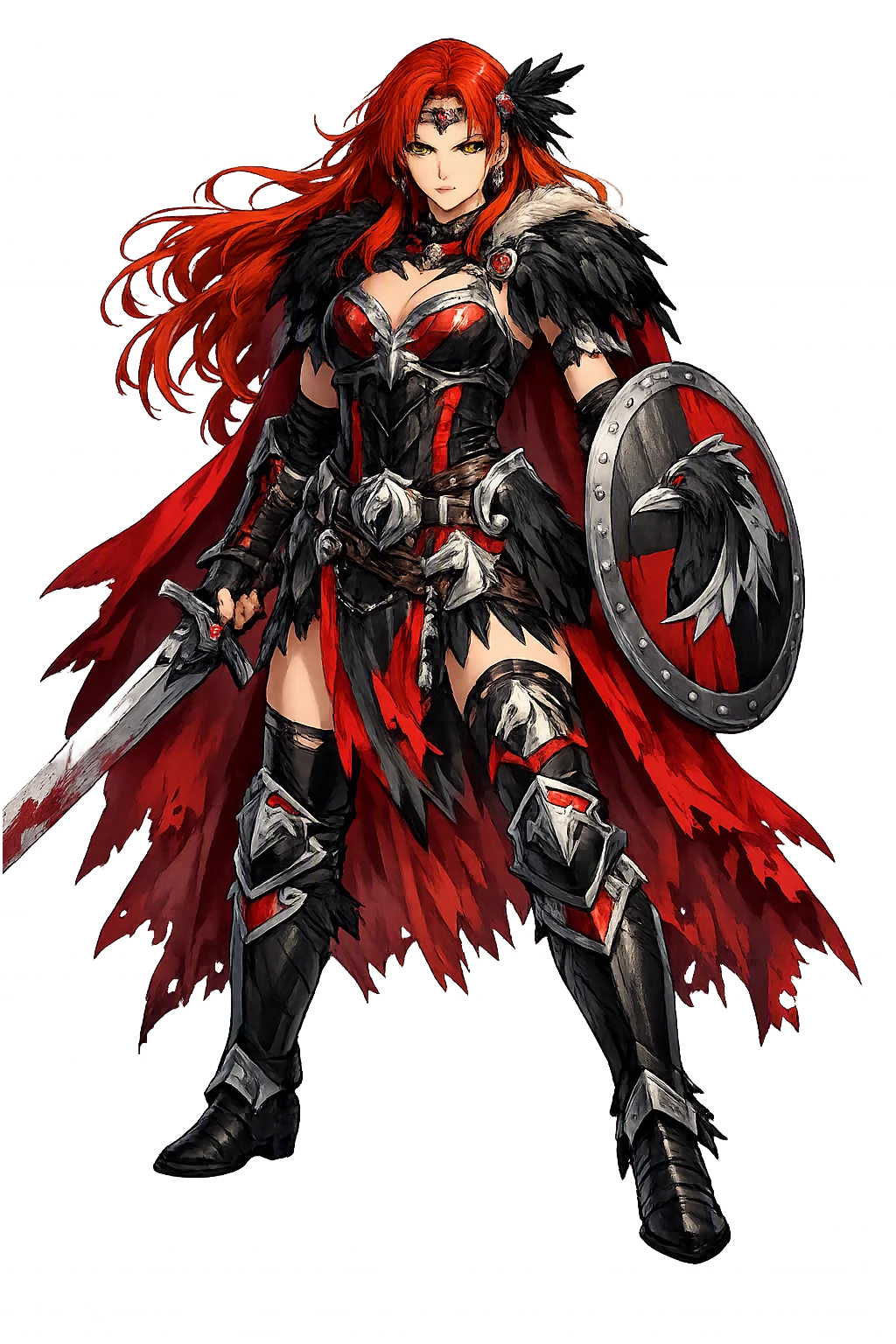
The second is Macha Mongrúad, the red-maned daughter of Áed Rúad. When her father and his brothers Díthorba and Cimbáeth had held the kingship of Ireland in rotation, seven years each, and Áed died, the brothers refused the daughter her turn. She took it by war: she married Cimbáeth, defeated Díthorba's five sons — after going to them, the tale says, in the guise of a leprous hag — and held the kingship herself. It was she who marked out the rampart of Emain Macha with the brooch of her neck, her eo-muin, and made the captives dig it. The dindsenchas keeps both etymologies side by side — Macha's twins and Macha's brooch — and the tradition never chose between the goddess of the race and the queen of the fort.
The Woman Who Outran the King's Horses
Macha is the sovereignty figure of the Ulster Cycle: the otherworld woman who came to the door of the widower Cruinniuc and made his house prosper, and who — when her husband boasted at the assembly that she could outrun the king's horses — was brought out pregnant to the racetrack, outran the horses of Conchobar mac Nessa at the finish, gave birth to twins on the field, and laid on the men of Ulster the curse that shapes the whole Táin: in their hour of greatest need, the pangs of childbirth.
Nine months gone, she begged for delay until she had given birth; the Ulaid refused. She raced the king's chariot-horses and beat them at the line.
Her curse, the ces noínden: for five days and four nights, in every generation to the ninth, the men of Ulster would lie in the pangs of a woman in labor — whenever the province needed them most.
'Macha's twins' — the boy and girl born at the finish line named the royal seat of Ulster, the Navan Fort that still stands outside Armagh.
The red-maned queen of the Lebor Gabála who seized the kingship of Ireland in her own right and traced the rampart of Emain with the brooch of her neck.
From the original script to the living URL
Macha
The name survives in scholarly transliteration. Macha is the standard Celtic romanisation, documented in academic sources — “Field, plain”. Because the spelling uses only Latin letters, the form is the same in both ASCII and Unicode.
No indigenous writing system is securely attested for individual celtic names. The form shown is a modern scholarly transliteration.
macha
The plain macha form is identical to the Unicode restoration. Because this name is already written in Latin letters, no diacritics, stress, or script information were lost — only capitalization differs.
Macha
The Unicode restoration does not need to recover lost marks for Macha. Its value is canonical spelling and consistent cataloguing, not the reconstruction of erased orthography. The domain is readable as-is to both DNS and humanity.
Macha.com
This restoration is written entirely in ASCII letters — no Punycode encoding stands between Macha and the DNS. The domain reads identically to machines and to human eyes.
Owned, ideal, and ASCII forms of Macha
Macha
The full Unicode restoration. macha.com is not in the PuniCodex collection — it is watched for release; if it drops, this temple upgrades to an owned flagship.
How Macha was spoken
How Macha is preserved in writing
No indigenous writing system is securely attested for individual celtic names. The form shown is a modern scholarly transliteration.
Contribute scholarly provenance →The lore you have read is the living myth. Extended Lore opens the scholarly vault beneath it: the cult and its material remains, a history of the image, the name after antiquity, a meditation on what the name still means, and the full scholarly apparatus — etymology, orthography, sources.
Enter Extended Lore