PuniCodex

Extended Lore

𓁦 Mꜣꜥt

Etymology · Orthography · Cultural Legacy · Reception · Primary Sources

Tier 1 Mꜣꜥt
Mꜣꜥt — Truth, Justice, Order
01

Quick Facts

Essential information about Mꜣꜥt, Truth, Justice, Order

Original Script𓁦
Unicode RestorationMꜣꜥt
Reconstructed Pronunciation/maʔ.ʕaːt/
PantheonEgyptian
DomainTruth, Justice, Order
MeaningTruth, straightness (Egyptian mꜣꜥt)
ClassificationTier 1
Primary DomainMꜣꜥt
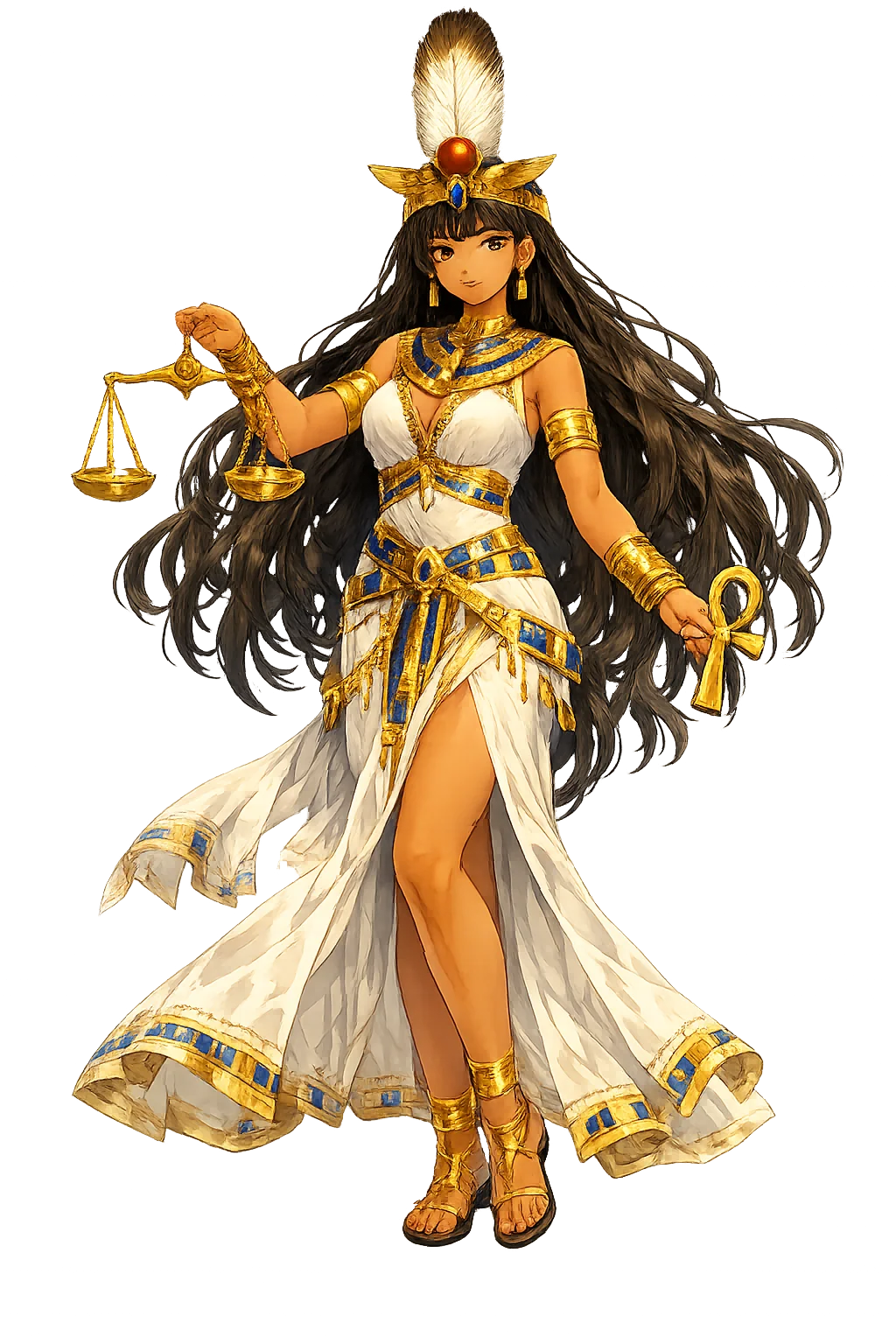
Sacred SymbolsOstrich feather, Set-scales, Kneeling goddess with feather, Primeval mound (benben), Pharaoh offering Maat
02

Etymology & Word Family

From original script to Unicode restoration

Original Script 𓁦 Mꜣꜥt — "Truth, straightness (Egyptian mꜣꜥt)"
Unicode Restoration Mꜣꜥt Restored stress, length, and script
Modern ASCII maat Plain-ASCII fallback

From Egyptian mꜣꜥt 'truth, justice, order', abstracted from the verb mꜣꜥ 'to be true, straight'; the hieroglyphic spelling records consonants only.

03

Unicode Character Breakdown

Character-by-character philological analysis

CharacterUnicodeNameBlockPhonetic Role
MU+004DLatin Capital Letter MBasic LatinSame
U+A723Latin Small Letter Egyptological AlefLatin Extended-DAlef: glottal stop
U+A725Latin Small Letter Egyptological AinLatin Extended-DAyin: pharyngeal fricative
tU+0074Latin Small Letter TBasic LatinSame

The Tier 1 classification reflects how much of the original phonology this restoration preserves — stress and vowel length for Greek names, distinctive letters and diacritics for every other tradition.

04

Cultural Significance

From ancient cult to modern memory

Mꜣꜥt in Later Traditions

Maat resisted translation. The Greeks, who happily equated Amun with Zeus and Hathor with Aphrodite, had no goddess of cosmic correctness to offer, and later writers reach instead for abstractions — Dikē, Justice, or the Stoic notion of a rational order governing gods and men alike; Plutarch's treatise on Isis discusses Maat-like concepts under Greek ethical categories rather than any divine name. Inside Egypt the syncretisms ran the other way: late theology fused Maat with Isis as 'the great god's mother, lady of Maat', and paired her constantly with Thoth — the divine couple of the two intellectual virtues, cosmic order and divine utterance, scholarship married to its standard. In Coptic, Maat survives not as a goddess but as the ordinary word for truth, ⲙⲉ. A deity can be absorbed into the language and disappear from the pantheon in the same gesture — that is Maat's fate, and fittingly, her triumph.

Modern Legacy

Maat's feather is among the most recognized images on earth — the badge of Egyptian judgement, stamped on museum merchandise and book covers, invoked wherever an emblem of conscience is needed. Her name powers a modern ethical revival: Afrocentric and Kemetic movements place Maat at the center of a living moral philosophy, sometimes with an 'ideals of Maat' list derived from the Negative Confession; courts, schools, and community organizations invoke her as the ancient warrant that justice is older than any state. Egyptologists — Assmann's classic study above all — treat her as the key to everything Egyptian: art that renders 'the right way', architecture aligned to cosmic axes, a state whose ideology was a promise of order. And because her name means simply 'right, straight, true', she survives in every language's plea that things be set right. Few abstract nouns have ever carried so much divinity.

In the Earth

The material record of Maat is a record of repetition — which is her point. The weighing scene survives in dozens of New Kingdom Book of the Dead papyri, most famously the Papyrus of Ani (BM EA 10470) and of Hunefer (EA 9901,3); temple walls from Karnak to Abydos carry the offering-of-Maat scene from Seti I through Ramesses II; and small votive figures of the kneeling goddess — a woman with a single feather — were dedicated in the thousands, from the gold and lapis amulets of Tutankhamun's treasures to the humble faience examples of Deir el-Medina. The Hall of the Two Maats in the Osireion at Abydos names the standard twice, as if for emphasis. Even scribal palettes and builders' plumb bobs invoke her. An abstract goddess leaves abstract archaeology: not a temple she can call her own, but a civilization aligned, wall by wall, to her axis.

05

The Meditation

What Mꜣꜥt means — beyond the dictionary

Maat is the Egyptian answer to the oldest political question: is justice a human invention or a feature of the universe? Egypt answered without hesitation — a feature of the universe, as real as gravity, which is why the sun depends on it. The answer sounds naive until you notice what it built. A state that measured its legitimacy against an impersonal standard produced four thousand years of obsessive self-audit: kings offering Maat back to the gods, peasants lecturing stewards, scribes copying wisdom books that define the quiet man as the one who has mastered himself.

The standard was flattered more often than obeyed — corrupt stewards are the stock villain of Egyptian literature precisely because the standard existed to be violated. But the flattery matters. A society that must at least pretend its law is cosmic will, over centuries, leave a record that makes the pretense legible. Maat is that pretense hardened into principle: the wager that reality itself is on the side of the straight path, and that a feather is enough to weigh a life against.

06

Frequently Asked Questions

Common questions about Mꜣꜥt, Truth, Justice, Order, and Unicode restoration

01How do you pronounce Mꜣꜥt?

In reconstructed pronunciation, Mꜣꜥt is /maʔ.ʕaːt/ — approximately 'mah-ʿAHT' — a soft 'm', a deep throaty 'ah' in the middle, and a crisp final 't'.

02What does Mꜣꜥt mean?

Mꜣꜥt means Truth, straightness (Egyptian mꜣꜥt) in the egyptian tradition.

03What are the symbols of Mꜣꜥt?

Mꜣꜥt is associated with Ostrich feather (The feather of truth weighed against the heart in the judgement hall), Set-scales (The balance on which the heart is tested before Osiris), Kneeling goddess with feather (Maat as the personification of cosmic order, often shown kneeling or winged), Primeval mound (benben) (The first land rising from chaos, ordered by the presence of Maat), Pharaoh offering Maat (The ritual gesture by which the king upholds truth and renews the cosmos).

04Why restore Mꜣꜥt in Unicode?

Plain ASCII maat strips the stress, length, and script that make the name specific. Unicode restoration returns the name to its original written dignity.

05What is the most important myth about Mꜣꜥt?

“Order Before the World” — Maat has no cycle of adventures — she is Egypt's most abstract major power, a principle wearing a woman's face. Her 'myths' are therefore texts: the creation theology that makes order prior to the world, the judgement scene that made her feather the most famous image of Egyptian religion, and the wisdom literature that turned her into the common man's cause. The full telling lives on the lore page.

07

Scholarly Sources

The philological foundations of this restoration

Every claim on this page is grounded in established scholarship. The orthographic restorations follow disciplinary convention. The etymological chain follows the best available reference works. This is not invention — it is resurrection through scholarship.

Lexicography & Philology

  • Faulkner, R. O. A Concise Dictionary of Middle Egyptian. Oxford: Griffith Institute, 1962.
  • Wb

Primary Texts

  • Book of the Dead, spell 125 (Papyrus of Ani, BM EA 10470)
  • Book of the Dead, spell 15B
  • Memphite Theology (Shabaka Stone, BM EA 498)
  • Instruction of Amenemope

Archaeology & Art History

  • Material evidence — iconography, inscriptions, and temple archaeology — for Mꜣꜥt and related cults.

Religious Studies

  • Tale of the Eloquent Peasant (Papyrus Berlin 3023)
  • Assmann, Ma'at: Gerechtigkeit und Unsterblichkeit im Alten Ägypten
Return

The Surface Awaits

You have traced the name from its earliest attestation to its Unicode restoration. Now return to the myth. The story is where the name lives.

Back to Lore
Mꜣꜥt mascot