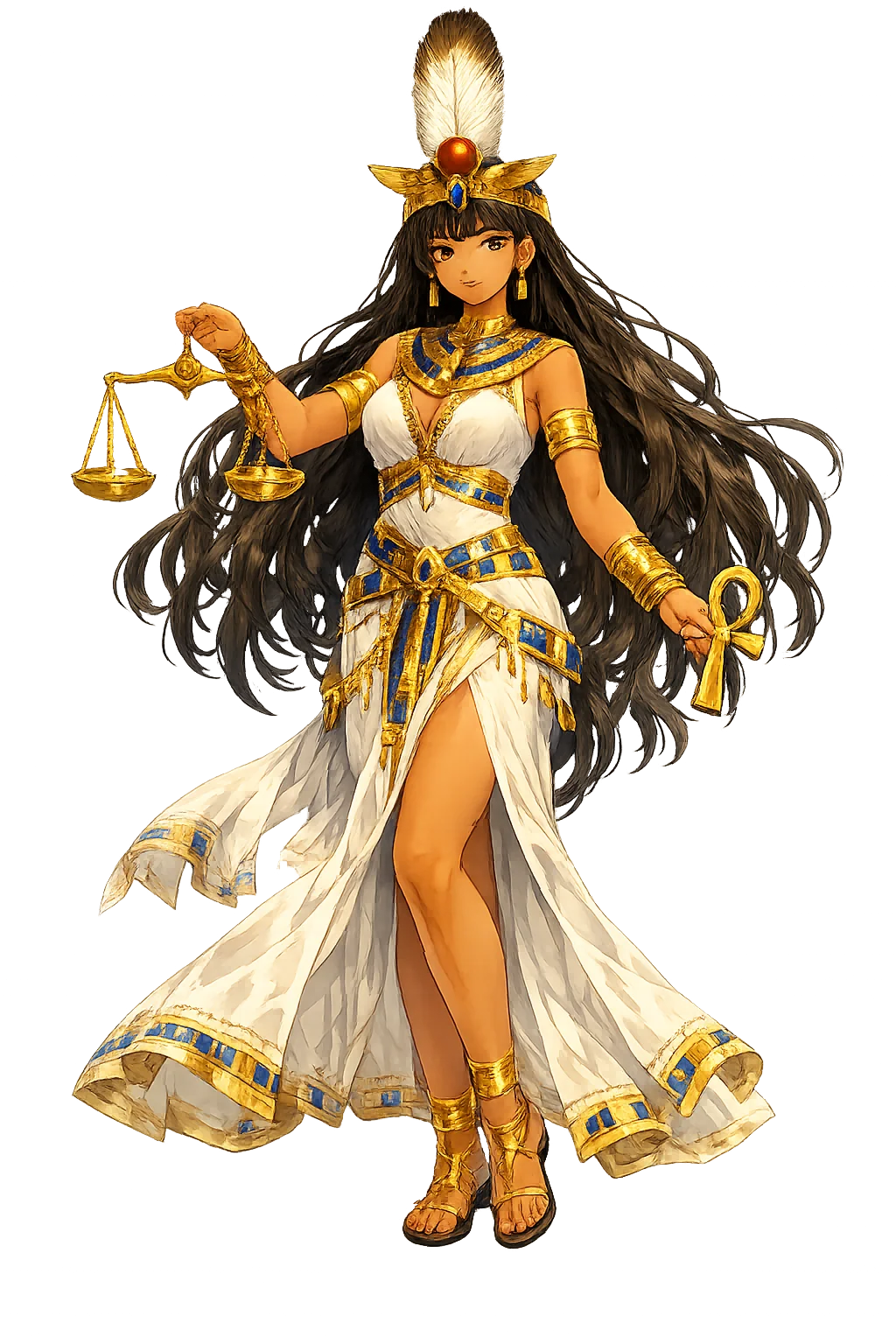
Stories of Mꜣꜥt
Maat has no cycle of adventures — she is Egypt's most abstract major power, a principle wearing a woman's face. Her 'myths' are therefore texts: the creation theology that makes order prior to the world, the judgement scene that made her feather the most famous image of Egyptian religion, and the wisdom literature that turned her into the common man's cause.
Egyptian creation theology insists that order precedes the world rather than following it. On the Shabaka Stone — the Late Period copy of the Memphite Theology — Ptah conceives creation 'through the heart' (thought) and 'through the tongue' (the commanding word), and the text closes its account with the consequence in the vocabulary of Maat: justice is done for the one who does what is loved, and punishment for the one who does what is hated. Sun hymns make the dependence still more intimate. The great hymn of Book of the Dead spell 15B addresses the sun as one who lives upon Maat, and temple tradition calls Maat the daughter of Re — the very air the sun-god breathes, set at his nose. Without her the sun would not rise and the chaos before creation would rush back: Maat is not a rule the cosmos obeys but the medium it breathes. The theology turns morality into physics — and physics, remarkably, into something worth keeping.
The most famous scene in Egyptian religion survives on the Papyrus of Ani (BM EA 10470, c. 1250 BCE) at the head of Book of the Dead spell 125. The scribe Ani's heart — his conscience made organ — is set in the pan of a balance against a single ostrich feather, Maat herself, the minimum possible weight of a life. Anubis crouches at the scales, adjusting the plumb line; Thoth, ibis-headed, waits with palette to record the verdict; behind the god crouches Ammit the Devourer, crocodile-headed, lion-fronted, hippopotamus-backed, for the hearts that fail. Before the tribunal's assessors the deceased recites the Negative Confession — 'I have not committed evil against men... I have not diminished the offerings in the temples... I have not made anyone weep' — forty-two denials for the forty-two judges. A heart exactly level with Maat is declared 'true of voice' and crosses to the Field of Reeds. The scene's genius is its unit of measurement: a feather. Ethics is weighed not in laws broken but in lightness — the only guilt is heaviness.
If Maat flows from the gods to the world, Egyptian ritual sent it back. From the New Kingdom onward, temple walls at Karnak, Luxor, and Abydos show a recurring scene: the king, tiny before the colossal god, lifts a seated statuette of Maat — a woman with a single feather — and presents her to Amun-Re or Osiris. The gesture says that justice is not the monarch's possession but his loan; he returns it to its source so that order can circulate again from god to king to field and river. Hymns make the circuit explicit — the king 'offers Maat to the lord of Maat', and Maat comes to the one she loves. The ritual did not flatter the king; it audited him. Each presentation was a receipt for a reign's conduct, and the tiny statuette in pharaoh's arms is one of antiquity's most lucid images of government as trusteeship: power standing before its source with the evidence in its hands, returning what was only ever lent.
Egypt's most searching meditation on Maat is not a myth but a story: the Tale of the Eloquent Peasant (Papyrus Berlin 3023), a Middle Kingdom masterpiece. A poor farmer, robbed of his goods by a corrupt steward, petitions the high official Rensi nine times, and his speeches are a running treatise — 'Do Maat for the Lord of Maat', he cries, 'for Maat is not carried off; it endures, and him who reaches it, it leads to blessedness.' Each petition grows more eloquent and is ignored with equal artistry, until the exasperated king himself orders the steward to keep listening — the audience, not the verdict, being the tale's point about courts. When justice finally comes, it comes because speech aligned with Maat outlasted indifference. The peasant's refrain became Egyptian literature's most quoted line on law: justice delayed is the system's default, and the only weapon the powerless own is the demand that it not be. Few ancient texts let a beggar lecture the state; Egypt canonized the lecture.
The domain of Mꜣꜥt
Mꜣꜥt is the Egyptian cosmos made moral: truth, straightness, the even plumb line, the feather against which the heart is weighed. Not a law code but a state of being — the king upholds her, the priest recites her, the scribe writes her, and the justified dead speak her name before the gods. To live in Maat is to move in harmony with the structure of reality itself.
The heart of the deceased is weighed against Maat's feather; only the light heart passes the tribunal.
Re 'lives on Maat' each morning; without her, the sun would not rise and chaos would rush back in.
Maat is the plumb line, the even measure, the straight path that kings, priests, and scribes must keep.
Pharaohs presented small figures of Maat to the gods, ritually restoring order to its divine source.
From the original script to the living URL
𓁦
The name in its original Egyptian form. Mꜣꜥt (𓁦) is attested in the source tradition — “Truth, straightness (Egyptian mꜣꜥt)”. Its Egyptological ain and alef letters carry the full phonetic and orthographic weight of the source tradition.
maat
Reduced to plain maat, the name loses everything that made it specific: Egyptological ain and alef letters. What remains is an ASCII string that machines can parse but that no longer speaks with its original voice.
Mꜣꜥt
The Unicode restoration recovers what ASCII flattened. Mꜣꜥt restores Egyptological ain and alef letters, returning the name to its original written dignity. The domain encodes to Punycode, but the browser displays the truth.
Mꜣꜥt.com → xn--mt-sq8hia.com
The non-ASCII characters in Mꜣꜥt are encoded while the ASCII remains visible. To the DNS, it is Punycode. To humanity, it is Mꜣꜥt.
Owned, ideal, and ASCII forms of Mꜣꜥt
Mꜣꜥt
Restores 𓁦. The full Unicode restoration. mꜣꜥt.com is not in the PuniCodex collection — it is watched for release; if it drops, this temple upgrades to an owned flagship.
maat
Flattens 𓁦. The plain ASCII fallback — what DNS and legacy systems see.
How Mꜣꜥt was spoken
How Mꜣꜥt travels from ancient script to the modern URL
Egyptian mꜣꜥt; the original vocalisation is unknown. The name denotes “truth, straightness, order", related to the verb mꜣꜥ “to be straight".
Truth, Justice, Order
The Unicode restoration Mꜣꜥt uses Egyptological characters registrable in .com; hieroglyphs are outside the .com IDN table.
The lore you have read is the living myth. Extended Lore opens the scholarly vault beneath it: the cult and its material remains, a history of the image, the name after antiquity, a meditation on what the name still means, and the full scholarly apparatus — etymology, orthography, sources.
Enter Extended Lore