
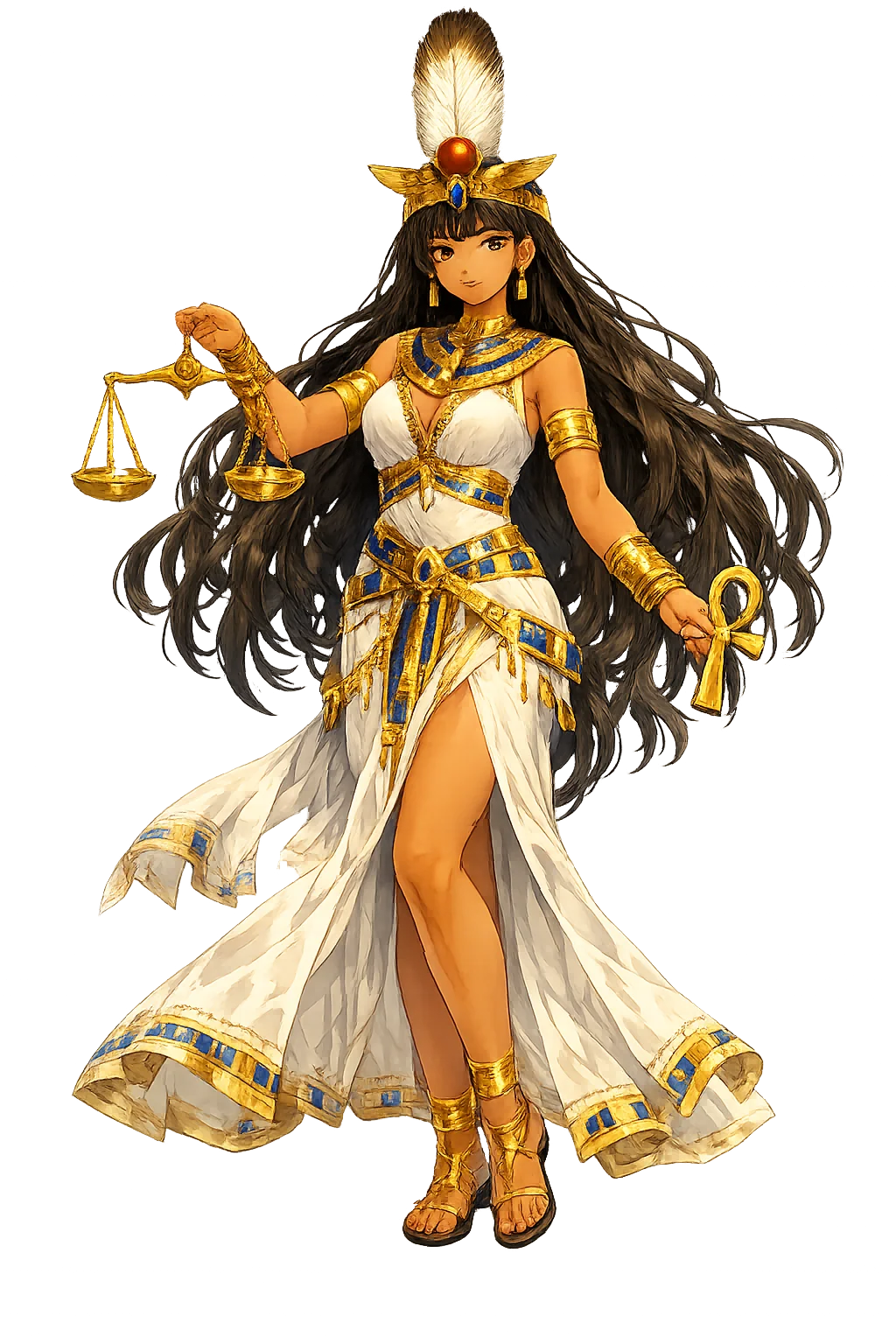
The appointments Mꜣꜥt made — and who is keeping them
The mistake is reading myths as entertainment. Mꜣꜥt's cycle reads more like a charter — each story assigning a duty the modern world still pays for.
At a Glance
- Temple: Mꜣꜥt
- Pantheon: Egyptian
- Domain of influence: Truth, Justice, Order
- Pattern seats: 5
- Sectors touched: Commerce & Governance · Home & Lifestyle · Energy & Natural World · Society & Spirit · Technology & Innovation
- Strongest seat: Legal, Justice & Compliance
- Series: The Resonance Files, No. 286 of 546
The Cycle, Read Forward
Legal, Justice & Compliance — through Order Before the World
Egyptian creation theology insists that order precedes the world rather than following it. On the Shabaka Stone — the Late Period copy of the Memphite Theology — Ptah conceives creation 'through the heart' (thought) and 'through the tongue' (the commanding word), and the text closes its account with the consequence in the vocabulary of Maat: justice is done for the one who does what is loved, and punishment for the one who does what is hated.
The atlas states the seat in one line: Truth, justice, and order; the feather against which every heart is weighed. The story above is the long version of the same sentence. Industries do not invent their archetypes; they inherit them and call them best practice.
Architecture & Spatial Design — through The Weighing of the Heart
The most famous scene in Egyptian religion survives on the Papyrus of Ani (BM EA 10470, c. 1250 BCE) at the head of Book of the Dead spell 125.
The atlas states the seat in one line: Her plumb line set the cosmic axes of the temples; straightness is her hieroglyph and the builder's creed. The story above is the long version of the same sentence. The trade thinks it is optimizing a process. It is re-enacting a charter.
Environmental & Climate Services — through The King Gives Maat Back
If Maat flows from the gods to the world, Egyptian ritual sent it back. From the New Kingdom onward, temple walls at Karnak, Luxor, and Abydos show a recurring scene: the king, tiny before the colossal god, lifts a seated statuette of Maat — a woman with a single feather — and presents her to Amun-Re or Osiris.
The atlas states the seat in one line: The balance that keeps the Nile within its banks; ecological harmony was her portfolio before the word existed. The story above is the long version of the same sentence. Industries do not invent their archetypes; they inherit them and call them best practice.
Philosophy, Ethics & Standards — through The Peasant's Appeal
Egypt's most searching meditation on Maat is not a myth but a story: the Tale of the Eloquent Peasant (Papyrus Berlin 3023), a Middle Kingdom masterpiece. A poor farmer, robbed of his goods by a corrupt steward, petitions the high official Rensi nine times, and his speeches are a running treatise — 'Do Maat for the Lord of Maat', he cries, 'for Maat is not carried off; it endures, and him who reaches it, it leads to blessedness.
The atlas states the seat in one line: Truth weighed against a feather; ethics made measurable. The story above is the long version of the same sentence. That is the cycle working: story becomes duty, duty becomes trade.
The Theme That Runs the Cycle
Maat has no cycle of adventures — she is Egypt's most abstract major power, a principle wearing a woman's face. Her 'myths' are therefore texts: the creation theology that makes order prior to the world, the judgement scene that made her feather the most famous image of Egyptian religion, and the wisdom literature that turned her into the common man's cause.
The Method, Stated Plainly
Skeptical? Good — the system is built for you. Every seat in this file carries its why-line and its weight, the full derivation is public at the methodology page, and the challenge process is part of the design. Falsifiable is not a posture here; it is the mechanism.
For the Ones Who Work There
If you work in legal, justice & compliance, architecture & spatial design, or any trade this temple holds a seat in, this is the honest version of what a placement means: your industry beside the story it has been re-telling all along — on the temple floor itself, before an audience that came specifically to read it. The patron tier and the advertising terms describe the mechanics; the resonance above describes the fit.
The File Continues
One of 546 Resonance Files — the series where the pantheon goes to work. Read the founding dispatch for the name, the Restoration File for the spelling, or the whole archive end to end.
Continue the series — previous: Mꜥ (read it) · next: Macha (read it).
The Resonance Files are argued from the same canonical record as the pattern atlas itself: the lexicon, the lore catalog, and the cited sources. Every seat can be challenged at the methodology page — and the challenge is the point.