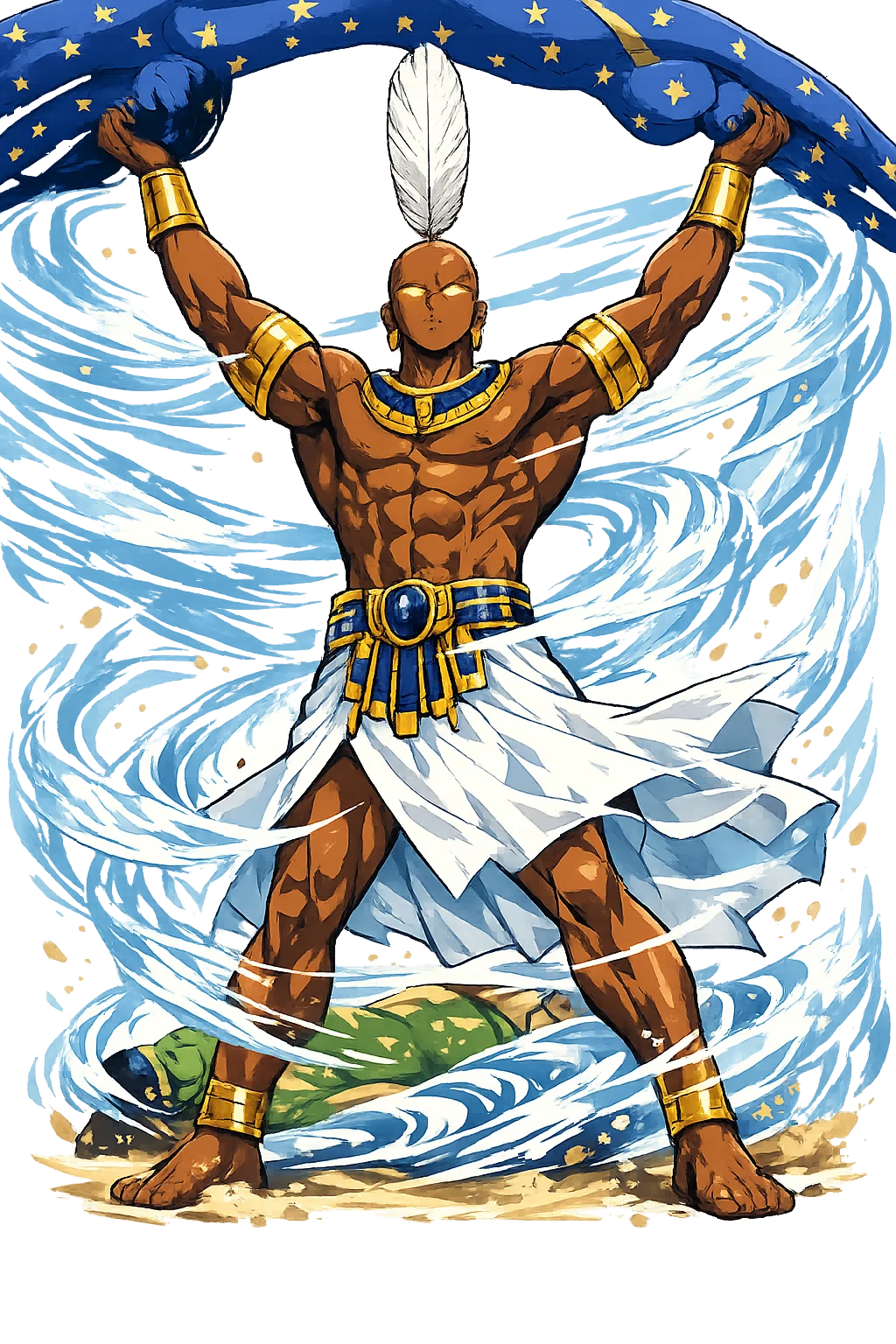
Stories of Mꜣ
Mꜣ has no independent mythic biography because it is the principle that makes biography possible. It appears in every major Egyptian funerary and royal text as the standard against which lives, deeds, and even gods are measured. Its personification, Mꜣꜥt, sits in the solar barque and stands at the throne of every legitimate king.
Spell 125 of the Book of the Dead stages the most famous judgment scene of the ancient world. The deceased enters the Hall of the Two Truths, faces Osiris enthroned among the forty-two assessor gods, and delivers the Negative Confession — the great litany in which he denies, one by one, theft, murder, falsehood, adultery, and every act that disturbs mꜣꜥt. Then the moment of test: Anubis sets his heart on the scales against the single ostrich feather of Mꜣꜥt, while Thoth stands ready to record the result. If the heart is light, the justified dead pass into the beautiful west; if heavy with wrongdoing, the composite monster Ammit — crocodile head, lion torso, hippopotamus hindquarters — waits beside the scales to devour it, and the soul is annihilated, denied even the afterlife it petitioned for. The most celebrated witness is the Papyrus of Ani (c. 1250 BCE, British Museum), whose vignette has taught the scene to every generation since Champollion. The myth's claim is stark: at the end, nothing you owned is weighed — only what you did, against a feather.
Egyptian temple theology never lets the sun simply shine. Hymns and ritual scenes from the New Kingdom onward place Mꜣꜥt beside Ra in the solar barque: the creator sails the sky in a boat whose steersman is Truth herself, and Spell 17 of the Book of the Dead identifies the eye of Ra with mꜣꜥt. When the barque descends into the Duat each night, the serpent Apophis — isfet, chaos, the lie given serpent form — attacks it at every hour, and the order of the cosmos survives only because the god and his company hold to the standard. Kings performed the daily rite of presenting a small figure of Mꜣꜥt to the temple god, a gesture the inscriptions gloss plainly: 'I offer you Maat; I satisfy her for you' — the monarch paying truth as tribute, renewing the cosmic contract each dawn. The myth encodes a physics: light is not the default state of things but an achievement, re-won every night against the forces of disorder.
Every pharaoh ruled as the earthly guardian of mꜣꜥt, and Egyptian wisdom literature turns the doctrine into instruction. The Instruction for Merikare, a Middle Kingdom king's testament addressed to his son, commands: nourish your people as a shepherd tends his flock, for 'a ruler who rules by mꜣꜥt' is the one whose memorial endures; the speaker warns against unjust seizure, because a single act of violence breeds a generation of disorder. Temple reliefs make the same argument in stone: the king, tiny before the god, presents the figure of Mꜣꜥt — the world kept in balance, offered back to its source. Coronation rites, the Sed jubilee, and the daily cult all rehearsed this offering, so that kingship itself became a liturgy of maintenance. The doctrine even had a fiscal face, for taxes, boundaries, and Nile gauges were all instruments of the same straightness. The myth's political meaning is exact: legitimacy is not inherited but performed, every day, as the visible upkeep of order.
The Middle Kingdom Tale of the Eloquent Peasant — preserved in four papyri including Papyrus Berlin 3023 and Papyrus Butler — is the great narrative of mꜣꜥt from below. A poor peasant named Khunanup, travelling to market, is robbed by the steward Nemtynakht, who seizes his donkeys and goods by a legal trick; the peasant petitions the high steward Rensi, and his nine petitions are masterpieces of rhetoric in which he argues not for charity but for rectification. Do mꜣꜥt for the lord of mꜣꜥt, he pleads; the balance is the lord's own scale — rob not the poor man of his goods, for a man's goods are the breath of his nostrils. The tale delays its justice deliberately: King Nebkaure orders the petitions kept for the record, so that the peasant must speak until the ideal is fully articulated. When judgment finally comes, the peasant is compensated and the steward's goods given to him — yet the tale's fame rests on the speaking, not the verdict. The myth defines mꜣꜥt from the victim's side: order is not what the powerful declare but what the wronged can make them hear.
Truth, Measure, and Cosmic Order
Mꜣ is the Egyptian root for what is straight, true, right, and in measure. It is not merely an abstract virtue; it is the line against which the cosmos, society, and the individual life are tested. From this root comes Mꜣꜥt, the goddess of truth, whose feather is weighed against the heart of the dead. To say mꜣ is to invoke the standard by which all things are judged.
The ostrich feather of Mꜣꜥt is weighed against the deceased's heart in the judgment hall of Osiris.
Mꜣ governs geometry, law, and the moral axis that keeps maat from slipping into isfet (chaos).
Kings rule by upholding mꜣꜥt; the sun's daily course, the Nile's flood, and justice on earth all depend on it.
In temple oaths and legal documents, one swears by mꜣꜥt; to lie is to throw the cosmos out of alignment.
From the original script to the living URL
𓌴𓏤
The name in its original Egyptian form. Mꜣ (𓌴𓏤) is attested in the source tradition — “Truth, rightness, correctness, measure. Root of Maat (mꜣꜥt), the cosmic principle of truth and order”. Its Egyptological ain and alef letters carry the full phonetic and orthographic weight of the source tradition.
ma
Reduced to plain ma, the name loses everything that made it specific: Egyptological ain and alef letters. What remains is an ASCII string that machines can parse but that no longer speaks with its original voice.
Mꜣ
The Unicode restoration recovers what ASCII flattened. Mꜣ restores Egyptological ain and alef letters, returning the name to its original written dignity. The domain encodes to Punycode, but the browser displays the truth.
Mꜣ.com → xn--m-yw3e.com
The non-ASCII characters in Mꜣ are encoded while the ASCII remains visible. To the DNS, it is Punycode. To humanity, it is Mꜣ.
Owned, ideal, and ASCII forms of Mꜣ
Mꜣ
Restores 𓌴𓏤. The live temple domain — mꜣ.com.
ma
Flattens 𓌴𓏤. The plain ASCII fallback — what DNS and legacy systems see.
How Mꜣ was spoken
How Mꜣ travels from ancient script to the modern URL
Egyptian mꜣ “truth, rightness"; the root of Maat, the principle of cosmic order.
Truth, Rightness, Correctness, Measure
The Unicode restoration Mꜣ uses Egyptological characters registrable in .com; hieroglyphs are outside the .com IDN table.
The lore you have read is the living myth. Extended Lore opens the scholarly vault beneath it: the cult and its material remains, a history of the image, the name after antiquity, a meditation on what the name still means, and the full scholarly apparatus — etymology, orthography, sources.
Enter Extended Lore