
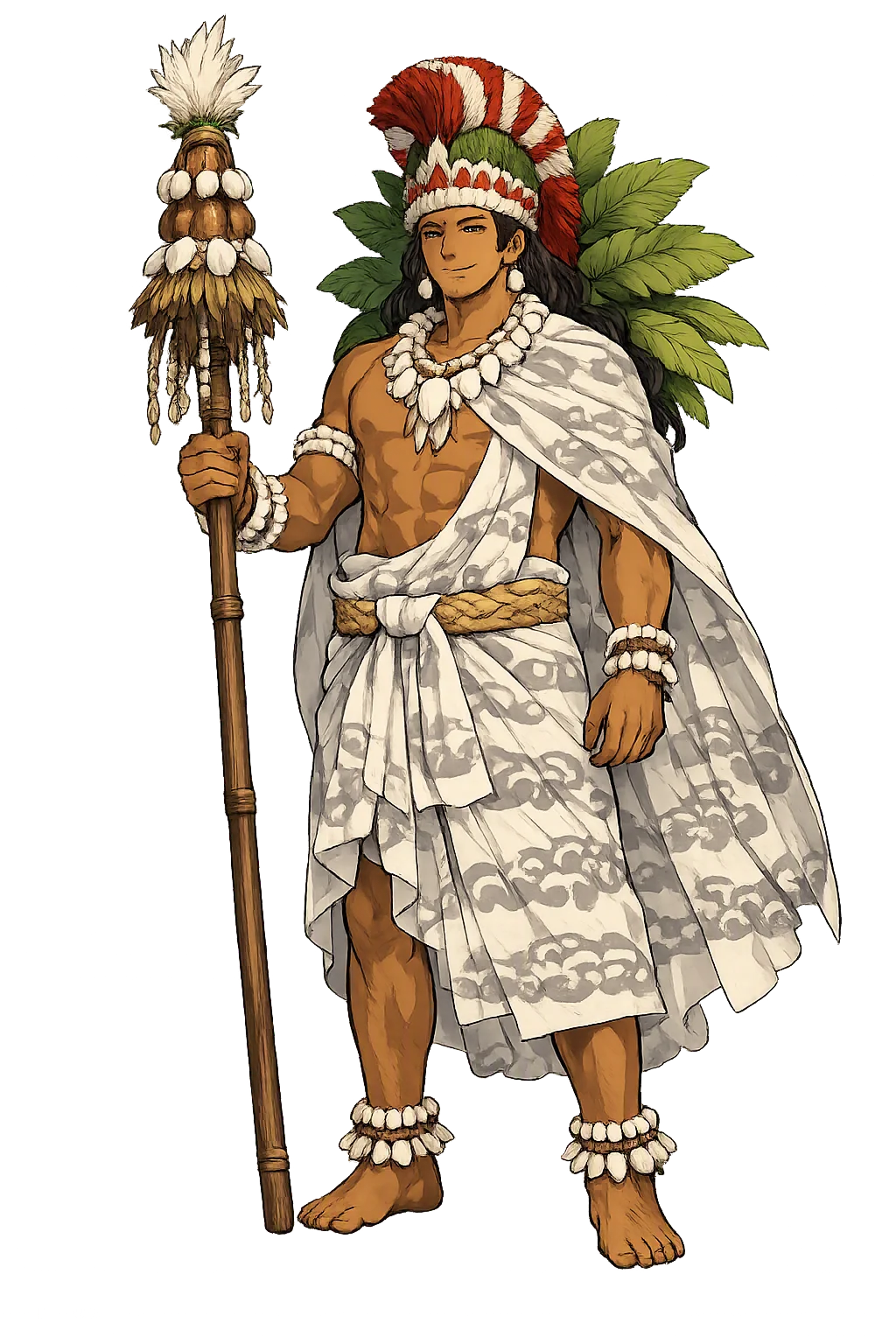
Lono: The God of Rain, Peace, and the Hawaiian Year
When Captain Cook's ships arrived in the Hawaiian Islands in 1778, they did so during the season of Makahiki, the months dedicated to Lono, the god of agriculture, peace, rainfall, music, and fertility. According to some accounts, the white sails of Cook's vessels resembled the banner of Lono, and the British commander was greeted, at least initially, as a manifestation of the god himself. Whether or not Cook was truly identified with Lono, the story reveals something essential about this deity: he is the god who arrives from the sea, brings rain, suspends war, and presides over the agricultural renewal of the year. His name is not merely a label for a set of attributes; it is the sound of peace returning after conflict, of clouds gathering over dry fields, of the Makahiki games replacing the drums of war.
At a Glance
- Restored name: Lono
- ASCII form: lono
- Meaning: Associated with news, report, fertility, peace, and rain
- Domain of influence: Agriculture, Peace, Rain
- Pantheon: Polynesian (Hawaiian)
- Classification: Tier 2
Overview
Lono is one of the four great male deities of traditional Hawaiʻi, alongside Kū, Kāne, and Kanaloa. Where Kū is the god of war and male generative power, Kāne the god of life and fresh water, and Kanaloa the god of the ocean depths, Lono governs the cultivated world: the taro patches, the sweet potato fields, the rain that waters them, and the peace that allows planting to proceed. He is also the god of sports, games, and hula performed in his honor during Makahiki. His domain is therefore not narrow. It encompasses everything that makes settled agricultural life possible: weather, fertility, leisure, and the ritual calendar.
In the PUNICODEX lexicon, Lono is catalogued under "Agriculture, Peace, Rain." Each term points to a different dimension of his cult. Agriculture is the material foundation: without Lono's rain, the fields fail. Peace is the social condition: during Makahiki, warfare is suspended and tribute is offered to the god. Rain is the visible sign of his presence, the blessing that descends from the clouds. Together they describe a deity who binds nature and society into a single rhythmic order.
Etymology and Meaning
The name Lono is related to the Proto-Polynesian root longo, meaning "news," "report," or "hearing." In Hawaiian, the verb lono can mean to hear, to perceive, or to report news. The name therefore suggests a god who is attentive, who hears the prayers of the people and responds with rain. Some scholars connect Lono to the idea of a distant god who arrives with news from beyond the horizon, fitting the tradition that he comes from Kahiki, the ancestral homeland, during the Makahiki season.
This etymology shapes Lono's personality. He is not a remote creator but a responsive presence, a deity who listens and answers. The sound of thunder, the fall of rain, the arrival of the Makahiki image circling the island, these are all forms of divine communication. To call upon Lono is to ask for a response from the sky.
The connection between hearing and rain is not arbitrary. In an agricultural society, the arrival of rain is the most important news of the year. A god whose name means "news" is therefore the god who brings the best possible report: the fields will grow, the people will eat, the community will survive another year. The name encodes a theology of divine attentiveness to human need.
Mythology and Domain
Lono's mythology is less a single continuous narrative than a set of interlocking rituals and symbols. The most important of these is the Makahiki festival, which begins when the constellation Pleiades (Makaliʻi) rises at sunset. During this four-month period, normal political and military activity is suspended, taxes are collected in the form of offerings to Lono, and athletic and theatrical competitions take place. A carved image of Lono, often with a distinctive pole and crosspiece, is carried around the island to receive tribute and bless the land. The festival ends with a ceremony in which the image is returned to the sea, symbolizing Lono's departure until the next year.
This cycle encodes a theology of agricultural time. The god arrives, brings rain, receives honor, and departs. Human society mirrors this rhythm by alternating between war and peace, production and festival, giving and receiving. Lono is thus the divine patron of a balanced annual life, a deity who ensures that conflict does not become permanent and that the land is allowed to renew itself.
Lono is also associated with marriage, fertility, and healing. He is sometimes paired with Laka, the goddess of hula, or with other female deities who embody the growth of vegetation. In some traditions, he leaves Hawaiʻi and returns each year, making him a dying-and-returning god whose annual journey explains the seasons. This aspect of his mythology has invited comparison with deities from other parts of the world, though Hawaiian scholars caution against flattening Lono into a generic fertility symbol.
The Makahiki image of Lono, called Akua Loa or Akua Makahiki, was a tall pole with a crosspiece near the top, draped with white barkcloth. It was carried in procession around each district, and offerings of taro, sweet potato, fish, and other produce were placed before it. This image has sometimes been compared to a ship's mast and sail, which may help explain why Cook's arriving ships were interpreted in Lonoan terms.
Pronunciation, Orthography, and the Restored Form
The name Lono is pronounced with two syllables in Hawaiian: lo-no. The vowels are pure, without the diphthongization common in English, and the stress falls on the first syllable. Unlike some Hawaiian names, Lono does not contain a glottal stop or long vowel in its most common form, which makes the ASCII form lono closer to the spoken name than it is for names like Hiiaka or Kamapuaa. However, the lowercase form still fails to mark the name as a proper noun. The PUNICODEX restoration Lono therefore makes a minimal but crucial change: it restores the capital letter that distinguishes the god from the common verb lono, "to hear" or "to report." This is enough to place the entry in Tier 2.
Cultural Legacy
The legacy of Lono is inseparable from the legacy of Makahiki. Although the festival was suppressed after the overthrow of the traditional Hawaiian religion in 1819, it has been revived in recent decades as part of the broader Hawaiian cultural renaissance. Schools, communities, and cultural organizations now hold Makahiki games, teach the associated chants, and discuss the ecological wisdom embedded in the four-month fallow period. Lono has thus become a symbol of sustainable agriculture, peace, and the recovery of indigenous knowledge.
The association with Captain Cook has also kept Lono in the global historical imagination. The debate over whether Cook was actually identified with Lono, initiated by the scholar Marshall Sahlins and contested by others, became one of the most famous arguments in twentieth-century anthropology. Whatever one's position, the debate shows that Lono is not just a Hawaiian deity but a figure through which Western scholars have tried to understand the nature of cross-cultural encounter, divinity, and kingship.
In contemporary Hawaiian spirituality, Lono is honored in ceremonies that ask for rain, healing, and peace. Farmers, hula practitioners, and environmental activists invoke him as a patron of the land. His name appears in place names, family names, and the names of cultural organizations throughout the islands.
The Unicode Restoration
PUNICODEX restores the name as Lono, a Tier 2 entry because the spelling recovers the conventional capitalization of a proper noun without adding diacritics unavailable in the .com IDN table. The ASCII form lono loses the capital letter and, with it, the grammatical marker that tells a reader this is a name and not a common word. In the case of Lono, that distinction matters because lono is also a Hawaiian verb meaning "to hear" or "to report." The lowercase form thus blurs the boundary between the deity and the everyday action of listening.
The restoration also carries symbolic weight. Lono is the god who arrives and departs, who brings rain and peace in a seasonal rhythm. To give him a Unicode domain is to make that arrival visible in the digital landscape. It says that the agricultural calendar, the sound of rain, and the suspension of war are not archaic curiosities but living concerns that deserve a recognizable address. The name returns, as it does each Makahiki, to the place where it belongs.
Sources and Further Reading
This account draws on Martha Beckwith's Hawaiian Mythology, David Malo's Hawaiian Antiquities, the anthropological work of Marshall Sahlins on the Cook-Lono question, and the scholarship of Robert D. Craig and Margaret Orbell on Polynesian religion. These sources preserve the rituals, chants, and calendar that make the restoration of Lono meaningful.
The Digital Life of a Polynesian Name
The story of Lono does not end with mythology or ethnography. It continues every time someone types the name into a search engine, a chat message, or a browser's address bar. For most of the internet's history, that act has been constrained by the ASCII character set, the limited alphabet of the early domain-name system. The result is that a name like Lono appears as lono, stripped of its initial capital and, in many cases, of the diacritics that carry its pronunciation and meaning. This is not a minor formatting issue. It is a structural feature of the digital world that has systematically disadvantaged languages and cultures whose names do not fit inside the English typewriter's character set.
The Domain Name System was designed in an era when network engineers assumed that all meaningful identifiers could be written with the letters A to Z, the digits zero to nine, and a handful of punctuation marks. That assumption encoded a particular linguistic hierarchy into the infrastructure of the internet. English and a few closely related languages fit naturally; Hawaiian, Māori, Samoan, Tahitian, Rapa Nui, and hundreds of other languages did not. For decades, the only way for a Polynesian name to become a web address was to anglicize it, to drop its glottal stops, to flatten its macrons, and to lowercase its first letter until it looked like an ordinary English word.
The introduction of Internationalized Domain Names, or IDNs, changed the technical situation without fully changing the cultural one. IDNs allow Unicode characters in domain names, which means that Lono can in principle exist as a working address. The mechanism that makes this possible is called punycode, a way of encoding Unicode strings within the ASCII-only DNS. When you type Lono into a modern browser, the address bar may display the Unicode form while the underlying DNS request uses the punycode form beginning with xn--. This dual life, visible Unicode and hidden ASCII, is a fitting metaphor for the status of indigenous names online: present, but often unreadable to the systems that route traffic.
PUNICODEX exists to make the visible form authoritative. By restoring Lono as the canonical domain, the project insists that the name should be encountered in its proper shape, not merely as a punycode translation. The restoration is not a rejection of technology; it is a use of technology to correct an earlier limitation. The punycode form still does the routing, but the user sees the name as it is spelled in scholarly and cultural contexts. This matters for search engines, which increasingly take Unicode into account; for AI training corpora, which need accurate names to avoid amplifying anglicized biases; and for human readers, who deserve to encounter Polynesian culture without first passing through an ASCII filter.
The choice to restore Lono also has implications for education and cultural transmission. Teachers and students who encounter the name in its correct form are more likely to ask the right questions: Where does this name come from? What language does it belong to? What stories and obligations does it carry? A lowercase ASCII string does not invite those questions; it looks like any other internet handle, stripped of history. The restored name, by contrast, announces itself as a proper noun and invites inquiry.
The classification of Lono as Tier 2 reflects a specific philological judgment. In the PUNICODEX tier system, Tier 1 names are those whose restored forms include distinctive letters or diacritics that the ASCII form cannot represent, such as macrons or the ʻokina. Tier 2 names are those whose restoration primarily recovers the conventional capitalization of a proper noun, without adding characters blocked by the .com IDN table. For Lono, the restoration from lono to Lono is therefore a restoration of grammatical dignity rather than a recovery of lost phonetic marks. It says that this is a name, a person, a power, and not a common noun or a string of lowercase letters.
The practical effects of this restoration ripple outward. A student searching for Lono is more likely to find serious cultural and scholarly material if the name is spelled correctly across the web. A language learner sees a model of how Polynesian names should appear in formal contexts. A descendant of the culture encounters a small but concrete assertion that their ancestral names belong in the digital public square. And a casual visitor, arriving at the temple page, receives the implicit message that the name is worth spelling with care.
There is also a subtle but important effect on link integrity and citation. When scholars, journalists, and educators link to a domain that spells Lono correctly, they reinforce that spelling with every click. Over time, the correct form accumulates authority in search rankings and in collective memory. The lowercase form, by contrast, circulates as a kind of error that becomes harder to correct the more often it is repeated. Restoration is therefore not only a matter of present dignity but of future accuracy.
There is also a defensive value to restoration. When names are routinely rendered in lowercase ASCII, they become easier to misappropriate, to reduce to generic fantasy tropes, or to separate from their cultural context. A domain that resolves to Lono is a kind of digital landmark, a place where the correct spelling is maintained and the full story can be told. It does not solve every problem of cultural appropriation, but it establishes a baseline: this name has a home, and that home spells it correctly.
In the end, the restoration of Lono is part of a larger project that extends far beyond any single name. It is part of the effort to make the internet multilingual not only in its content but in its architecture, to ensure that the address bar can carry the world's names in their own forms. The myths tell us that names have power, that to know a name is to know something of the being it names. The digital restoration of Lono is an act of that kind of knowing: a recognition that the goddess, god, ancestor, or power called Lono deserves to be named fully, even and especially in the most technologized spaces of contemporary life.
When you visit the restored temple at Lono, you are not merely visiting a page. You are witnessing a small but real correction in the way the digital world handles indigenous names. You are affirming that Lono is not a fragment to be anglicized, a curiosity to be lowercased, or a myth to be filed away. You are affirming that Lono is a name, and that names, properly restored, remain one of the most durable forms of sovereignty. In a world of rapid technological change, that durability matters more than ever. The restoration of Lono is therefore both backward-looking and forward-looking: it honors the past by preserving the name, and it prepares the future by making that name available to the next generation of speakers, learners, and builders.
Related Names
- Kāne — Creator, Light, Life
- Kū — War, Forests, Fishing
- Māui — Trickery, Fishing, Fire, Islands
- Papatūānuku — Earth, Creation, Fertility
- Rūaumoko — Earthquakes, Volcanoes
Sources
- George Grey, Polynesian Mythology and Ancient Traditional History of the New Zealand Race (1855).
- Elsdon Best, Māori Religion and Mythology (1924).
- Martha Beckwith, Hawaiian Mythology (1940).