PuniCodex

Extended Lore

Libyē — The Deeper Record

Etymology · Orthography · Cult · Iconography · Reception · Sources

Preserves vowel length Libyē.com
Libyē — Personified Continent of Africa
01

At a Glance

Libyē — every fact links to its home

PantheonGreek
DomainPersonified Continent of Africa
Attestedc. 1208 BCE
Original ScriptΛιβύη →
Primary Sources1 cited →
02

Etymology & Word Family

From original script to Unicode restoration — the full etymology page →

Proto-afro-asiatic *lebu Libyan, western
Original Script Λιβύη Libyē — "The African continent (etymology uncertain)"
Unicode Restoration Libyē Restored stress, length, and script
Modern ASCII libye Plain-ASCII fallback

From Greek Λιβύη, name for North Africa west of Egypt.

03

Unicode Character Breakdown

Character-by-character philological analysis

CharacterUnicodeNameBlockPhonetic Role
LU+004CLatin Capital Letter LBasic LatinLambda
iU+0069Latin Small Letter IBasic LatinIota
bU+0062Latin Small Letter BBasic LatinBeta
yU+0079Latin Small Letter YBasic LatinUpsilon
ēU+0113Latin Small Letter E with MacronLatin Extended-AEta: long vowel

More than one historically valid Unicode spelling of Libyē exists — each variant is a real, attested restoration, and the owned forms live as temples.

04

Cult & Worship

How the sacred was kept — rites, sanctuaries, remains

The Cult

Libyē the nymph had no cult, and the honest record is short: no sanctuary, festival, priesthood, or votive is attested for her anywhere in Greek or Latin literature. Like her sisters Asia and Europe she was a name before she was a goddess, and no city claimed her tomb. What was worshipped in the land that bore her name was real enough — above all Apollo at Cyrene, whose spring festival of the Karneios was the greatest of the city's year — but the nymph herself stood outside all of it, a genealogical convenience given flesh by Herodotus' informants. Her one cultic legacy is accidental: Greek settlers spoke her name as a home address, and three thousand years of devotion on that coast — Greek, Roman, African, Islamic — have never once been offered to her.

In the Earth

The Libu are material before they are myth. Egyptian records name them from the New Kingdom onward — among the hostile 'Nine Bows' on the great Karnak inscription of Merneptah (c. 1208 BCE) and as captives with sidelocks and phallic sheaths on the reliefs of Ramesses III's Libyan wars at Medinet Habu (twelfth century BCE). Greek colonisation then wrote the name in stone: Cyrene, founded c. 631 BCE by Battus of Thera (Herodotus 4.150–158), with its great temple of Apollo and its coinage bearing the silphium plant; the sanctuary of Ammon at Siwa (Aghurmi), where Alexander was confirmed in 331 BCE; and the Severan cities of Tripolitania — Leptis Magna's forum and arch of Septimius Severus, Sabratha's theatre — which carry the name into the Roman centuries.

05

Iconography

How Libyē was imaged across the ages

The Image

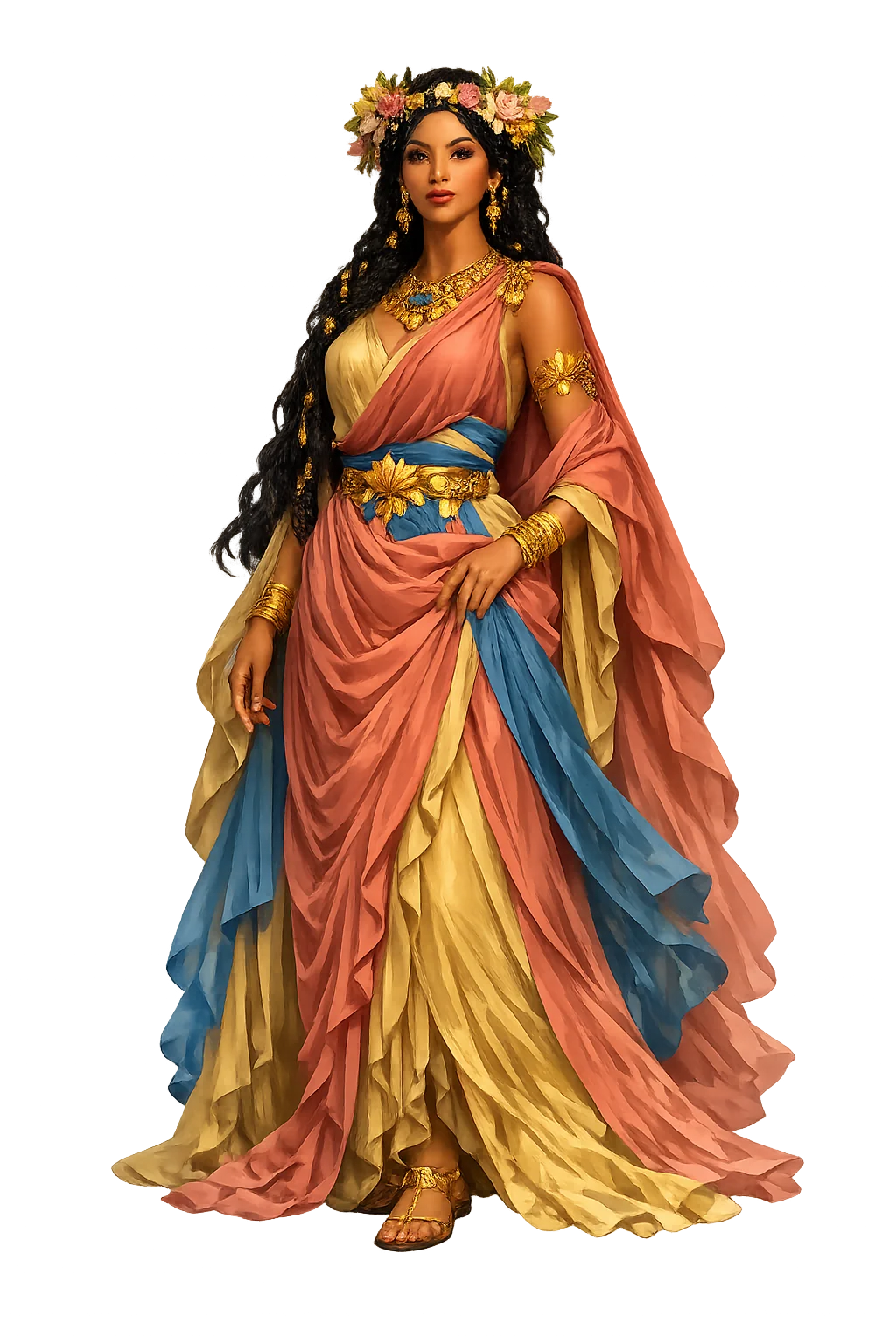
The nymph Libya was never imaged, but her continent was — on money, from the first. Her first portrait was botanical: Cyrene's silver staters bearing the silphium stalk, the wonder-plant that made Libyan abundance visible on every trade counter. Under Rome the personification became a woman, and Roman coinage and North African mosaics carried her standard face: AFRICA in the elephant-scalp headdress, cornucopia and scorpion in hand — the desert, the harvest, and the zodiac's hottest sign compressed into one figure. Cesare Ripa's Iconologia (1593) fixed the Baroque formula — Africa enthroned with elephant skin, scorpion, and ears of grain — and the four-continents ceilings of the seventeenth and eighteenth centuries seated her eternally between Asia's incense and Europe's church. The images survive in the cabinets still: Cyrene's silphium staters in the British Museum and the Cabinet des Médailles, the turreted Africa on Roman bronzes. The nymph's true portrait was her own coast.

06

Reception & Transformation

The name after its own age — transmission, translation, survival

Afterlives

Libya rode out of antiquity in three vehicles. The first was scripture: the Greek name crossed into the New Testament as 'the parts of Libya about Cyrene' (Acts 2:10), fixing her in the Latin Bible and every vernacular that translated it. The second was the map: Isidore of Seville's Etymologies transmitted the threefold division of the world, the medieval mappae mundi kept the name on the southern continent, and Ptolemy devoted his fourth book to Libya — so when his Geography entered Latin in 1406, Renaissance cartographers inherited the word and printed LIBYA along the African coast for three more centuries. The third was scholarship: classicists kept Libyē as the Greek name of Greek North Africa, and modern etymology — Beekes among others — weighed the Egyptian Libu and the Semitic options without closing the case. Rome's poets had made her a byword for lions and endless summer; the modern age made her a nation. The woman beneath both did nothing but lend her name — which is the one thing a personified continent can do.

Identifications Across Traditions

Rome kept the geography and changed the grammar. In Latin the name became Libya, a poetic synonym for the whole African continent — Vergil's Libyae deserta, Ovid's land of lions and endless summer — while administratively the conquered province was called Africa, carved from Carthage's ruins after 146 BCE. The most famous 'Libyan' of the empire was born there: Septimius Severus of Leptis Magna, emperor from 193 to 211, who reportedly never lost his African accent (Historia Augusta, Severus 19). Under Byzantium 'Libya' narrowed to Cyrenaica and its Pentapolis. The modern resurrection was colonial and abrupt: in 1934 the Italian administration fused Tripolitania and Cyrenaica as 'Libia', a name the independent kingdom kept in 1951. Every stage of the name's life — people, woman, continent, province, country — survives in it; restoring Libyē restores the Greek layer of that palimpsest.

Modern Legacy

The Greek name outlived the Greek world. On Cyrene's coins the extinct silphium plant — the medicinal herb once worth its weight in silver — advertised Libyan abundance to the whole Mediterranean; the plant is gone, the coins remain. At Siwa the oracle of Ammon answered Greeks and, in 331 BCE, Alexander, before its priests hailed him son of Zeus. Leptis Magna and Sabratha still stand as the best-preserved Roman cities of Africa. The name passed through Latin into every European language as the standard term for the continent until 'Africa' displaced it in administrative use; it lives on as the name of a nation and as 'Libyan', an ethnonym attested in Egyptian records three thousand years old. In scholarship and modern fiction, Libyē remains the Greek ear's name for the land west of the Nile.

07

The Original Script Note

What the written record preserves — and what it does not

Original Script

The name is written in Greek as Λιβύη, first the Greek word for the land west of Egypt and then a personification, daughter of Epaphus in the genealogical tradition. The word is probably of African origin, taken from the Libu — Egyptian Rbw — one of the peoples of the western desert fringe; the Greek adaptation gives it the acute on the penult and a long final eta. The canonical form Libyē marks that final length with a macron, the one feature ASCII 'Libye' cannot show. The personified Libyē steps fully into view in Pindar's ninth Pythian, where she bears Aepytus to Poseidon.

08

The Meditation

What Libyē means — beyond the dictionary

Names migrate differently than borders. Before Libyē was a place it was a people — the Libu of Egyptian annals; before it was a people it may have been a word no one can now parse (the etymology is uncertain, and Beekes treats it as a probable loan). Then it became a princess, a continent, a Roman poetic byword, a Byzantine region, an Italian colony, a kingdom, and a revolutionary state — the same syllables wearing seven histories. The Greeks made geography genealogy: Libya the woman, daughter of Epaphus, sister of Asia and Europe, mother of Belus and Agenor, so that three continents could be read as three daughters of one wandering Argive cowherd's line. It is a fiction, and a useful one: it insists that the map is a family, not a frontier. Restoring Libyē — acute, long eta, and all — restores the Greek ear that first heard Africa as kin.

09

Frequently Asked Questions

Deep-dives into the cult, attestation, reception, and sources of Libyē

01How do we know how Libyē was worshipped?

The Libu are material before they are myth. The full cult record →

02Where do the earliest attestations of Libyē come from?

The record rests on Herodotus, Histories 4.168–199 (Libyan ethnography), Apollodorus, Library 2.1.4 and 2.5.11 (genealogy of Libya; the apples of the Hesperides), Beekes, Etymological Dictionary of Greek, s.v. Λιβύη, among 5 cited works. The full source apparatus →

03How did later traditions reinterpret Libyē?

Libya rode out of antiquity in three vehicles. Reception & transformation →

04What do the surviving images of Libyē actually show?

The nymph Libya was never imaged, but her continent was — on money, from the first. The iconography →

05What does the written record of Libyē actually preserve?

The name is written in Greek as Λιβύη, first the Greek word for the land west of Egypt and then a personification, daughter of Epaphus in the genealogical tradition. The Original Script note →

10

Scholarly Sources

The philological foundations of this restoration

Every claim on this page is grounded in established scholarship. The orthographic restorations follow disciplinary convention. The etymological chain follows the best available reference works. This is not invention — it is resurrection through scholarship.

◈

Lexicography & Philology

  • Liddell, H. G., Scott, R., & Jones, H. S. A Greek-English Lexicon. Oxford: Clarendon Press, 9th ed. 1996.
  • Herodotus
◎

Primary Texts

  • Apollodorus, Library 2.1.4 and 2.5.11 (genealogy of Libya; the apples of the Hesperides)
◉

Archaeology & Art History

  • Boardman, J. Greek Sculpture: The Classical Period; Carpenter, T. H. Art and Myth in Ancient Greece.
✦

Religious Studies

  • Herodotus, Histories 4.168–199 (Libyan ethnography)
  • Beekes, Etymological Dictionary of Greek, s.v. Λιβύη
  • Chamoux, François, Cyrène sous la monarchie des Battiades (Paris, 1953)
  • Mattingly, David J., Tripolitania (Batsford, 1995)
Return

The Surface Awaits

You have traced the name from its earliest attestation to its Unicode restoration. Now return to the myth. The story is where the name lives.

Back to Lore
Libyē mascot