The Living Myth
Personified Continent of Africa · The Sun-Baked Continent
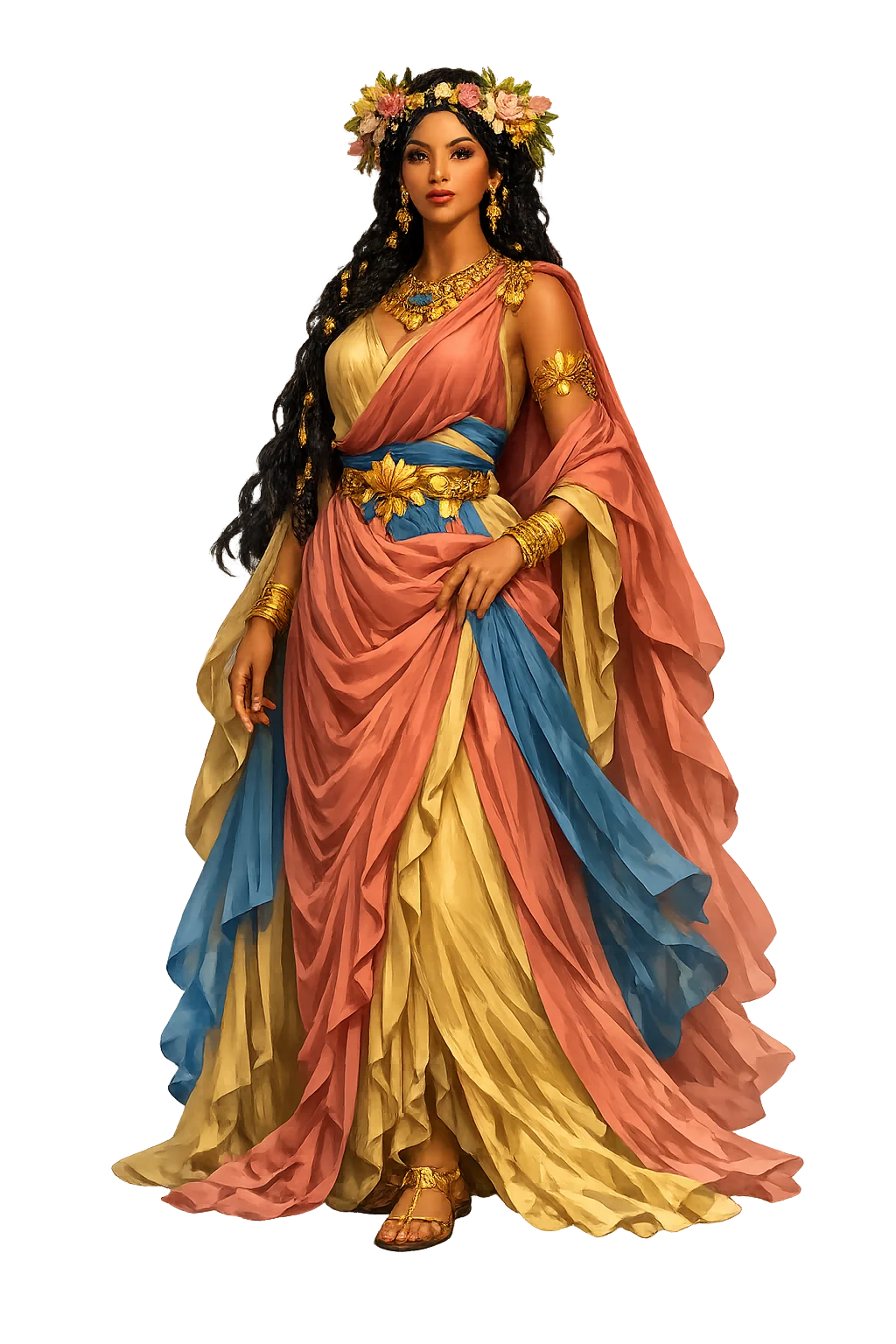
Stories of Libyē
Libyē is the Greek name for Africa west of Egypt, personified as a daughter of Epaphus and Memphis. Her myth places her at the intersection of Egypt and the Greek colonial world: ancestress of the Libyan peoples, mother of Belus and Agenor, founders of the great Near Eastern dynasties. Through her, the African continent enters Greek genealogy as a sister of Asia and Europe — equally ancient, equally consequential. The name later designated the Roman province of Africa and, in modern usage, the nation-state on the Mediterranean coast; through every transformation it kept its association with the vast Sahara and the cultures that edge it.
Libya's father was Epaphus, the son born to Io after her wanderings from Argos to Egypt. Io, transformed into a heifer by Zeus and driven across Europe and Asia, finally found rest in Egypt, where Zeus restored her and she bore Epaphus. Epaphus in turn married Memphis, the eponym of the Egyptian capital, and their daughter Libya became the namesake of the African land west of the Nile (Apollodorus, Library 2.1.4).
This genealogy makes Libya the granddaughter of the Argive princess Io, linking the African continent to the same mythic network that produced Europa and Asia. The Greeks thus imagined Libya not as an alien south but as a branch of a single divine family tree rooted in Argos, Egypt, and Phoenicia — a genealogy that quietly claims the whole eastern Mediterranean as kin.
By Poseidon, Libya bore twin sons Belus and Agenor, who became the eponymous founders of the dynasties of Egypt and Phoenicia (Apollodorus, Library 2.1.4). Belus remained in Egypt and fathered Danaus and Aegyptus, whose quarrel produced the story of the Danaïds; Agenor traveled to Phoenicia and fathered Cadmus, Europa, and Phoenix, whose descendants founded Thebes and shaped the mythic history of Crete.
Through these sons, Libya becomes the mythic source of the migrations and conflicts that bind Egypt, Phoenicia, and Greece together. The African continent is not a peripheral zone but a generatrix of the very dynasties whose stories dominate Greek heroic legend — the Danaïds with their fatal wedding night, Cadmus bringing the alphabet, Europa carried across the sea — all descend from a woman whose only role in myth is to be the land itself.
Herodotus devotes a long digression in Book 4 to the peoples, animals, and customs of Libya, from the lotus-eating coast-dwellers (4.177) to the chariot-borne Garamantes who hunted the cave-dwelling Troglodytes (4.183–184) and the gold-trading Carthaginians. He reports strange creatures — the dog-headed men, the headless Blemmyes with eyes in their chests, the wild cattle whose horns curve forward, forcing them to graze walking backward (4.183) — and records that the Libyans were the first of all peoples to yoke the four-horse chariot (4.189).
For Greek writers, Libya was a land of extremes: burning deserts, miraculous springs, and marvel at every margin. The continent personified thus embodied both the harshness and the wonder of the African interior — the threshold beyond which the known world dissolved into fable, and the reason Greek maps had to end somewhere.
Greek writers placed the Garden of the Hesperides at Libya's western extremity, where the sun sinks into the Ocean and the known world yields to marvel. There golden apples of immortality grew under the care of nymphs — daughters of Atlas or of Night — and were guarded by the ever-watchful serpent Ladon. Herakles' eleventh labor brought him to this Libyan margin, where he took the apples either by slaying the serpent or by persuading Atlas to fetch them (Apollodorus, Library 2.5.11; cf. Herodotus 4.184). The episode makes the continent not merely a geographical name but the threshold between mortal travel and the wonders that lie beyond the setting sun. Libya thus frames both the genealogical origin and the fantastical limit of the Greek imagination — the land where the map runs out and the gods begin.
The domain of Libyē
Libyē is the Greek name for the African continent west of Egypt — first a personified princess, then a geographical frame, finally a Roman province and a modern nation. Greek myth made her the granddaughter of the wandering Io and the mother of the dynasties of Egypt and Phoenicia, folding Africa into one divine family tree with Europe and Asia.
Libyē is the daughter of Epaphus and Memphis, granddaughter of the Argive princess Io who wandered to Egypt (Apollodorus, Library 2.1.4).
By Poseidon she bore the eponymous founders of the Egyptian and Phoenician dynasties (Apollodorus, Library 2.1.4).
Later Greek writers placed the golden garden of the Hesperides at Libya's western edge, where the sun sank and wonder began (cf. Herodotus 4.184).
Herodotus mapped Libya's interior peoples, from the lotus-eating coast-dwellers to the chariot-borne Garamantes, defining the African frontier (4.168–199).
From the original script to the living URL
Λιβύη
The name in its original Greek form. Libyē (Λιβύη) is attested in the source tradition — “The African continent (etymology uncertain)”. Its long vowels and acute accents carry the full phonetic and orthographic weight of the source tradition.
libye
Reduced to plain libye, the name loses everything that made it specific: long vowels and acute accents. What remains is an ASCII string that machines can parse but that no longer speaks with its original voice.
Libyē
The Unicode restoration recovers what ASCII flattened. Libyē restores long vowels and acute accents, returning the name to its original written dignity. The domain encodes to Punycode, but the browser displays the truth.
Libyē.com → xn--liby-eva.com
The non-ASCII characters in Libyē are encoded while the ASCII remains visible. To the DNS, it is Punycode. To humanity, it is Libyē.
Owned, ideal, and ASCII forms of Libyē
Libyē
Restores Λιβύη. The live temple domain — libyē.com.
Libýē
Restores Λιβύη. Acute on the stressed short vowel, matching Greek Λιβύη; preserves stress where the canonical macron-only form records length only.. Not in the PuniCodex collection.
libye
Flattens Λιβύη. The plain ASCII fallback — what DNS and legacy systems see.
How Libyē was spoken
How Libyē travels from ancient script to the modern URL
Greek Λιβύη; the name of the African region west of Egypt; etymology uncertain, perhaps from a Berber or Egyptian source.
Personified Continent of Africa
The Unicode restoration Libyē preserves Greek stress and length; the ASCII form libye loses these features.
The lore you have read is the living myth. Extended Lore opens the scholarly vault beneath it: the cult and its material remains, a history of the image, the name after antiquity, a meditation on what the name still means, and the full scholarly apparatus — etymology, orthography, sources.
Enter Extended Lore