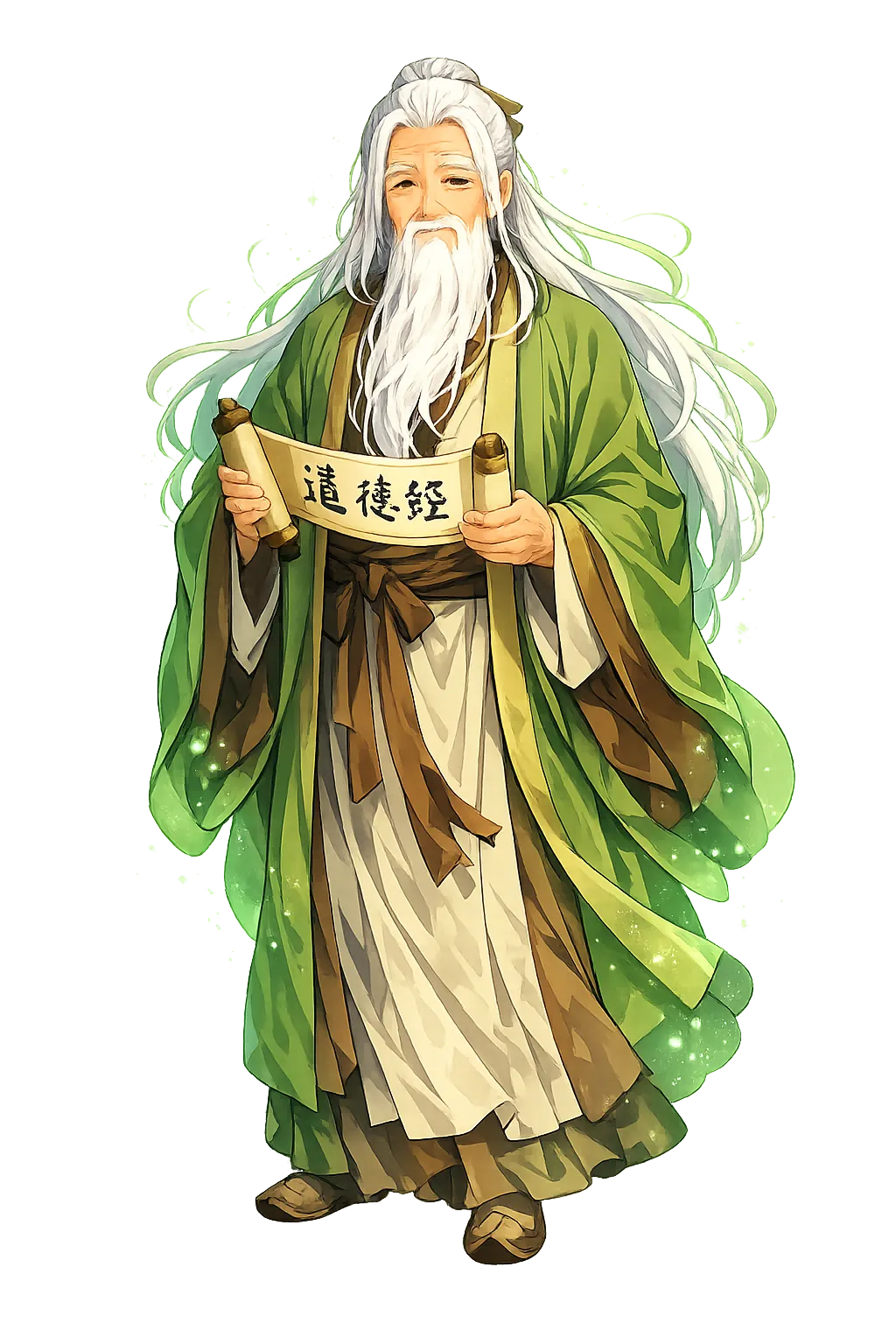
Stories of Lǎozǐ
Lǎozǐ's mythology is inseparable from the biography invented for him by later tradition and from the enigmatic poems of the Dàodé Jīng. The sage is less a character in narrative than the voice of a teaching, but stories gathered around him to give that teaching a body.
Sīmǎ Qiān's Shǐjì (chapter 63) records the most influential biography of Lǎozǐ, and it is a story about a book. Weary of the Zhou court's decay, the old archivist mounted a water buffalo and rode west toward the frontier. At Hán Gǔ Guān, the pass keeper Yīn Xī — who had divined that a sage would pass and had watched the sky for a purple vapor — recognized him and would not let him through without leaving a record. Lǎozǐ sat and wrote five thousand characters in eighty-one short chapters, the Dàodé Jīng, 'Classic of the Way and its Power,' then passed beyond the pass and was never reliably seen again. The story turns the text into a deposit: wisdom compelled to leave one artifact at the edge of the known world before disappearing into the wilderness it describes. Later tradition made the crossing cosmic — the sage leaving history for the realm where the Dào has no name — and the water buffalo became his fixed attribute in a thousand paintings.
The opening of the Dàodé Jīng is not a narrative myth but a cosmogony, and it dissolves the genre as it speaks: 'The Dào that can be told is not the eternal Dào; the name that can be named is not the eternal name. The nameless is the beginning of heaven and earth; the named is the mother of the ten thousand things' (ch. 1). Chapter 42 sketches the generation in three lines — 'The Dào gives birth to One; One gives birth to Two; Two gives birth to Three; Three gives birth to the ten thousand things' — and immediately grounds that cosmos in paired opposites, yīn and yáng, 'harmonized by the blending of breaths.' Chapter 25 names the source itself: 'There is something formed from chaos, born before heaven and earth... I do not know its name, so I style it Dào.' Chapter 40 gives the whole process its motion: 'Reversal is the movement of the Dào.' The myth's point is anti-mythic: any story of the world's origin is already one of the ten thousand things, and the source keeps its silence.
By the Han dynasty, Lǎozǐ had been transformed from philosopher to god. The Tàipíng Jīng and the emerging Daoist canon identified him as the embodiment of the Dào itself, an eternal being who descends in successive bodies to reveal saving teachings whenever the world decays — the Dào become substance, substance become Lǎozǐ, as the later formula has it. The Táng imperial house, surnamed Lǐ, claimed descent from him; Emperor Gāozōng honored him in 666 CE as Tàishàng Xuányuán Huángdì, 'Supreme Emperor of the Mysterious Origin,' and temples received state support. In organized Daoism he became Tàishàng Lǎojūn, 'the Most High Lord Lao,' enthroned among the highest deities of the pantheon — the uncarved archivist made into the fixed center of a religion's heaven. The apotheosis completed the journey in one direction: the man who wrote that 'the sage has no fixed heart-mind' became a celestial bureaucracy's most fixed star.
The Shǐjì sets Lǎozǐ's one recorded meeting against the greatest name in Chinese education. Confucius, says Sīmǎ Qiān, came to the capital to consult the archivist about the rites of antiquity — and Lǎozǐ received the question with open disdain: 'The men about whom you talk have mouldered, their bones are dust; only their words remain. Remove your pride and your many desires, your studied manner and your over-fond heart — these profit you nothing. That is all I have to say to you' (Shiji 63). Confucius withdrew and told his disciples: 'I know how birds fly, how fishes swim, how beasts run... but of the dragon I can say nothing — today I have seen Lǎozǐ, and he is like the dragon' (Shiji 63; Zhuāngzǐ 13 and 21 tell the meeting with variations). The scene gave Chinese philosophy its two poles in a single encounter: the teacher of ritual standing silent before the teacher of the wordless Way — and admitting that he had met something his categories could not hold.
Dao, Wuwei, and the Art of Ruling by Not Ruling
Lǎozǐ is the legendary author of the Dàodé Jīng, the founding text of Daoism and one of the most translated books on earth. His name means simply 'Old Master,' and the figure behind it is as elusive as the philosophy he teaches. Whether archivist, composite, or symbol, he gave Chinese thought its most radical sentence: the way that can be told is not the eternal way.
The unnamable source of all things; empty yet inexhaustible, it gives birth to heaven and earth.
Acting without forced interference, like water that wears down stone by yielding.
The pǔ, primal simplicity before society carves people into roles, names, and desires.
The ideal leader governs by emptying hearts and filling bellies, keeping people simple and content.
From the original script to the living URL
老子
The name in its original Taoist form. Lǎozǐ (老子) is attested in the source tradition — “Old master”. Its original diacritics and script distinctions carry the full phonetic and orthographic weight of the source tradition.
laozi
Reduced to plain laozi, the name loses everything that made it specific: original diacritics and script distinctions. What remains is an ASCII string that machines can parse but that no longer speaks with its original voice.
Lǎozǐ
The Unicode restoration recovers what ASCII flattened. Lǎozǐ restores original diacritics and script distinctions, returning the name to its original written dignity. The domain encodes to Punycode, but the browser displays the truth.
Lǎozǐ.com → xn--loz-hdbm.com
The non-ASCII characters in Lǎozǐ are encoded while the ASCII remains visible. To the DNS, it is Punycode. To humanity, it is Lǎozǐ.
Owned, ideal, and ASCII forms of Lǎozǐ
Lǎozǐ
Restores 老子. The live temple domain — lǎozǐ.com.
laozi
Flattens 老子. The plain ASCII fallback — what DNS and legacy systems see.
How Lǎozǐ was spoken
How Lǎozǐ is preserved in writing
A bespoke provenance study for Lǎozǐ is being prepared by the PUNICODEX scholarly team.
Contribute scholarly provenance →The lore you have read is the living myth. Extended Lore opens the scholarly vault beneath it: the cult and its material remains, a history of the image, the name after antiquity, a meditation on what the name still means, and the full scholarly apparatus — etymology, orthography, sources.
Enter Extended Lore