
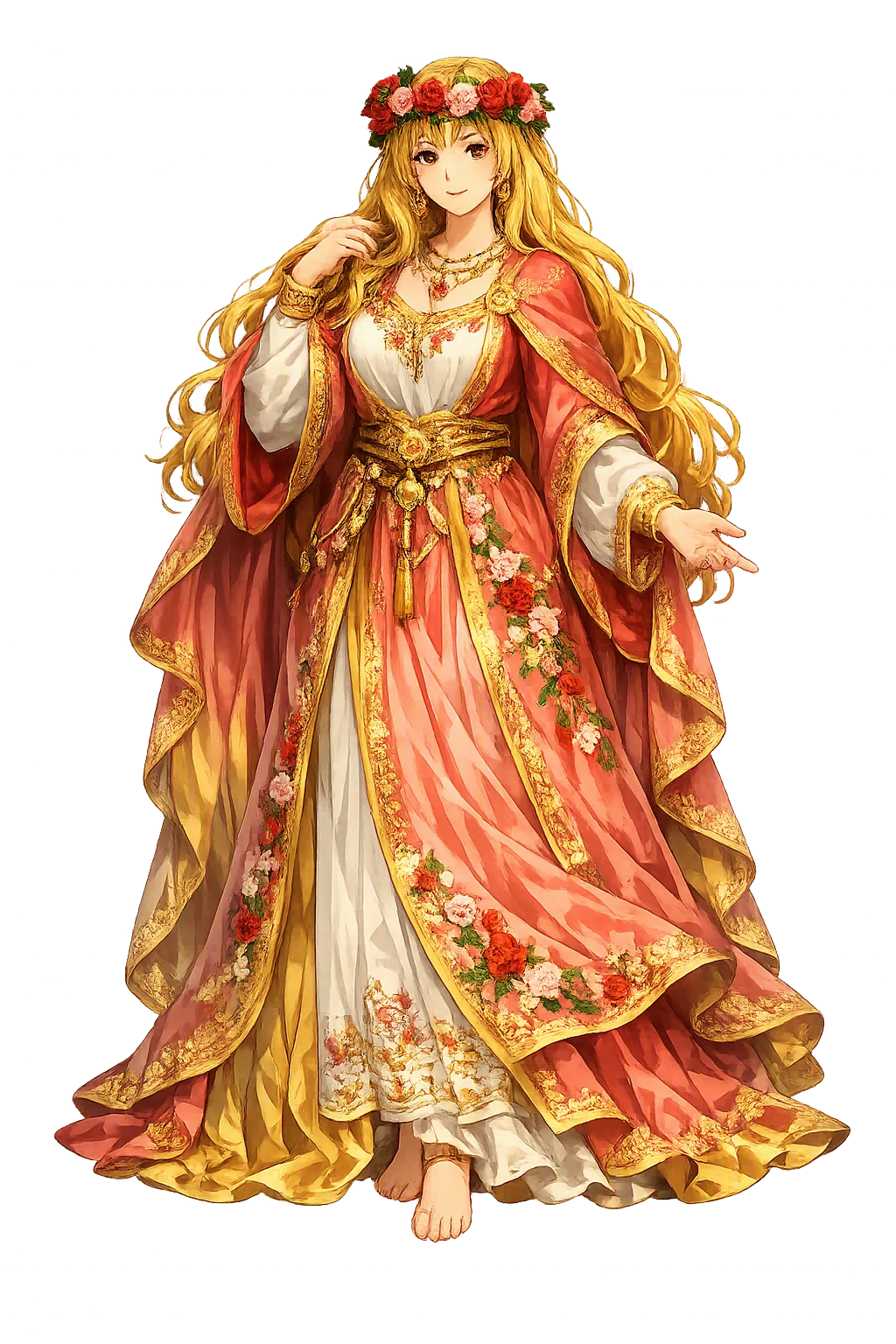
The name Lada and the world it opens
A name is a door. Lada opens onto an entire world: the domain of love, beauty, and spring, a Slavic tradition of song and ritual, and centuries of storytelling, worship, and scholarship. She is one of the most tantalizing figures in Slavic mythology because her name is so widely attested in folklore, yet her divine status remains uncertain. Was Lada a goddess, a mythological personage, or simply a refrain in ancient songs? Did she preside over marriage and fertility, or was she invoked as a poetic figure without cultic reality? These questions have occupied scholars for generations. This post walks through the world that the name opens room by room — the etymology and meaning, the mythological and ritual evidence, the cultural afterlife across Slavic lands, and the Unicode restoration that makes the name addressable once again.
The ambiguity of Lada is itself instructive. It reminds us that ancient religions were not tidy systems with fixed pantheons. They included major gods, local spirits, ancestral powers, personified forces, and countless poetic figures whose status was never precisely defined. A name could be sung for centuries without anyone deciding whether it belonged to a goddess. Lada lives in this fertile ambiguity. She is a refrain, a maiden, a spring spirit, and — for many modern believers — a goddess.
For those who encounter Lada today, the name carries an immediate musical charm. It sounds like a song, and indeed it was a song before it was anything else. The refrain "Lado, Lado!" echoes through wedding processions and spring dances, connecting the modern listener to centuries of celebration. The restoration of the name as a Unicode domain extends this musical life into the digital age, giving the ancient refrain a new place to resound.
At a Glance
- Restored name: Lada
- ASCII form: lada
- Meaning: "Lady, order"
- Domain of influence: Love, Beauty, Spring
- Pantheon: Slavic
- Classification: Tier 2
Overview
Lada belongs to the Slavic tradition, where she is catalogued under the domains of love, beauty, and spring. The name appears most famously in the refrains of Slavic folk songs: "Lado, Lado, Lado!" Singers call upon Lada in wedding songs, spring rituals, and round dances, suggesting a figure intimately connected to youth, marriage, and the renewal of life. Yet the same ubiquity makes her hard to pin down. A refrain is not a theology, and the presence of a name in folk poetry does not automatically make its bearer a goddess.
This ambiguity has not diminished Lada's importance. If anything, it has increased it. She occupies a space between the documented gods of the medieval Slavic pantheon and the vast, half-submerged world of folk belief. In that space, she can be maiden, mother, spring spirit, patroness of marriage, or even a memory of a once-great goddess whose cult has been fragmented into song and custom. Her name carries the emotional weight of countless weddings, spring festivals, and young women's rites of passage.
The PuniCodex restoration presents Lada in her scholarly form, preserving the simple, resonant spelling that appears in folklore studies. The ASCII form lada is a modern convenience imposed by the early domain-name system; the restored form returns the name to its cultural and philological context. Because the name does not require diacritics or distinctive letters to be recognizable, it falls into Tier 2, but this classification in no way reduces its significance as a flagship entry.
The figure of Lada also invites comparison with similar figures in neighboring traditions. The Baltic Laima, the Roman Flora, the Greek Aphrodite and Persephone, and the Norse Freyja all share aspects of love, beauty, spring, and fertility. Whether these similarities reflect common Indo-European inheritance, cultural borrowing, or simply the universal human tendency to personify the forces of life is a matter of ongoing debate. Lada is best understood first in her Slavic context, but she also participates in a broader European conversation about the divine feminine.
In Slavic folk practice, Lada's season is unmistakably spring. She belongs to the time when the earth warms, the birds return, and young people turn their thoughts to love and marriage. Her presence is felt in the flowering meadows, the greening branches, and the circle dances that celebrate the renewal of life. She is not a distant Olympian figure but a deity embedded in the rhythms of the agricultural year.
Etymology and Meaning
The etymology of Lada is as contested as her mythology. One influential proposal connects the name to the Slavic word lad ("order, harmony, agreement"), which appears in many Slavic languages. In this reading, Lada is the Lady of Order, the one who brings harmony to marriage, community, and the natural world. The connection is attractive because it aligns with her appearance in wedding songs: marriage is, after all, a kind of social and cosmic ordering.
Another proposal links Lada to the word lada meaning "female friend" or "companion" in some Slavic dialects, or even to words for beauty and attractiveness. A third possibility, less widely accepted, sees the name as a borrowing or adaptation of a foreign divine name, perhaps related to the Baltic Laima or the Roman Leda. These connections are speculative, but they show how eager scholars have been to give Lada a secure place in the Indo-European family of love and fate goddesses.
The most common gloss in the scholarly literature is "Lady, order." This captures both the possible etymology and the sense of dignified feminine authority that clings to the name. Lada is not a wild force like some fertility deities; she is the ordered, beautiful, harmonious aspect of love and spring. She makes the world bloom, but she does so in due season and with proper ceremony.
Whatever the precise origin, the sound of the name is significant. La-da has a light, open quality, almost like laughter or song. It is easy to chant, easy to rhyme, easy to remember. These phonetic qualities help explain why the name survived so long as a refrain, even when the theology behind it was forgotten. The name itself is a kind of music.
Some scholars have emphasized that "Lado" may have functioned more as an invocation or cry than as a name in the strict sense. In this view, "Lado!" was something like "Hooray!" or "O joy!" — an expression of festive emotion rather than a summons to a deity. If this is correct, then the later identification of Lada as a goddess may be a misunderstanding of the refrain. But even if "Lado" began as a cry, it could easily have become personified over time, acquiring the features of a divine maiden in the popular imagination.
The possibility that Lada is not a goddess in the conventional sense makes her no less important. Many of the most enduring figures in religion began as cries, refrains, or personifications of natural forces. The Greek Eros, the Roman Venus, and the Norse Freyja all have complex origins that blur the boundaries between person, force, and poetic image. Lada fits this pattern perfectly: she is a name that became a presence, a sound that became a goddess.
Mythology and Domain
Lada's mythology is woven from folk songs and seasonal customs rather than from epic narratives. She belongs to the world of the khorovod, the circle dance; of spring processions; of wedding laments and blessings. In these contexts, she is associated with three great domains: love, beauty, and spring.
The domain of love is perhaps the most prominent. Wedding songs invoke Lada as a patroness of brides and happy marriages. Young women dance in her honor, asking for beauty, fertility, and a good husband. The connection to love is not merely romantic but social: in traditional Slavic communities, marriage was the central rite that transformed a girl into a woman and linked two families. Lada's blessing was sought at this crucial threshold.
The domain of beauty follows naturally. To be beautiful in the traditional sense is to be healthy, blooming, fit for love and childbearing. Lada embodies the beauty of youth in its springtime. She is the rose, the morning, the first green leaves. Folk imagery often associates her with flowers, particularly those that bloom in late spring and early summer. To be like Lada is to be in the fullness of life.
The domain of spring ties love and beauty to the agricultural year. Spring is the season of awakening, of planting, of betrothals and weddings. It is when the earth becomes beautiful again and when human love finds its natural expression. Lada's presence in spring rituals makes her a kind of divine springtime, the personification of the world's renewed capacity for growth and delight.
Some scholars have argued that Lada was originally a more powerful goddess whose cult was diminished and fragmented over time. In this reconstruction, she may have been a patroness of sovereignty, marriage, and seasonal renewal, comparable to the Greek Aphrodite or the Norse Freyja. The evidence is thin, but the structural parallels are suggestive. At the very least, Lada occupies a symbolic role in Slavic folk religion that no other figure quite fills.
The rituals associated with Lada often involved young women gathering flowers, dancing in circles, and singing refrains that invoked her name. These practices linked the community to the seasonal cycle and to the ideals of beauty, harmony, and marital happiness. Even when the divine identity of Lada was forgotten, the customs preserved something of her spirit. The circle dance, in particular, survives as a living trace of her worship, a bodily memory of the spring goddess.
Cultural Legacy
Lada's cultural afterlife is inseparable from the Romantic and nationalist movements of the nineteenth century. As Slavic peoples sought to define their identities against German, Ottoman, and Habsburg rule, they turned to folklore as a treasury of national spirit. Lada, with her beautiful name and her association with love and spring, became an emblem of idealized Slavic womanhood. She appeared in poetry, opera, and visual art as a slender maiden crowned with flowers.
This Romantic Lada was partly an invention, but she was a powerful one. She gave artists and intellectuals a way to imagine a pre-Christian Slavic world that was gentle, beautiful, and harmonious — a world unspoiled by foreign domination. The image persists in popular culture, where Lada is often depicted as a spring goddess surrounded by flowers and dancing maidens.
In contemporary Rodnovery and Slavic pagan revival movements, Lada is honored as a goddess of love, beauty, and marriage. Rituals in her honor may include flower crowns, circle dances, offerings of honey and bread, and prayers for harmonious relationships. For many practitioners, she represents the joy and creativity of life, the divine force that makes the world worth loving.
Lada also survives in place names, personal names, and folk memory across Eastern Europe. The name itself has been used as a given name, and it appears in the titles of songs, dances, and festivals. Every spring, in villages and cities alike, people still sing and dance in ways that would be recognizable to their ancestors. Lada may never have been a great temple goddess, but she is deeply embedded in the living culture of the Slavs.
The figure of Lada has also inspired composers and choreographers. Folk dances that invoke her name continue to be performed by ethnographic ensembles and at folk festivals. These performances preserve the gestures and melodies associated with Lada, even when the religious meaning is no longer explicit. The body remembers what the mind forgets.
Unicode Restoration and Conclusion
The PuniCodex restoration of Lada returns the name to its simple, lyrical form. The ASCII version lada is serviceable as a domain, but it lacks the presence of a proper name. The restored spelling, with its capital L, announces that this is not a random string of letters but a figure of cultural and religious significance.
The restoration is particularly fitting because Lada's name has always been a kind of address. "Lado, Lado!" is a call, an invocation, a summons to dance and celebrate. A domain name is also an address, a way of calling visitors to a place. The Unicode restoration allows that ancient call to resonate in a modern medium. When someone types Lada into an address bar, they are not merely navigating to a website; they are invoking a name that has echoed through Slavic song for centuries.
The restoration also honors the feminine and folkloric dimensions of Slavic religion. Too often, discussions of Slavic paganism focus on the warrior gods and rulers' cults while neglecting the folk figures associated with women, spring, and the household. Lada brings those dimensions to the fore. Her restored name is a reminder that the divine world includes not only thunder and war but also love, beauty, and the renewal of life.
The restoration of Lada also carries a lesson about the survival of feminine divine names. Across many traditions, the names of goddesses associated with love, beauty, and household rites have survived longer in folk custom than in official theology, precisely because they were embedded in women's practices and children's games. Lada is a perfect example: her name lived in songs and dances when temples had disappeared. The Unicode restoration continues that tradition of informal preservation, giving the name a new venue in the digital realm where songs and dances once carried it.
In the end, Lada reminds us that not every important name comes with a temple or an epic. Some names live in refrains, in dances, in the annual return of spring. Her power is diffuse but enduring, a thread of beauty and joy running through Slavic culture. The restoration does not claim to settle the scholarly debates about her divine status. It simply gives the name the respect it deserves and invites the world to hear it again.
Lada in Song and Season
The survival of Lada in folk song is one of the most remarkable aspects of her legacy. While the names of many Slavic gods disappeared from popular memory after Christianization, "Lado" continued to be sung. It appeared in wedding laments, spring round dances, and harvest songs, often without any explicit theological meaning. The sound itself was enough to carry the name forward. This musical survival tells us something important about how religion persists: not only through doctrine and temple but through rhythm, melody, and the bodily pleasure of singing together.
In wedding songs, Lada was often invoked as a witness to the bride's transition. The young woman leaving her parents' home would call upon Lada to bless her new life, to make her beautiful and fertile, to ensure harmony between her and her husband. These songs were not composed by priests or scholars; they were the creations of women, passed from mother to daughter across generations. In them, Lada is intimate and approachable, a divine companion to the great rites of female life.
Spring songs associated with Lada often feature imagery of awakening: birds, flowers, green branches, running water. The singers process through the village, carrying the signs of the new season, and call upon Lado to drive away winter and bring back joy. These customs survive in various forms across Eastern Europe, from the Polish gaik and majówka to Russian and Ukrainian spring games. Even when the name Lada is no longer used, the gestures and melodies remain, preserving something of her spirit.
The seasonal dimension of Lada's worship connects her to the agricultural year in ways that are easy to overlook. Spring was not only a time of romantic love but a time of planting, of betrothals arranged to coincide with the growing season, of communal labor in the fields. Love and fertility were not private matters; they were essential to the survival of the community. Lada's blessing was therefore a public concern, invoked for the prosperity of the whole village.
Modern ethnographic ensembles have played an important role in keeping Lada's musical legacy alive. By collecting, recording, and performing traditional songs, these groups ensure that the name and its associated melodies do not disappear. Their work is not merely preservation but reinterpretation: each performance adapts the old material for new audiences, finding ways to make the ancient songs meaningful in the present.
Contemporary composers and musicians have also drawn on Lada's imagery. Folk-rock bands, neofolk projects, and electronic musicians have incorporated the name and the springtime symbolism into their work. These modern adaptations sometimes take liberties with the historical material, but they keep the name in circulation and introduce it to listeners who might never attend a traditional ritual.
The Unicode restoration of Lada is therefore part of a much longer history of preservation through repetition. From the refrains of ancient songs to the digital address bar, the name has traveled through many media, each one offering a new way to keep it alive. The restoration does not replace the songs or the dances; it adds another layer, a place where the name can be encountered, studied, and shared.
Related Names
- Baba Jagá — Forest Witch, Death
- Černobog — Darkness, Chaos, Evil
- Dažbog — Sun, Wealth, Giving
- Domovój — Household Spirit
- Kikimóra — House Spirit, Swamp Hag
Sources
- N. I. Tolstoi et al., Slavic Antiquities: Ethnolinguistic Dictionary (1995–2012).
- Vyacheslav Ivanov & Vladimir Toporov, comparative Slavic mythology studies.
- L. Niderle, The Slavic Antiquities (1902–1924).