
From Devanagari to Unicode: the journey of Kṣitigarbha
Long before it was a domain, this name traveled through scripts. Kṣitigarbha begins in Devanagari, passes through scholarly transliteration, and ends — for now — inside the punycode machinery of the global DNS. Each stage of that journey preserves some information and loses some, and the craft of restoration is knowing exactly which marks matter. This post follows the name stage by stage: the original script, the reconstructed pronunciation, the mythological record, the material evidence, and finally the Unicode form that carries all of it into the address bar. Think of it as a biography of a name, told through its spelling.
At a Glance
- Restored name: Kṣitigarbha
- ASCII form: ksitigarbha
- Meaning: "The Earth-Womb — bodhisattva of the great vow to empty the hells (kṣiti 'earth' + garbha 'womb')"
- Domain of influence: Earth Womb, Savior of Hell Beings
- Pantheon: Buddhist
- Classification: Tier 1
- Original script: क्षितिगर्भ (Devanagari)
- Live domain: kṣitigarbha.com
Overview
Kṣitigarbha (ksitigarbha) — Earth Womb, Savior of Hell Beings · The Earth-Womb, Vow to Empty the Hells — is the bodhisattva who made the most extreme vow in Buddhism: not to attain Buddhahood until every hell is empty.
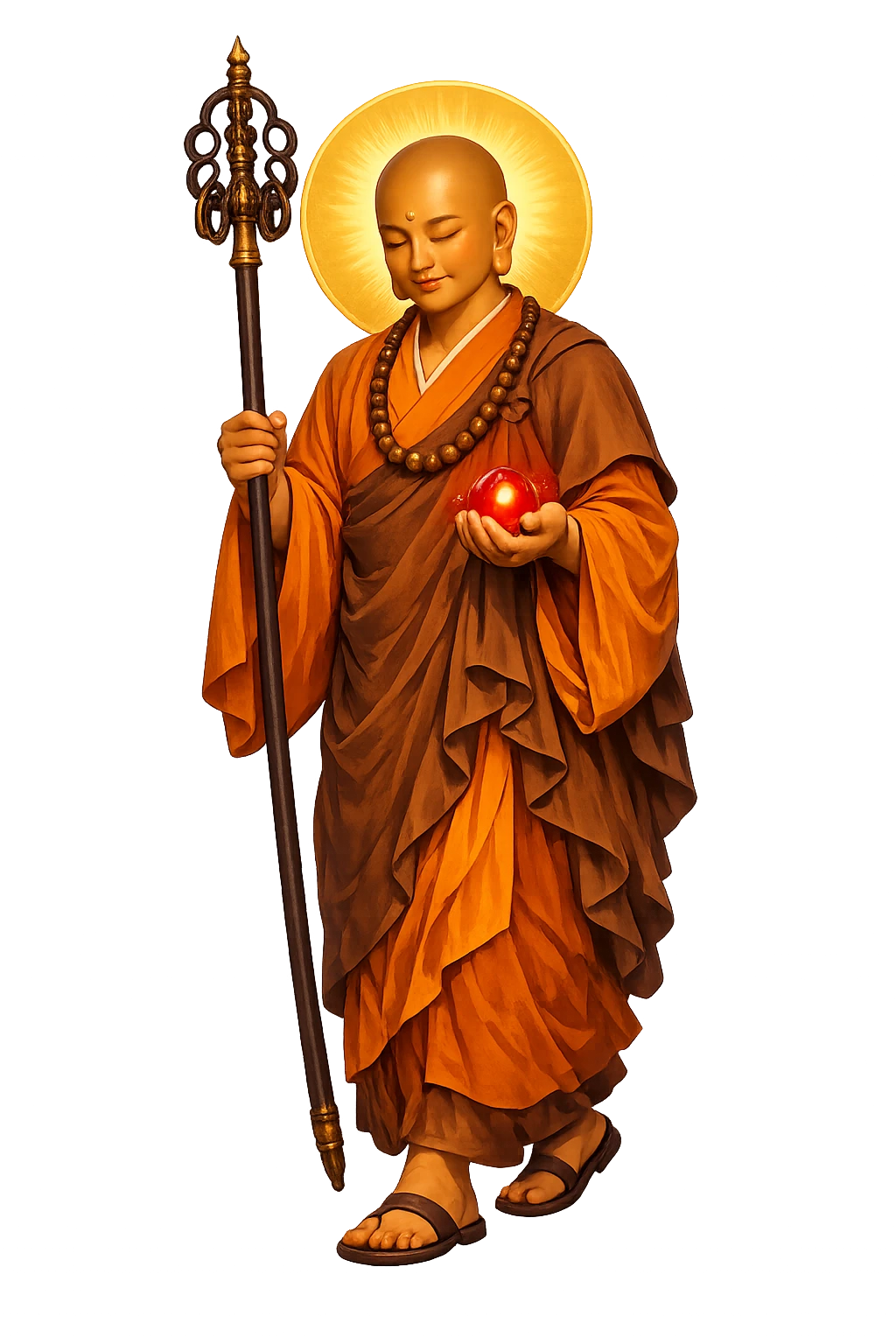
His name joins kṣiti, ‘earth’, with garbha, ‘womb, embryo, inner chamber’ — ‘Earth-Womb’, or as the Chinese render him, Dìzàng 地藏, ‘Earth-Store’: the bodhisattva in whom the earth's patience and a mother's compassion are one. Monk-robed, shaven-headed, carrying the six-ringed staff whose jingle warns the small creatures and the cintāmaṇi jewel that lights the darkest roads, he is the patron of travellers, children, and the dead — above all of the beings in the hells, whom he visits age after age rather than rest. In China he is Dìzàng, lord of Mount Jiuhua; in Japan, Jizō, the most beloved figure of the roadside and the graveyard.
PuniCodex restores the name as Kṣitigarbha and serves its temple at kṣitigarbha.com. The restoration keeps the retroflex ṣ of the initial cluster kṣ; the plain ASCII ksitigarbha is a modern convenience of the early domain-name system, not an attested ancient spelling.
The Name
The name is attested in Sanskrit as क्षितिगर्भ (IAST kṣitigarbha): a tatpuruṣa compound of kṣiti, ‘earth’ (from √kṣi, ‘to dwell, abide’ — the earth as the dwelling-place), and garbha, ‘womb, embryo, innermost chamber’ — ‘Earth-Womb’, ‘the womb of the earth’. The image is generative patience: the earth holds every seed in darkness and asks nothing. The Chinese translation Dìzàng 地藏, ‘Earth-Store’, and the Japanese Jizō 地蔵 carry the same metaphor, and Tibetan renders the name Sā'i snying po (Sayi Nyingpo), ‘Essence of the Earth’.
The ASCII form ksitigarbha survives only because the early domain-name system could not carry diacritics; it is a technological compromise, not an ancient spelling, and it opens the name with the unpronounceable-looking ASCII cluster ks- that the retroflex ṣ resolves. The Unicode restoration Kṣitigarbha recovers the retroflex directly in the address bar. Because the restoration preserves a distinctive letter the ASCII form loses, the name is classified Tier 1.
The letter-by-letter transformation runs:
- k → K — Same, capitalized
- s → ṣ — Retroflex ṣ (the kṣ cluster)
- i → i — Same
- t → t — Same
- i → i — Same
- g → g — Same
- a → a — Same
- r → r — Same
- b → b — Same
- h → h — Same
- a → a — Same
The project holds the domain kṣitigarbha.com (xn--kitigarbha-wy2e.com) as the canonical home of this name.
The Original Script
The name is preserved in Devanagari as क्षितिगर्भ — Brahmic abugida, attested Buddhist Sanskrit, in the sūtra manuscripts of India and Nepal; the script is written left-to-right.
The scholarly transliteration is Kṣitigarbha (IAST), giving the normalized reading /kʂi.ti.ˈɡəɾ.bʱə/.
The rendering proceeds step by step:
- Sanskrit Kṣitigarbha is written क्षितिगर्भ in Devanagari: क्षि (kṣi) + ति (ti) + गर्भ (garbha); the conjunct क्ष — the same ligature that opens Akṣobhya's name — writes the cluster kṣ.
- The compound is kṣiti (‘earth’, from √kṣi, ‘to dwell’) + garbha (‘womb, embryo, inner chamber’): ‘Earth-Womb’.
- IAST writes the retroflex sibilant as ṣ, distinguishing it from palatal ś and dental s.
- The Unicode restoration Kṣitigarbha is registrable in .com; the Devanagari form is not supported in the .com IDN table.
Pronunciation
The reconstructed pronunciation of the name is /kʂi.ti.ˈɡəɾ.bʱə/ — Sanskrit Reconstruction.
Phoneme by phoneme:
- Kṣi- — The cluster [kʂ], voiceless velar plus retroflex sibilant, with short [i]: ‘earth’
- -ti- — Voiceless dental [t] with short [i]
- -gar- — Voiced velar [g] with short [ə] and tapped [r]; the stressed syllable of garbha, ‘womb’
- -bha — Voiced aspirated bilabial [bʱ] with short [ə]; one breathy sound, not b + h
For the modern speaker, the closest approximation is: ‘kshi-tih-GUR-bhuh’ — the opening cluster like the ksh in ‘backseat’ said quickly.
Kindred and historical forms of the name:
- Sanskrit — क्षितिगर्भ (kṣitigarbha), ‘Earth-Womb’
- Chinese — 地藏 (Dìzàng), ‘Earth-Store’
- Japanese — Jizō; Korean — Jijang
- Tibetan — Sā'i snying po (Sayi Nyingpo), ‘Essence of the Earth’
Kṣitigarbha is Tier 1 because the retroflex ṣ is a distinctive letter ASCII cannot carry; the ‘ks’ of the fallback is an accident of transliteration.
Mythology
Kṣitigarbha's mythology is a cycle of vows and descents, preserved above all in the Sūtra of the Past Vows of Earth Store Bodhisattva (Taishō 412), the most beloved scripture of East Asian devotion to the dead.
The Brahmin Daughter
In a past age, the sūtra tells, he was a Brahmin girl whose mother died scoffing at the Three Jewels and fell into the Avīci hell. The daughter sold everything, made offerings before the Buddha of that era, and by the merit and by her own piercing meditation saw her mother raised to a better rebirth — and then, before the Buddha's image, she made the vow that defines him: that through measureless aeons she would work for the deliverance of all beings in the evil destinies, everywhere, without exception. The saviour of the hells began as a daughter who would not accept her mother's damnation.
The Two Kings
The sūtra's second vow-story makes the same point from the other side: two kings of a former age, friends, both resolved to save their people. One vowed to attain Buddhahood quickly, the better to help; the other vowed to save every suffering being first and only then awaken. The first is long since a Buddha; the second is Kṣitigarbha still — the bodhisattva who chose to be last.
The Lord of the Underworld (China)
In medieval China, Dìzàng's cult fused with the indigenous courts of the dead: the apocryphal Scripture on the Ten Kings made him overseer of the ten magistrates who judge the dead, the compassionate superior of the entire infernal bureaucracy. Zhiru Ng's study documents how this foreign bodhisattva became, in a few centuries, the Chinese dead's foremost advocate.
The Korean Incarnation (Mount Jiuhua)
The tradition's boldest claim is biographical: the Silla prince-monk Jin Qiaojue (Kim Gyo-gak, d. 794), who practised for seventy-five years at Mount Jiuhua in Anhui, was revered after death as Dìzàng's emanation — his body, enshrined and undecayed, made the mountain the bodhisattva's earthly residence, one of the four sacred peaks of Chinese Buddhism.
The Commission in the Trāyastriṃśa Heaven (Kṣitigarbha Sūtra)
The Sūtra of the Past Vows of Kṣitigarbha Bodhisattva is set in the heaven of the Thirty-Three, where the Buddha preaches for his mother's sake before his passing. There he recounts Kṣitigarbha's long record of vows and formally entrusts to him all beings of the coming age — the interval between Śākyamuni's parinirvāṇa and Maitreya's arrival. The sūtra's most quoted line is the vow itself: until the hells are empty, he shall not become a Buddha; only when every being is saved will he accept awakening. The Sanskrit original is lost; the text survives chiefly in Chinese and Tibetan, and its promise survived everything.
The Silla Prince of Jiuhua (Chinese Tradition)
In the eighth century a Korean prince of Silla, Jin Qiaojue, came to Mount Jiuhua in Anhui and practiced there in austerity until his death; the mountain's monks, finding his body uncorrupted, enshrined him as Dìzàng's own emanation, and Jiuhuashan became the bodhisattva's bodhimaṇḍa — one of China's four sacred Buddhist mountains. His "flesh body" is venerated there still, and Dìzàng's birthday on the thirtieth of the seventh lunar month closes the Ghost Month across the Chinese world.
Jizō of the Riverbank (Japanese Tradition)
Japan made him the most loved figure in its folk religion: Jizō, the roadside monk. In the tale of Sai-no-kawara, the dry riverbed of the underworld where the souls of dead children pile their little towers of stones, demons come to scatter the piles — and Jizō gathers the children into his great sleeves and shelters them. Parents tie red bibs and caps on his statues; travelers claim him for the roads; the Six Jizō stand at village boundaries for the six realms. The bodhisattva of the loneliest vow became the companion of every road.
Symbols & Iconography
The iconography of Kṣitigarbha is deliberately plain — a monk, not a prince — and every item is a tool of rescue:
- The khakkhara staff — The six-ringed mendicant's staff whose rings jingle to warn living creatures from the path; in the underworld tradition its sound opens the gates of the hells
- The cintāmaṇi jewel — The wish-fulfilling gem held in the left hand, glowing with the light that illumines the darkest ways: the lantern of the six realms
- The monk's robe and shaven head — The only great bodhisattva figured as a simple bhikṣu: rescue dresses for work, not for court
- The patched robes of Jizō — In Japan his statues wear red bibs and caps offered by grieving parents: the only iconography in Buddhism knitted by the bereaved
- Mount Jiuhua — His earthly seat in Anhui, one of the four sacred mountains of Chinese Buddhism, where his body is enshrined
Archaeology & Evidence
The monumental record begins at Dunhuang: the Mogao cave shrines preserve numerous Tang and Five Dynasties paintings of Dìzàng — alone with his staff, or enthroned above the Ten Kings of the underworld — the documentary archive of his rise in medieval China. Mount Jiuhua in Anhui is the living monument: its monasteries have kept the cult since the eighth century, and the Roushen (‘Flesh Body’) Hall enshrines the preserved body of Jin Qiaojue, the Silla monk venerated as Dìzàng's embodiment — a case unique in Buddhism of a bodhisattva with a postal address and a body.
In Japan the record is deliberately modest and therefore immense: uncounted stone Jizō at crossroads, mountain passes, and temple grounds, many centuries old, the largest body of vernacular religious sculpture in the country — archaeology of compassion, unsigned.
Realm & Domain
Kṣitigarbha is the bodhisattva of the lowest places: the one who goes down, age after age, where no other saviour will look.
The Hells
His vow — ‘until the hells are empty, I shall not become a Buddha’ — makes him the patron of the damned themselves: the beings furthest from rescue are his congregation.
The Dead and the Dying
He shepherds souls through the intermediate state and the courts of the underworld, the guide of the recently dead.
Children and Travellers
As Jizō in Japan he guards children — above all those who died young — and travellers on every road: his statues stand where the path is dark.
The Earth's Patience
His name is his method: like the earth, he holds every being in the dark until it ripens; the womb, not the throne, is his emblem.
Across Cultures
No bodhisattva was more thoroughly re-made by East Asia. In China the Sanskrit Earth-Womb became Dìzàng, absorbed the underworld bureaucracy of the Ten Kings, and took up residence at Mount Jiuhua through the Korean monk Jin Qiaojue — an Indian bodhisattva incarnated, by pious consensus, as a Korean prince on a Chinese mountain. In Japan he became Jizō, and the transformation completed itself: the saviour of hells became the small stone figure at every crossroads, guardian of children and travellers, and — in the modern mizuko rites — the comforter of aborted and stillborn children, the most intimate cult in Japanese Buddhism.
Korea keeps him as Jijang, second in devotion only to Avalokiteśvara; Tibet honours Sayi Nyingpo among the eight great bodhisattvas. His nearest kin in the PuniCodex cross-tradition index are Guānyīn (the other face of East Asian compassion) and Māra (the lord of death whose kingdom he has sworn to empty).
Cultural Legacy
Kṣitigarbha's legacy is measured in the smallest monuments of Asia: the roadside Jizō of Japan — bibs red, caps knitted, toys piled at the base — tended by strangers for other strangers' children; the funeral liturgies of China, where the Earth Store Sūtra is still the standard scripture for the dead; and the pilgrimage of Mount Jiuhua, where his embodied presence has drawn the grieving and the faithful for twelve centuries.
His vow has become the tradition's own conscience. ‘Until the hells are empty’ is quoted wherever Buddhism talks about the bottom line of compassion — the refusal to be saved first — and the mizuko rites documented by LaFleur have made his name, in our own century, part of the hardest conversations in Japanese society.
The Scholarly Record
The account of Kṣitigarbha given in this edition rests on the witnesses and reference works listed below. The lexica secure the name; the sūtras supply the vows; the modern studies document the Chinese and Japanese transformations.
- Monier-Williams, Monier, A Sanskrit-English Dictionary (Oxford: Clarendon Press, 1899), s.v. kṣiti, garbha, kṣitigarbha.
- Edgerton, Franklin, Buddhist Hybrid Sanskrit Grammar and Dictionary, vol. 2 (New Haven: Yale University Press, 1953), s.v. Kṣitigarbha.
- Kṣitigarbha-bodhisattva-pūrvapraṇidhāna Sūtra (Sūtra of the Past Vows of Earth Store Bodhisattva, Taishō 412).
- Daśacakra-kṣitigarbha Sūtra (Taishō 410–411).
- Ng, Zhiru, The Making of a Savior Bodhisattva: Dizang in Medieval China (Honolulu: University of Hawai'i Press, 2007).
- Teiser, Stephen F., The Scripture on the Ten Kings and the Making of Purgatory in Medieval Chinese Buddhism (Honolulu: University of Hawai'i Press, 1994).
- LaFleur, William R., Liquid Life: Abortion and Buddhism in Japan (Princeton: Princeton University Press, 1992).
- Getty, Alice, The Gods of Northern Buddhism (Oxford: Clarendon Press, 1914).
- Buswell, Robert E., ed., Encyclopedia of Buddhism (New York: Macmillan Reference, 2004), s.v. ‘Kṣitigarbha’, ‘Dizang’, ‘Jizō’.
A Meditation
Every religion has a doctrine of the last place in line. Kṣitigarbha is Buddhism's: the bodhisattva who looked at the queue for salvation and went to the back of it, permanently. The vow is, by design, unfulfillable — the hells refill as fast as they empty — and that is precisely its meaning: compassion is not a project with a completion date.
He is also the tradition's answer to an unbearable question: what about the ones no one wants — the worst, the forgotten, the stillborn, the damned? His answer is a shaven head and a jingling staff at the bottom of everything: them first. The Earth-Womb holds what the world discards, the way the earth holds every seed in the dark and calls it not waste but winter.
The Unicode Restoration
Kṣitigarbha is classified as Tier 1: the restoration preserves at least one distinctive feature — a diacritic or a distinctive letter — that the ASCII form loses. The ASCII fallback ksitigarbha still resolves everywhere, but it is the restored form that carries the name's full information. Across the 11 characters of the name, the restoration adjusts 1: 1 further adjustment (ṣ). That is the whole thesis of this temple: the marks are the message.
The Domain Name
The restored name is live as a working domain: kṣitigarbha.com, which the DNS carries in punycode form as xn--kitigarbha-wy2e.com — an ASCII-compatible encoding that lets a non-ASCII name travel the global network without breaking older infrastructure. The visitor sees Kṣitigarbha; the machines see the encoding. That duality is the engineering compromise on which the entire restoration rests, and it is why a name written the way its own tradition wrote it in Devanagari can now be typed into any browser on earth.
Why This Restoration Matters
Every stage of the journey from Devanagari to Unicode was an act of care: the scribe who first wrote the name, the lexicographer who glossed it, the engineer who taught the DNS to carry it. The PuniCodex restoration is the latest stage, not the last word — the Scholarly Edition is revised as the evidence improves. What does not change is the principle: a name deserves to be written the way its own tradition wrote it. Kṣitigarbha in the address bar is that principle, made routable.
Explore Further
This post is one doorway into the temple. The home page carries the full character breakdown and the ambient canvas; the lore page tells the myths in long form; the Scholarly Edition preserves the sources, pronunciation data, and revision history; and the patron wall supports the restoration directly. For the wider map, browse the Lexicon, explore the Pantheon, or return to the PuniCodex blog.
Related Names
Sources
The full scholarly apparatus — every citation, revision, and review — lives in the Scholarly Edition. Key references for this post:
- Buswell, Robert E., ed., Encyclopedia of Buddhism (New York: Macmillan Reference, 2004), s.v. ‘Kṣitigarbha’.
- Ng, Zhiru, The Making of a Savior Bodhisattva: Dizang in Medieval China (Honolulu: University of Hawai'i Press, 2007).
- Monier-Williams, Monier, A Sanskrit-English Dictionary (Oxford: Clarendon Press, 1899), s.v. kṣiti, garbha.
- Monier-Williams, Monier, A Sanskrit-English Dictionary (Clarendon Press, 1899), s.v. kṣiti, garbha, kṣitigarbha.
- Lexicon authorities for this entry: Mahayana texts, Buddhist texts.