PuniCodex

Extended Lore

Κρόνος Krónos

Etymology · Orthography · Cult · Iconography · Reception · Sources

Tier 2 Krónos.com
Krónos — Time, Harvest, Titans
01

Quick Facts

Essential information about Krónos, Time, Harvest, Titans

Original ScriptΚρόνος
Unicode RestorationKrónos
Reconstructed Pronunciation/kró.nos/
PantheonGreek
DomainTime, Harvest, Titans
MeaningYoungest Titan, personification of time, who castrated and deposed his father Uranus before being overthrown by his son Zeus
ClassificationTier 2
Primary DomainKrónos.com
Sacred SymbolsSickle/Harpē, Serpent, Golden grain, Swallowed stone, Scythe
02

Etymology & Word Family

From original script to Unicode restoration

Proto-indo-european *kers- to cut
Original Script Κρόνος Krónos — "Youngest Titan, personification of time, who castrated and deposed his father Uranus before being overthrown by his son Zeus"
Unicode Restoration Krónos Restored stress, length, and script
Modern ASCII kronos Plain-ASCII fallback

Traditionally linked to χρόνος (time), but the etymology is disputed; some connect the Titan’s name to a root meaning "to cut" (referring to the castration of Uranus)

03

Unicode Character Breakdown

Character-by-character philological analysis

CharacterUnicodeNameBlockPhonetic Role
KU+004BLatin Capital Letter KBasic LatinSame, capitalized
rU+0072Latin Small Letter RBasic LatinSame
óU+00F3Latin Small Letter O with AcuteLatin-1 SupplementAcute stress on the first omicron
nU+006ELatin Small Letter NBasic LatinSame
oU+006FLatin Small Letter OBasic LatinShort omicron
sU+0073Latin Small Letter SBasic LatinSame

The Tier 2 classification reflects how much of the original phonology this restoration preserves — stress and vowel length for Greek names, distinctive letters and diacritics for every other tradition.

04

Cult & Worship

How the sacred was kept — rites, sanctuaries, remains

The Cult

For a god who once ruled the universe, Kronos kept a modest cult. The Greeks built him no great temples: his sanctuary was a hilltop — the Kronion above Olympia, where Pausanias says the Eleans still sacrifice on the summit — and his festival was midsummer license, the Kronia of 12 Hekatombaion, when at Athens master and slave changed places for a day. Abroad he absorbed a darker cult: the Carthaginians' Baal Hammon was identified with Kronos, and Diodorus describes the crisis of 310 BCE, when two hundred children of noble houses went into the fire after the god's favor failed — whether the Tophet sanctuaries truly attest child sacrifice is still debated, but the identification is ancient and certain. At Rome his double Saturn fared best: a temple in the Forum that doubled as the state treasury, the god's feet bound in woolen fetters all year and loosed at the Saturnalia of 17 December, celebrated in Greek fashion with uncovered head.

In the Earth

At Olympia the Hill of Kronos (Kronion) rises above the sanctuary; Pausanias (6.20.1) records that the Eleans honor the god on its summit, and the Kronia was celebrated there in connection with the games' founding legend. Votive material from the precinct links the site to the old couple Kronos and Rhea. In Athens the Kronia marked the height of summer with its licensed inversion. At Rome, the Temple of Saturn in the Forum — vowed in the early Republic, rebuilt by L. Munatius Plancus in 42 BCE — housed the state treasury and the god's image bound in woolen fetters loosed for the Saturnalia; its surviving columns still stand at the foot of the Capitoline.

05

Iconography

How Krónos was imaged across the ages

The Image

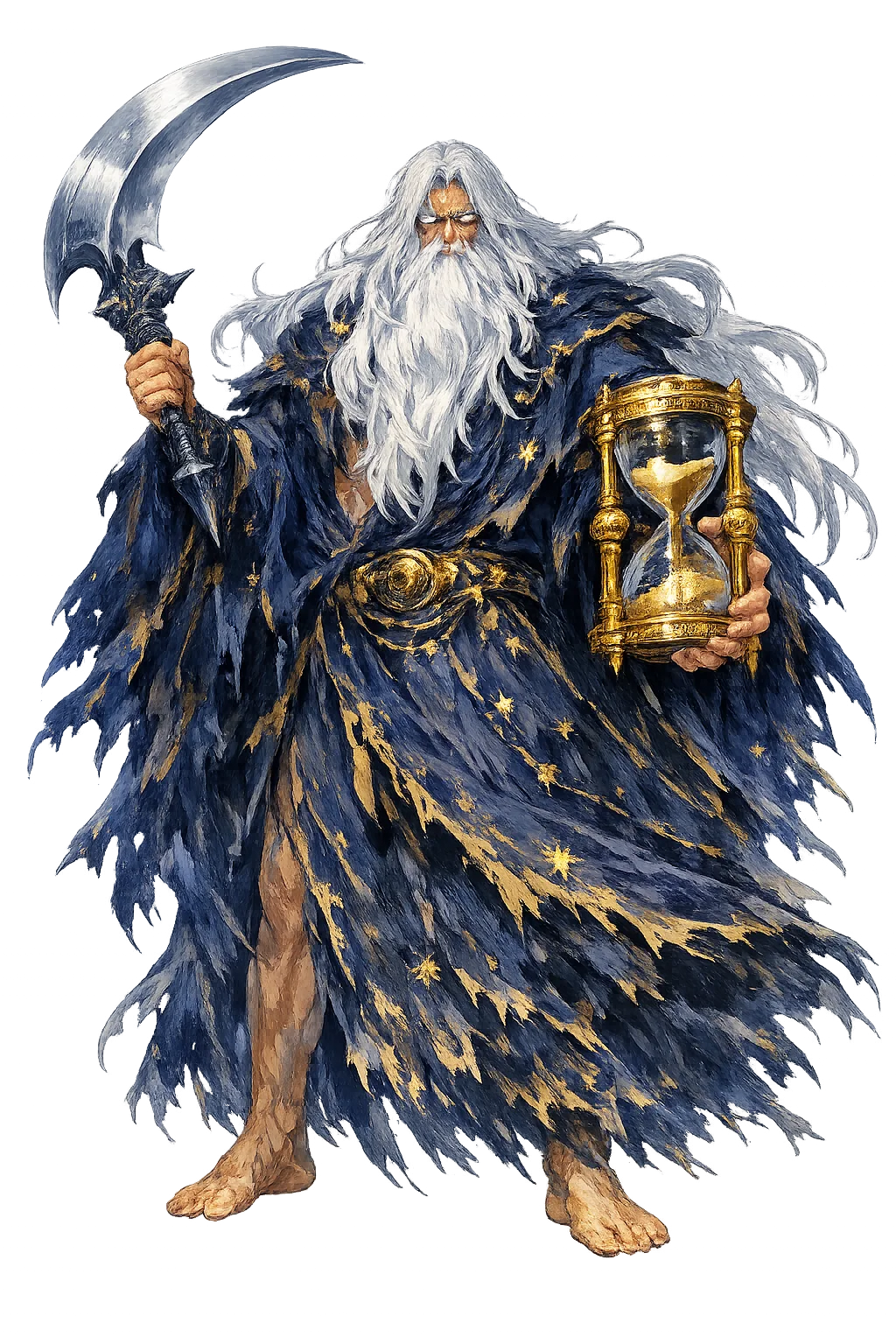
Kronos is oddly hard to see: the great usurper of Greek poetry almost never posed for Greek art. The earliest images are small and brutal — bronze shield-band reliefs from archaic Olympia, sixth century BCE, apparently showing him crouched in ambush for Ouranos, sickle in hand; the myth's violence was fit for votive hardware rather than temple walls. His identifying signs come from the texts: the sickle that reaps sky and grain alike, the crooked counsel. In Roman hands Saturn acquired a civic image — a robed elder enthroned, sickle in hand, as on coins and in the lost cult statue of the Forum temple, whose feet were bound in wool all year. Roman Mithraea housed a stranger claimant to his name: a lion-headed, snake-entwined figure gripping keys, read by modern scholarship as Kronos-Aion, master of time — an inference from his dominion, not a name the god himself bears. Once the conflation with Time was complete, the image froze for good: the bent old man with the long scythe, reaping mankind.

06

Reception & Transformation

The name after its own age — transmission, translation, survival

Afterlives

Kronos's second life was as an idea, and it ran through philosophy before art. Plato's Statesman made his reign the mirror-age — the cosmos turning backward, men sprung from the earth, flocks of daimones shepherding a people who needed neither law nor family: utopia, and deliberately without philosophy. Euhemerus then humanized him into a king of the golden age, a reading Christian antiquity happily kept. At Rome the golden age became politics: Virgil's fourth Eclogue promised that Saturnia regna would return, and his Evander showed Aeneas a Latium still living under Saturn's shadow; Ovid's opening lines gave the West its fixed picture of the age before toil. Macrobius' vast dialogue preserves the festival's lore into the fifth century, and the Middle Ages read the golden age as Eden's pagan twin. The image went to painting — Cranach's Golden Age, Wtewael's — and in 1818 Keats gave the fallen Titan his most moving modern scene, the dethroned Saturn sunk in 'shady sadness.' Comparative scholarship later mapped his eastern kin, and Hesiod's succession myth remains the most studied of its kind in the ancient world.

Identifications Across Traditions

The Romans identified Krónos with Saturnus (Saturn), an old Italic agricultural god whose temple stood at the foot of the Capitoline, and whose December feast, the Saturnalia — gift-giving, feasting, dice-playing, the temporary lordship of slaves — is the Golden Age staged as carnival (Macrobius, Saturnalia 1). The confusion with Khrónos, ‘Time’, began in Orphic and philosophical speculation and was complete by the Hellenistic age: Kronos, Time, and Saturn fused into the old man with scythe and hourglass who devours his children as the years devour our days. The Near Eastern comparative evidence is even older: the Hittite Song of Kumarbi (CTH 344, second millennium BCE) tells how the sky-god Anu is overthrown by Kumarbi, who bites off and swallows the offending organ — the direct eastern relative of Hesiod's scene, carried westward into Greek epic.

Modern Legacy

Krónos haunts Western imagination as Father Time. Goya's Saturn Devouring His Son turned the myth into an image of mortality and madness. The planet Saturn bears his Roman name; Saturday (Saturni dies) is his day, and Christmas sits, by scholarly argument, atop the Saturnalia's feast-date. In fantasy and science fiction, ‘Cronus’ and ‘Kronos’ name doomsday weapons, time-travel devices, and tyrant-gods; the scythe of the Grim Reaper descends from Saturn's sickle through the Time-conflation. His name underlies the scholarly words ‘chronology’, ‘chronicle’, ‘anachronism’. Yet the original Krónos was also the lord of a lost age of plenty — a reminder that every devourer was once a generous king, and that time, which consumes all things, also made them possible.

07

The Meditation

What Krónos means — beyond the dictionary

Krónos is the god of the inevitable replacement. He does not ask permission to succeed his father, and he does not forgive his son for succeeding him. In this he is the most honest of the gods: he admits that power is temporary, that every ruler becomes the obstacle the next generation must remove.

But Krónos is also the god of the harvest, and the harvest is time made visible. The sickle cuts the grain because the grain has reached its hour. His tragedy is that he tried to stop the cycle he embodied. To name him Krónos is to remember that time cuts down even the one who holds the blade.

08

Screen & Culture

Where Krónos echoes through film, television, and games — and how

09

Frequently Asked Questions

Common questions about Krónos, Time, Harvest, Titans, and Unicode restoration

01How do you pronounce Krónos?

In reconstructed pronunciation, Krónos is /kró.nos/ — approximately "KROH-nohs" — first syllable like "crow" without the w, second like "nose".

02What does Krónos mean?

Krónos means Youngest Titan, personification of time, who castrated and deposed his father Uranus before being overthrown by his son Zeus in the greek tradition.

03What are the symbols of Krónos?

Krónos is associated with Sickle/Harpē (The instrument of usurpation and harvest — one curved blade cuts the sky and the grain alike), Serpent (His kinship with the old chthonic powers; the devouring snake that seizes its prey whole is his animal), Golden grain (The wheat of the lost Golden Age, when earth bore fruit of itself and no one hungered), Swallowed stone (His single moment of blindness — the decoy that Rhea fed him, later the omphalos at Delphi), Scythe (The later, longer blade he acquired after the conflation with Time — from Saturn's sickle to Death's scythe).

04Why are there different spellings of Krónos?

Each form is a historically attested restoration rather than a mistake: krónos is the owned form (Lowercase owned domain form); Cronus is the alt form (Latinized spelling common in English). PUNICODEX registers the full set so the tradition is preserved under every defensible spelling.

05Why restore Krónos in Unicode?

Plain ASCII kronos strips the stress, length, and script that make the name specific. Unicode restoration returns the name to its original written dignity.

06What is the most important myth about Krónos?

“The Castration of Ouranos” — the The Usurpation story that anchors the mythology of Krónos, told in full on the lore page.

10

Scholarly Sources

The philological foundations of this restoration

Every claim on this page is grounded in established scholarship. The orthographic restorations follow disciplinary convention. The etymological chain follows the best available reference works. This is not invention — it is resurrection through scholarship.

◈

Lexicography & Philology

  • Liddell, H. G., Scott, R., & Jones, H. S. A Greek-English Lexicon. Oxford: Clarendon Press, 9th ed. 1996.
  • Pape, W., & Benseler, G. E. Wörterbuch der griechischen Eigennamen. Braunschweig: Vieweg, 1884.
  • Beekes, R. S. P. Etymological Dictionary of Greek. Leiden: Brill, 2010.
◎

Primary Texts

  • Hesiod, Theogony
  • Hesiod, Theogony 166–210, 453–491, 617–735; Works and Days 109–126
  • Pindar, Olympian 2.68–77
  • Apollodorus, Library 1.1.5–1.2.1
◉

Archaeology & Art History

  • Material evidence — iconography, inscriptions, and temple archaeology — for Krónos and related cults.
✦

Religious Studies

  • Macrobius, Saturnalia
  • Hittite Song of Kumarbi (CTH 344)
Return

The Surface Awaits

You have traced the name from its earliest attestation to its Unicode restoration. Now return to the myth. The story is where the name lives.

Back to Lore
Krónos mascot