The Living Myth
Time, Harvest, Titans · The Crooked-Sickle King · Devourer and Father of Gods
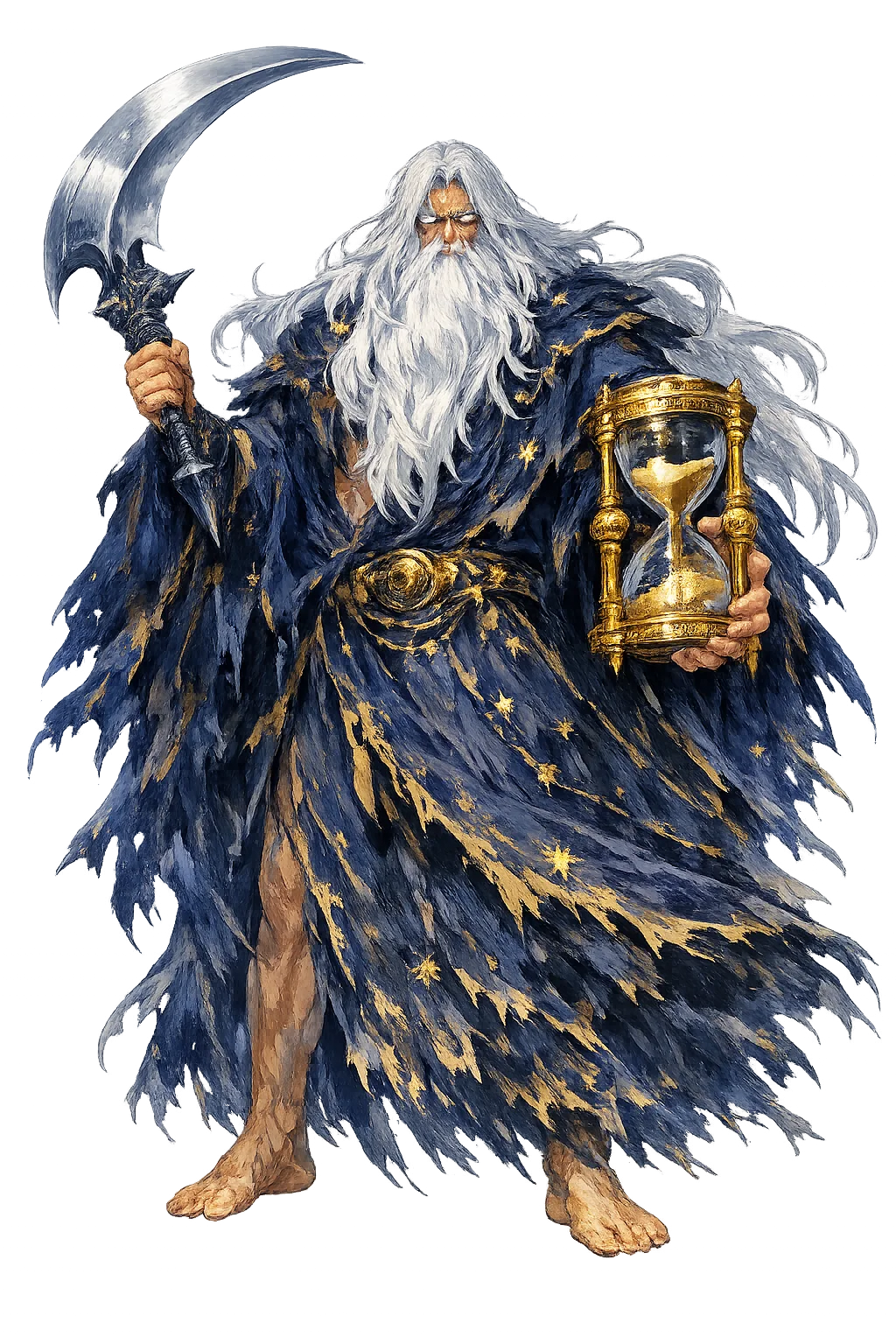
Stories of Krónos
Krónos is the hinge between the primordial gods and the Olympian order. His myth is the myth of generational succession — the son who overthrows the father and is in turn overthrown — and it is one of the most widely travelled stories in the ancient world.
When Ouranos hid his and Gaia's children inside their mother, Gaia fashioned a great sickle of grey adamant and appealed to her sons. Hesiod records the decisive detail: ‘all of them were glad in their hearts to hear the words of Gaia's treacherous speech — all, that is, but great-hearted Kronos, the crooked of counsel, who was the youngest’; the others feared their father, but Kronos the youngest dared (Theogony 166–172). Gaia hid him in ambush; when Ouranós came at evening and spread himself over Gaia, Kronos stretched out his left hand and in his right took the great long sickle with jagged teeth, and swiftly cut off his own father's genitals and cast them behind him (Theogony 173–182). From the falling blood came the Erinyes, the Giants, and the Meliai; from the foam where the members fell, Aphrodítē. Even defeated, Ouranós names his sons Titanes, ‘strainers’, for their strained ambition (Theogony 207–210). The myth means that every Greek regime begins in a crime the victor does not regret: Kronos does what the others fear, and inherits the world for it.
Power taught Kronos its oldest lesson: do to your children what was done to your father. Warned by Gaia and starry Ouranós that he was fated ‘to be overthrown by his own son, strong though he was’, he kept constant watch, and Rhéā bore him Hestía, Deméter, Hēra, Hádēs, and Poseidôn — each of whom he swallowed whole, straight from the holy womb (Theogony 453–467; Apollodorus 1.1.5–7). The belly became his fortress: the children did not grow old inside him, imprisoned in the living darkness of their father's stomach. When Zeus was born, Rhéā turned the trick: a stone in swaddling bands went down Kronos's throat instead, and the youngest son grew up in a Cretan cave. The myth means that devouring is a failed form of immortality — Kronos could swallow the future but could not digest it, and what he swallowed he eventually had to give back.
The decade-long war that decided cosmic government is the largest single episode of the Theogony (617–735). Zeus grew to manhood in Crete, took the Oceanid Mētis as counselor — she gave Kronos the emetic that made him disgorge the swallowed children, ‘the stone last of all’, which Zeus set up as a wonder and sign at Pytho (Apollodorus 1.1.7–1.2.1) — and then opened war on the Titans. For ten years the battle hung even, ‘with no advantage on either side’, until Zeus descended into the depths and freed the Cyclopes, who armed him with the thunderbolt, and the Hundred-Handers, whose hundred rock-showered arms overwhelmed the Titan line. The defeated Titans were bound in painful chains and cast beneath the wide-pathed earth, as far beneath as earth is beneath heaven, into misty Tartaros (Theogony 717–725). Hesiod gives Kronos no speech and no defense; he simply falls, as Ouranós fell before him. The myth means that Greek cosmogony is written by the winners — each revolution calls the previous age a tyranny, and each tyranny believes its own propaganda.
The Hesiod who damns Kronos also preserves the memory of his best age. In the Works and Days (109–126), the golden generation lived when Kronos reigned in heaven: mortals lived like gods, free of toil and grief, their earth spontaneously bearing fruit in lavish abundance; they feasted at ease and ‘died as if overcome by sleep’, and after death became pure daimones who walk the earth as guardians of justice. The Athenian Kronia kept this memory in ritual: a harvest festival of the twelfth of Hekatombaion in which, later authors report, slaves and masters dined together and social ranks dissolved for a day — Saturnalian inversion before the Roman Saturnalia gave it its famous form. The myth means that the devouring father and the generous king are the same god seen from different ends of time: every age of plenty is remembered as Kronos's, and every Kronos ends by eating his children.
Not every tradition leaves Kronos in chains. Pindar, in the great second Olympian ode (68–77), describes the afterlife reserved for those who ‘thrice on either side of death have kept their souls from all unrighteousness’: they dwell in the Isles of the Blessed by the deep-eddying Ocean, ‘where fair-haired Rhadamanthys has his seat, and where Kronos is enthroned as king’ — a region of unplowed meadows, trees that drip frankincense, and flowers of gold. In this Orphic-tinged eschatology the fallen Titan is not the devourer but the just ruler of the happy dead, his crime swallowed by time as he once swallowed his children. Plato's Gorgias (523a–524a) keeps Kronos's memory in the myth of judgment, where Zeus ends the age of judging the living and institutes judgment of the dead — the old order of Kronos remembered as the era before justice became visible. The myth means that even the worst father can be redeemed by enough centuries: Kronos finally rules the one place where no son grows up.
Harvest, Time, Sovereignty
Krónos is the youngest of the first-generation Titans, but he is the one who acts. He takes the sickle his mother gives him and cuts the sky. He swallows his children to stop time from replacing him. He rules a Golden Age that ends the moment his last son is born.
The curved adamant blade with which he castrated Ouranos — the same shape that cuts grain at harvest.
The Athenian Kronia linked him to grain and the year's abundance; the sickle is a reaper's tool before it is a weapon.
Kingship over gods and men during the mythic Golden Age, before the war that cast him down.
He swallowed his children whole to defeat the prophecy of his overthrow — and swallowed a stone instead of Zeus.
From the original script to the living URL
Κρόνος
The name in its original Greek form. Krónos (Κρόνος) is attested in the source tradition — “Youngest Titan, personification of time, who castrated and deposed his father Uranus before being overthrown by his son Zeus”. Its acute accents carry the full phonetic and orthographic weight of the source tradition.
kronos
Reduced to plain kronos, the name loses everything that made it specific: acute accents. What remains is an ASCII string that machines can parse but that no longer speaks with its original voice.
Krónos
The Unicode restoration recovers what ASCII flattened. Krónos restores acute accents, returning the name to its original written dignity. The domain encodes to Punycode, but the browser displays the truth.
Krónos.com → xn--krnos-1ta.com
The non-ASCII characters in Krónos are encoded while the ASCII remains visible. To the DNS, it is Punycode. To humanity, it is Krónos.
Owned, ideal, and ASCII forms of Krónos
Krónos
Restores Κρόνος. The live temple domain — krónos.com.
kronos
Flattens Κρόνος. The plain ASCII fallback — what DNS and legacy systems see.
How Krónos was spoken
How Krónos travels from ancient script to the modern URL
Greek Κρόνος; perhaps related to χρόνος “time" by later folk-etymology, but probably pre-Greek.
Time, Harvest, Titans
The Unicode restoration Krónos preserves Greek stress and length; the ASCII form kronos loses these features.
The lore you have read is the living myth. Extended Lore opens the scholarly vault beneath it: the cult and its material remains, a history of the image, the name after antiquity, a meditation on what the name still means, and the full scholarly apparatus — etymology, orthography, sources.
Enter Extended Lore