PuniCodex

Extended Lore

𒀭𒆥𒄖 Kingu

Etymology · Orthography · Cult · Iconography · Reception · Sources

Tier 2 Kingu
Kingu — Dragon, Consort of Tiamat
01

Quick Facts

Essential information about Kingu, Dragon, Consort of Tiamat

Original Script𒀭𒆥𒄖
Unicode RestorationKingu
Reconstructed Pronunciation/ˈkiŋɡu/
PantheonMesopotamian
DomainDragon, Consort of Tiamat
MeaningUnknown
ClassificationTier 2
Primary DomainKingu
Sacred SymbolsDragon body, Tablet of Destinies, Blood, Crescent blade
02

Etymology & Word Family

From original script to Unicode restoration

Original Script 𒀭𒆥𒄖 Kingu — "Unknown"
Unicode Restoration Kingu Canonical scholarly spelling — ASCII-identical
Modern ASCII kingu Plain-ASCII fallback

The name Kingu reaches the modern world through scholarly transliteration of the mesopotamian tradition. Because the conventional spelling uses only Latin letters, its Unicode and ASCII forms coincide — the tradition it carries is in the name itself, not in diacritics.

03

Unicode Character Breakdown

Character-by-character philological analysis

CharacterUnicodeNameBlockPhonetic Role
KU+004BLatin Capital Letter KBasic LatinSame, capitalized
iU+0069Latin Small Letter IBasic LatinSame
nU+006ELatin Small Letter NBasic LatinSame
gU+0067Latin Small Letter GBasic LatinSame
uU+0075Latin Small Letter UBasic LatinSame

The Tier 2 classification here reflects fidelity to the attested tradition, not recovered diacritics: every character of Kingu already survives in ASCII. What the restoration preserves is the canonical spelling itself — the form scholarship standardised.

04

Cult & Worship

How the sacred was kept — rites, sanctuaries, remains

The Cult

No one ever built a temple to Kingu, and no hymn invokes him. He exists in one composition, the Enuma Elish, as the enemy — and Mesopotamian religion gave its enemies the treatment he received: not worship but annual re-enactment of his defeat. At the Babylon New Year rite in the Esagila, the epic that names him was recited before Marduk, his seizure of the Tablet of Destinies narrated and annulled afresh each year. If anything like a cult touched him, it was this: the yearly confirmation that order holds. As with everything about Kingu, the evidence is textual — a ritual that kept his one shining, fatal promotion alive precisely by never letting him win.

In the Earth

Archaeological evidence for Kingu comes primarily from the cuneiform manuscript tradition of the Enuma Elish: tablets from the libraries of Nineveh (the 'Ashurbanipal collection'), Aššur, Babylon, and Sippar, where the epic was copied and recited at the Akitu, the Babylonian New Year festival that reenacted Marduk's investiture. The poem's account of Kingu receiving the Tablet of Destinies and his blood serving as the material of humankind is preserved in the Standard Babylonian version. Visual context for the monster-host he leads comes from the glazed-brick dragons and bulls of Babylon's Ishtar Gate and from contemporary cylinder seals, which teem with the serpents and dragon-beasts of Mesopotamian demonology — though no securely identified image of Kingu himself survives.

05

Iconography

How Kingu was imaged across the ages

The Image

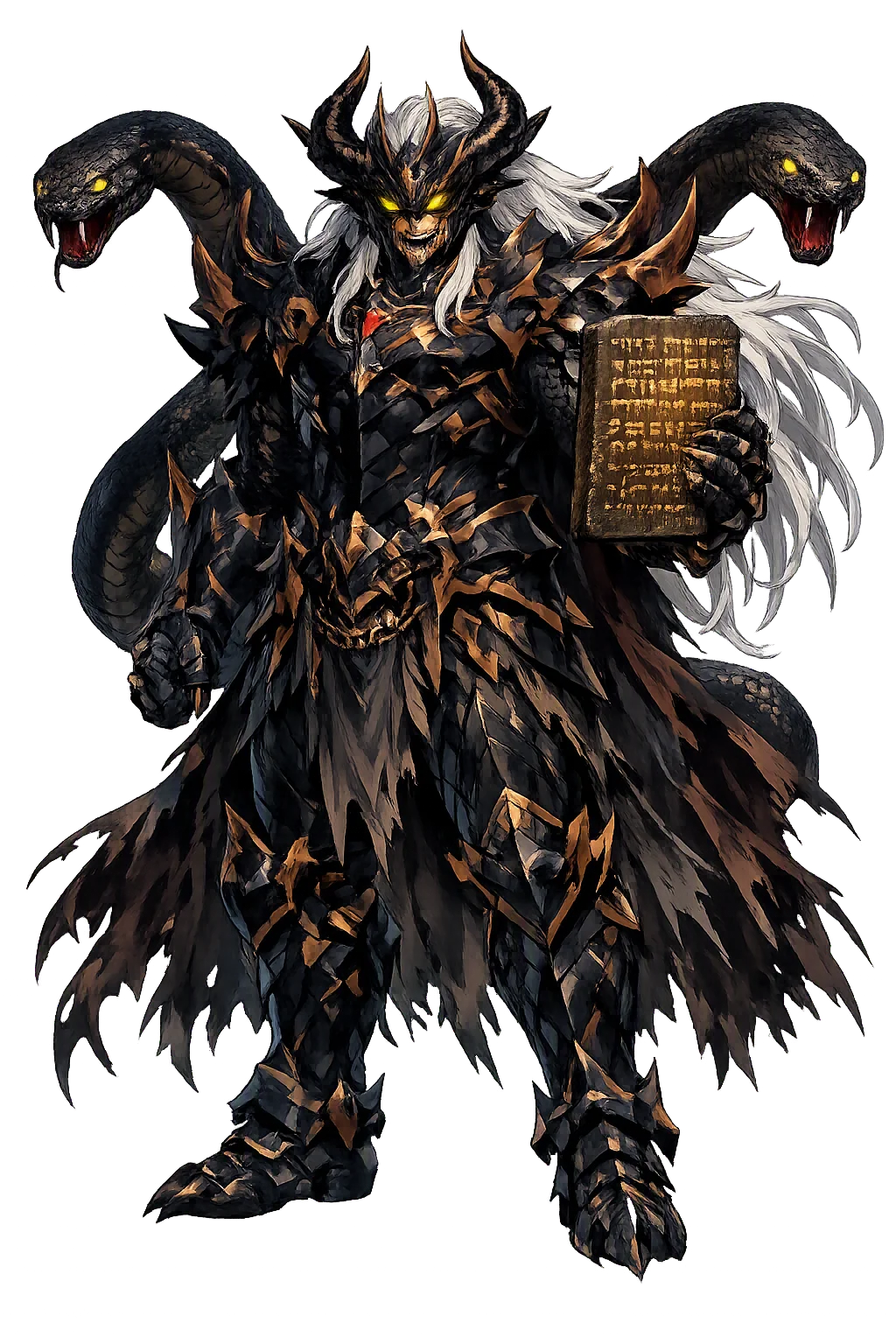
No image of Kingu survives, and none may ever have existed. The epic equips him with attributes rather than a body: the Tablet of Destinies fastened to his breast — the text says his orders were unchallengeable — and the command of Tiāmat's host, the horde of serpents, dragons, scorpion-men and storm-demons. Mesopotamian glyptic supplies those monsters in abundance: cylinder seals teem with the dragon-serpent mušḫuššu and with scorpion-men. Yet the irony is structural, for the mušḫuššu was sacred to Marduk himself — the god who kills Kingu wears the iconography of Kingu's army. On seals that show the combat with Tiāmat, a second figure sometimes stands behind the dragon-mother, and scholars have wondered whether an artist meant Kingu; no inscription confirms it. His portrait, in the end, is a gap in the corpus — the general of chaos, imagined only in words.

06

Reception & Transformation

The name after its own age — transmission, translation, survival

Afterlives

Kingu's afterlife is the afterlife of a library. His epic was copied in the seventh century BCE for Ashurbanipal's library at Nineveh, and there it slept for two and a half millennia until the mound of Kuyunjik yielded its tablets in the 1850s. George Smith electrified London in December 1872 by announcing the 'Chaldean Account of Genesis' — humanity created from the blood of a slain god — and the Daily Telegraph funded his return to dig for the missing tablets; his Chaldean Account of Genesis (1876) carried the Kingu passage to the public. Scholarship then gave the poem its frame: Leonard King's The Seven Tablets of Creation (1902) printed the cuneiform, Speiser's translation in Pritchard's Ancient Near Eastern Texts (1950) made it a syllabus staple, and Lambert and Parker's critical edition Enuma Eliš (1966), Foster's Before the Muses and Lambert's Babylonian Creation Myths (2013) keep refining the text. The discovery detonated in biblical studies — creation, flood, and chaos-battle all had Babylonian doubles — and Kingu, the rebel whose blood became humankind, became a permanent witness in the debate over Genesis's sources.

Identifications Across Traditions

Kingu is a specifically Babylonian figure, but his narrative pattern — the defeated dragon whose body becomes the stuff of human life — echoes across the Near East and beyond.

The closest parallel is Tiāmat herself: where she becomes the physical cosmos, Kingu becomes the biological substrate of humanity. In later Jewish and Christian traditions, the figure of a rebel bound and stripped of authority (Leviathan, the fallen angels) partially replays Kingu's defeat, and Gnostic and Manichaean mythologies similarly describe human bodies as fashioned from the matter of rebellious powers. In modern fantasy and games, Kingu survives as a dragon-general or dark consort archetype, usually conflated with Tiamat's own monstrous form. PuniCodex keeps the capitalized form 'Kingu' not as a reconstruction but as a philological placeholder: the name's etymology is unknown, and the ASCII form is the only form attested.

Modern Legacy

The myth of Kingu encodes several durable ideas: that chaos can be organized, that authority depends on the symbols of fate, and that human life is made from the remains of a defeated enemy.

The Tablet of Destinies — briefly worn by Kingu, then permanently by Marduk — became a template for later images of the book of fate, the sealed scroll, and the tablets of law. The idea that humanity was created from the blood or clay of a slain power appears in Greek (Prometheus's clay), Norse (the giant Ymir), and biblical traditions shaped by Mesopotamian models; the shadow of Kingu's sentence arguably falls on all of them. In popular culture he appears in role-playing games, trading cards, and fantasy novels as a dragon-lord or dark consort — usually stripped of his original cosmological function. PuniCodex keeps the name in its plain Assyriological form because there is no reconstructed diacritic to add; the unknown etymology is itself part of the entry's scholarly honesty.

07

The Meditation

What Kingu means — beyond the dictionary

Kingu endures because he is the enemy we cannot disown. No prayer was addressed to him, no temple raised; he exists in the Enuma Elish for perhaps a thousand lines, and nearly everything we know about him is something done to him — elevated by Tiāmat, given the Tablet of Destinies, defeated by Marduk, condemned by the assembly, and finally dismembered into the stuff of humankind. To meditate on Kingu is to sit with that passivity. He is chaos that dreamed of command, and the epic grants him just enough glory to make the verdict sting: for one shining interval, fate itself hung from his breast.

The deeper turn is the one few cosmogonies dare: humanity is not the victor's gift but the rebel's sentence. The Babylonians imagined their species as blood mixed with clay, built from the one who 'made war and suborned Tiāmat' — a creature whose restlessness, aggression, and longing for the tablet are, on this reading, inherited rather than chosen. Our mortality and our toil are the leftover interest of a war we did not fight. And yet the myth is not purely grim. Kingu is what happens to chaos when it is defeated well: it is not erased but repurposed, folded into order as its living foundation.

He offers the modern reader an uncomfortable mirror. Every civilization rests on materials it would rather forget — on subdued rivals whose substance became its people. Kingu, whose very name resists etymology, survives precisely as that reminder: the consort of chaos, remembered forever, understood almost not at all.

08

Frequently Asked Questions

Common questions about Kingu, Dragon, Consort of Tiamat, and Unicode restoration

01How do you pronounce Kingu?

In reconstructed pronunciation, Kingu is /ˈkiŋɡu/ — approximately 'KEENG-goo' — stress the first syllable; the middle consonant is a soft ng-sound, and the final vowel is rounded and firm.

02What does Kingu mean?

Kingu means Unknown in the mesopotamian tradition.

03What are the symbols of Kingu?

Kingu is associated with Dragon body (The monstrous form that opposes Marduk's cosmic order), Tablet of Destinies (The ṭuppi šīmāti, the badge of supreme authority Tiāmat briefly grants to Kingu), Blood (The material from which humanity is created after Kingu's defeat), Crescent blade (Kingu's martial role as general of Tiamat's army).

04Why restore Kingu in Unicode?

Kingu is written entirely in ASCII letters, so its restoration is about canonical fidelity rather than recovered diacritics: the temple fixes the name in its scholarly standard spelling, attested in the source tradition, instead of leaving it to drift.

05What is the most important myth about Kingu?

“Tiāmat Makes Kingu Her Consort” — the Elevation story that anchors the mythology of Kingu, told in full on the lore page.

09

Scholarly Sources

The philological foundations of this restoration

Every claim on this page is grounded in established scholarship. The orthographic restorations follow disciplinary convention. The etymological chain follows the best available reference works. This is not invention — it is resurrection through scholarship.

◈

Lexicography & Philology

  • Black-Green
◎

Primary Texts

  • Enuma Elish
  • Enuma Elish (Akkadian creation epic, Tablets I–VI), trans. Foster, Before the Muses, or Dalley, Myths from Mesopotamia
  • The Anzu Epic (parallel Tablet-of-Destinies tradition)
◉

Archaeology & Art History

  • Material evidence — iconography, inscriptions, and temple archaeology — for Kingu and related cults.
✦

Religious Studies

  • Lambert, W. G., Babylonian Creation Myths (2013)
  • Black & Green, Gods, Demons and Symbols of Ancient Mesopotamia, s.v. Kingu, ṭuppi šīmāti
Return

The Surface Awaits

You have traced the name from its earliest attestation to its Unicode restoration. Now return to the myth. The story is where the name lives.

Back to Lore
Kingu mascot