
The hidden history behind Keraunós
Behind the modern ASCII form keraunos hides a much longer story. Keraunós reaches back through manuscripts, inscriptions, and oral tradition long before it ever touched a keyboard, and every mark in the restored spelling is a receipt from that journey. In what follows we trace the name from its Greek attestations through its mythology, its cult, its symbols, and its afterlife in other cultures — and we show how the PuniCodex project turned that philological record into a Unicode domain that resolves today. The history was never lost. It was only waiting for the infrastructure to catch up.
At a Glance
- Restored name: Keraunós
- ASCII form: keraunos
- Meaning: "Thunderbolt (the weapon of Zeus)"
- Domain of influence: Thunderbolt
- Pantheon: Greek
- Classification: Tier 2
- Original script: κεραυνός (Greek)
- Live domain: keraunos.com
Overview
Keraunós (keraunos) — Thunderbolt · Thunderbolt (the weapon of Zeus) — belongs to the Greek tradition, where it is catalogued under the domain "Thunderbolt". The name means "Thunderbolt (the weapon of Zeus)".
Keraunós belongs to the Greek tradition, where it is associated with thunderbolt.
PuniCodex restores the name as Keraunós and serves its temple at keraunos.com. The original preserves one prosodic feature — stress or vowel length — rather than both, which places the name in Tier 2. The plain ASCII form keraunos survives as a modern convenience imposed by the early domain-name system; the restoration, not the fallback, is the form the project defends as philologically complete.
The Name
The name is attested in Greek as κεραυνός. Etymologically it means "Thunderbolt (the weapon of Zeus)".
The reconstructed proto-form is ker- (proto-indo-european, "to strike, horn"). Greek κεραυνός 'thunderbolt'; from κεραυνός, the smiting weapon of Zeus.
The ASCII form keraunos survives only because the early domain-name system could not carry diacritics; it is a technological compromise, not an ancient spelling. The Unicode restoration Keraunós recovers the stress accent of the original directly in the address bar. The original preserves one prosodic feature — stress or vowel length — rather than both, which places the name in Tier 2.
The letter-by-letter transformation runs:
- k → K — Kappa
- e → e — Epsilon
- r → r — Rho
- a → a — Alpha
- u → u — Upsilon
- n → n — Nu
- o → ó — Acute on omicron
- s → s — Sigma
The canonical temple for this name is served at keraunos.com.
Etymology & Roots
The recorded derivation reads: Greek κεραυνός 'thunderbolt'; from κεραυνός, the smiting weapon of Zeus.
The reconstructed proto-form is *ker- (proto-indo-european), glossed as "to strike, horn".
The reconstruction is classed as attested.
The Original Script
The name is written in Greek as κεραυνός. This original script is the form against which the ASCII fallback keraunos and the PuniCodex restoration Keraunós are measured: the restoration preserves its pitch accent of the written form, so that a reader typing the modern address still speaks the ancient name.
Pronunciation
The reconstructed pronunciation of the name is /keraunos/ — Greek Reconstruction.
Phoneme by phoneme:
- K — Initial character of the restored form Keraunós.
- eraunós — Remainder of the name, preserving the distinctive marks of the Greek tradition.
For the modern speaker, the closest approximation is: 'KERAUNOS' — pronounce the restored form with attention to the preserved diacritics and length.
Kindred and historical forms of the name:
- Greek — Keraunós, the restored Unicode form of the name
Keraunós is Tier 2 because the Greek form preserves distinctive features that ASCII loses: stress, length, or special characters.
Mythology
The stories of Keraunós circulate within the Greek corpus, where the figure embodies thunderbolt.
Primary Attestation (Sources)
Keraunós is attested in the canonical Greek sources as a figure associated with thunderbolt.
Name and Meaning (Etymology)
The name means "Thunderbolt (the weapon of Zeus)" and reflects the figure's role in the tradition. Keraunós is the thunderbolt itself, the weapon by which Zeus enforces cosmic law. In Hesiod and the Homeric poems the thunderbolt is not merely a meteorological event but a missile forged by the Cyclopes and entrusted to Zeus after the defeat of the Titans. Its flash marks the boundary between permissible and forbidden action; those struck by it are singled out by divine judgment. The epithet Keraunios attaches Zeus to this fearsome power and distinguishes him from the calmer sky-god of fair weather.
Symbols & Iconography
The iconography associated with Keraunós concentrates in a small set of recurring attributes, each a compressed statement about the name:
- Restored Name — The Unicode form Keraunós carries the original marks of the Greek tradition.
- Source Script — Attested in the original script as κεραυνός.
- Domain — Thunderbolt
- Etymology — Thunderbolt (the weapon of Zeus)
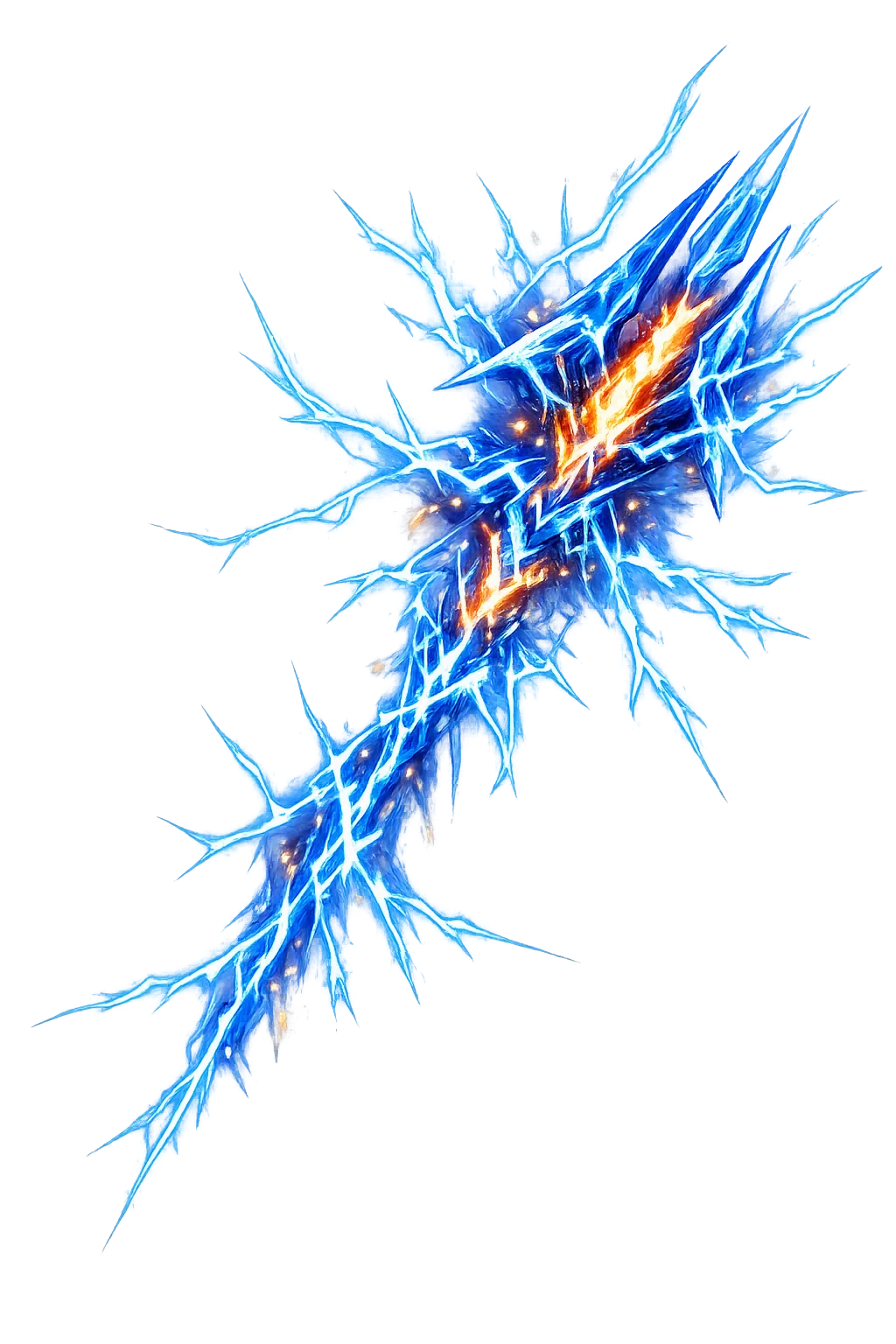
In Greek art the keraunós appears as a double-headed axe or a bundle of smoking thunder-darts with jagged zig-zag ends. Zeus hurls it in Gigantomachy scenes; Roman copies show Jupiter with the same weapon.
The bolt's form communicates instantaneous, irresistible force — the visual signature of cosmic justice.
Epithets & Cult Titles
Zeus bears thunderbolt epithets that pass to his weapon: Κεραύνιος (Keraunios, "of the thunderbolt"), Βρονταῖος (Brontaios, "of thunder"), and Τερπικέραυνος (Terpikeraunos, "delighting in the thunderbolt"). The keraunós is also called αἰθαλόεις (aithaloēis, smoky, blazing).
Each epithet stresses a different aspect of the bolt: its sound, its fire, and the pleasure Zeus takes in its use.
The Homeric Hymns
The keraunós — the thunderbolt — is the weapon the Cyclopes forged for Zeus and gave him in gratitude for their release from Tartaros, as recounted in the Theogony and echoed in the hymnic tradition. The Homeric Hymn to Zeus (no. 23) names him "greatest" and "fulfiller," the god whose will the thunderbolt executes.
The short hymn therefore presupposes the keraunós as the visible sign of Zeus's sovereign power.
Oracle Sites & Sanctuaries
Sanctuaries of Zeus Keraunios dotted the Greek world, especially on mountaintops exposed to lightning. At Olympia the altar of Zeus received thunderbolt-shaped offerings, while at Dodona Zeus spoke through his oak before the storm.
The thunderbolt thus linked oracular centres with the sky: the same god who hurled the keraunós also pronounced judgment through these shrines.
Archaeology & Evidence
The material record for Keraunós survives in a small number of securely identified remains, catalogued below; the corpus is thin but unambiguous, and each site is tied to the name by ancient testimony.
Keraunós is attested in the textual and iconographic record of the Greek tradition.
Realm & Domain
Keraunós belongs to the Greek tradition, where it is associated with thunderbolt.
Thunderbolt
The central domain of Keraunós in the greek tradition.
Thunderbolt (the weapon of Zeus)
The name signifies "Thunderbolt (the weapon of Zeus)".
Unicode Restoration
The restoration Keraunós recovers what plain ASCII keraunos flattens.
Original Attestation
Attested in the sources as κεραυνός.
Across Cultures
Keraunós appears within the Greek tradition and has influenced later retellings, artistic depictions, and scholarly study. The Unicode restoration preserves the name's distinctive orthography for contemporary use.
Within the Greek tradition, closely related names in the corpus include Achérōn, Achilleús, Adámas, Aḗr, Aithḗr, and Anánkē.
Cultural Legacy
Keraunós continues to appear in scholarship, art, and popular reception as a significant figure of the Greek tradition. Restoring the name in Unicode returns the original marks that ASCII removes. The thunderbolt remains one of the most durable symbols of sovereign power, from Roman imperial imagery to modern coats of arms and popular iconography.
The Scholarly Record
The account of Keraunós given in this edition rests on the witnesses and reference works listed below. Lexica and etymological dictionaries secure the form and meaning of the name; the literary and religious texts supply the narrative evidence.
- Liddell-Scott-Jones Greek-English Lexicon, 9th ed. with 1996 supplement, 1940. Full text
- Wörterbuch der griechischen Eigennamen, 3rd ed., 1863. Full text
- Etymological Dictionary of Greek, 2 vols., Brill, 2010. Full text
A Meditation
Keraunós embodies thunderbolt in the Greek imagination. The name's restoration is not merely cosmetic: it recovers the stress, length, and script that make the figure recognizable in the source tradition.
The Unicode Restoration
Keraunós is classified as Tier 2: the original carries only one of the two prosodic features — stress or vowel length — not both. The ASCII fallback keraunos still resolves everywhere, but it is the restored form that carries the name's full information. Across the 8 characters of the name, the restoration adjusts 1: 1 mark of stress (ó). That is the whole thesis of this temple: the marks are the message.
Character by Character
The journey from keraunos to Keraunós, one character at a time:
- k → K — Kappa
- e → e — Epsilon
- r → r — Rho
- a → a — Alpha
- u → u — Upsilon
- n → n — Nu
- o → ó — Acute on omicron
- s → s — Sigma
The Domain Name
The restored name is live as a working domain: keraunos.com. Behind the scenes the DNS carries it in punycode form — an ASCII-compatible encoding that lets a non-ASCII name travel the global network without breaking older infrastructure. The visitor sees Keraunós; the machines see the encoding. That duality is the engineering compromise on which the entire restoration rests, and it is why a name written the way its own tradition wrote it in Greek can now be typed into any browser on earth.
The Greek Pantheon
Keraunós is one of 274 entries the PuniCodex lexicon catalogues under the Greek pantheon. The Pantheon page gathers the tradition's major figures in one place, and the Lexicon lets you filter all 974 restorations by tradition, tier, or script — the fastest way to see where this name sits among its kin.
Frequently Asked Questions
What does Keraunós mean? The traditional gloss is "Thunderbolt (the weapon of Zeus)."
Which tradition does Keraunós belong to? Keraunós is catalogued in the Greek pantheon of the PuniCodex lexicon.
Why is Keraunós classified as Tier 2? Because the original carries only one of the two prosodic features — stress or vowel length — not both — and the marks in the restored spelling preserve exactly that evidence.
Is Keraunós a working domain? Yes — keraunos.com resolves today and routes to this temple.
Can I use Keraunós in a normal browser? Yes. The DNS resolves the punycode form automatically, and the type tool on this site converts keraunos to Keraunós for copying and pasting.
Where does the scholarly information come from? The entry is built from lexica, inscriptional evidence, and reviewed scholarly sources listed in the Scholarly Edition. Every claim is traceable to a canonical source.
Typing Keraunós
You do not need a special keyboard to use this restoration. The PuniCodex Type Tool converts the ASCII form keraunos into Keraunós as you type, and the browser extension offers the same conversion inside any text field. Copy the restored form, paste it into the address bar, and the DNS does the rest.
Sister Temples
Other temples in the Greek pantheon include Epistḗmē, Éris, and Êthos — each with its own restoration story, its own scholarly record, and its own place in the lexicon.
Why This Restoration Matters
The story of Keraunós did not end in antiquity; it changed medium. Names that survive for millennia do so because each generation finds a new carrier for them — clay, papyrus, print, and now DNS. The PuniCodex restoration simply makes the carrier honest: the spelling that resolves is the spelling the evidence supports. If this post showed anything, it is that keraunos and Keraunós are not the same name with different styling. They are a summary and the text it summarizes. The web can now serve the text.
Explore Further
This post is one doorway into the temple. The home page carries the full character breakdown and the ambient canvas; the lore page tells the myths in long form; the Scholarly Edition preserves the sources, pronunciation data, and revision history; and the patron wall supports the restoration directly. For the wider map, browse the Lexicon, explore the Pantheon, or return to the PuniCodex blog.
A Closer Look at the Marks
A restored name is a small map. In Keraunós, the journey from the ASCII fallback keraunos to the Unicode form can be read letter by letter, and each letter tells a story. Of the 8 characters, 7 remain unchanged; they anchor the name to its modern shape. The remaining adjustments recover marks the source tradition used to distinguish this name from every other word built from the same letters.
The k stays as it is — Kappa.
The e stays as it is — Epsilon.
The r stays as it is — Rho.
The a stays as it is — Alpha.
The u stays as it is — Upsilon.
The n stays as it is — Nu.
The o becomes ó — Acute on omicron.
The s stays as it is — Sigma.
Together these changes are not decoration. They are the minimum set of marks needed to keep the name legible in its own tradition. Remove them and you still have a string of letters; you no longer have the name as it was written.
Keraunós in Its Tradition
Keraunós does not stand alone. It belongs to the Greek tradition, where it is counted among 274 names in the PuniCodex lexicon. Its sphere — Thunderbolt — places it beside other figures who govern similar aspects of experience. The restored spelling is therefore not only a philological decision; it is a way of keeping the name in the company of its kin. When the address bar shows Keraunós, it marks the boundary between a generic search term and a named entry in a living catalog of myth. That catalog is the point of the project. Every restored name is a vote for specificity: the web should know the difference between a figure and a keyword, between a tradition and a trend. Keraunós is one such vote.
What You Will Find in the Temple
The temple page for Keraunós is more than a landing page. The home tab presents the character breakdown, the pronunciation guide, and the live domain status in a single view. The lore tab gathers the myths and narratives that give the name its depth. The Scholarly Edition tab publishes the sources, variant forms, and review history that justify the restoration. Industry patterns show where the name appears in modern commerce and culture, while the gallery and creatives tabs collect visual and sponsor material. The patron wall lets visitors support the restoration directly. Each tab is generated from the same canonical sources, so the domain, the blog, the scholars page, and the search index all agree. The result is a single source of truth about a name, delivered through several doors.
The Restoration on the Live Web
A domain name is a kind of publication. When Keraunós resolves, it proves that the restored spelling is not a theoretical exercise; it is a working address on the public internet. Search engines can index it, language models can encounter it, and anyone who copies it from a manuscript can paste it into a browser. That practical reality changes the status of the restoration. Before Unicode domains, a scholar could write the name correctly in an article while the public web flattened it to keraunos. Now the public web can carry the correct form end to end. The punycode translation happens silently, so the infrastructure remains compatible while the visible name keeps its marks. That compromise — human-readable restoration, machine-readable encoding — is the foundation of every PuniCodex temple.
Related Names
Sources
The full scholarly apparatus — every citation, revision, and review — lives in the Scholarly Edition. Key references for this post:
- Liddell-Scott-Jones Greek-English Lexicon, 9th ed. with 1996 supplement, 1940.
- Wörterbuch der griechischen Eigennamen, 3rd ed., 1863.
- Etymological Dictionary of Greek, 2 vols., Brill, 2010.
- Hesiod, Theogony 139–146 and 501–506.
- Homeric Hymn 23 to Zeus.
- Homer, Iliad 8.133; 14.416 (keraunos and epithets).
- Lexicon authorities for this entry: LSJ, Homer.