The Living Myth
Violent Death, Doom, Fate · The Dark Angel · Minister of Doom
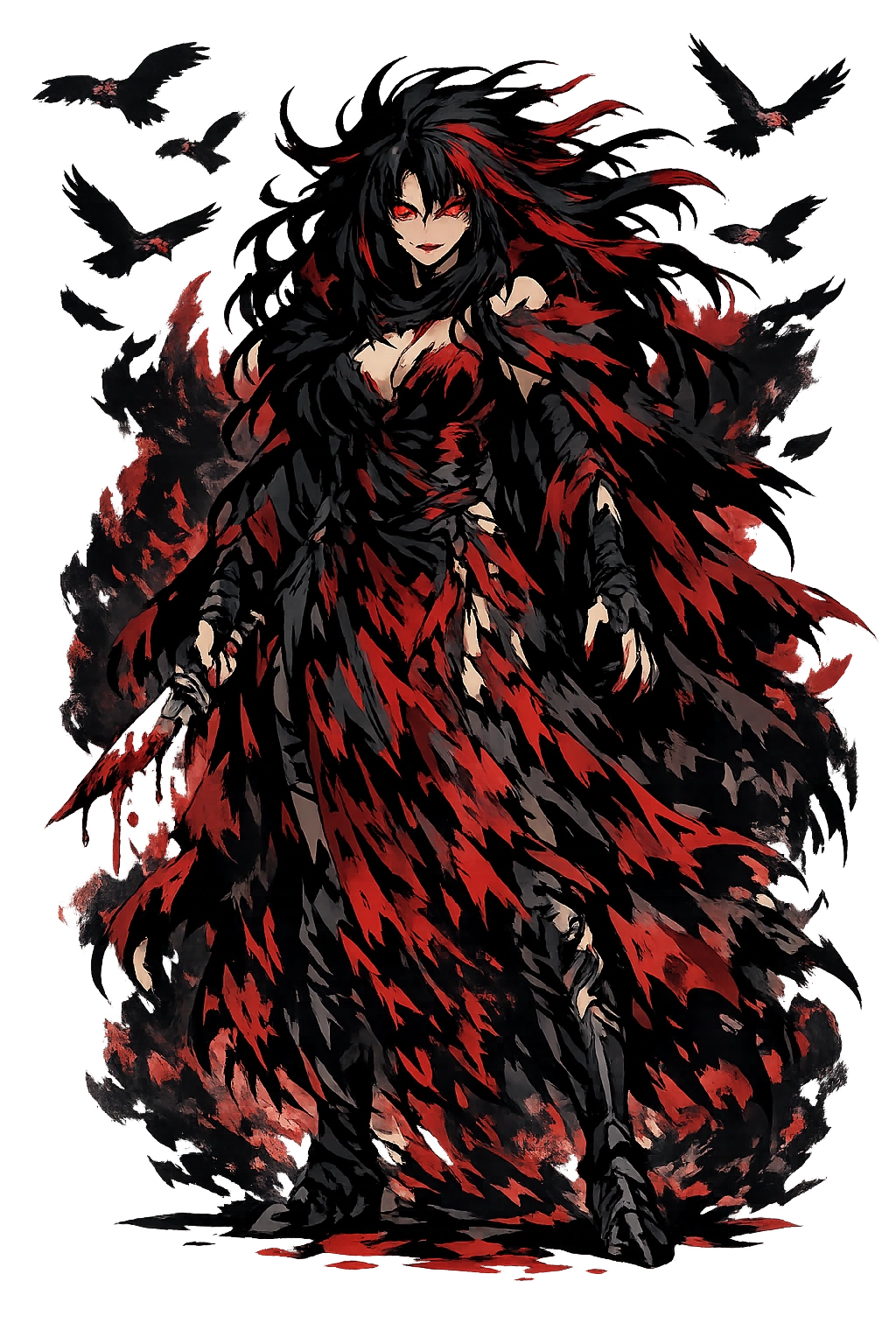
Stories of Kēr
Kēr has no coherent biography because she is not a person but a function: the personification of the moment death happens. She appears most vividly in the Iliad, in Hesiod's genealogy of Night's children, and on Attic vases; every source agrees on the essentials — wings, claws, and appetite.
The kēres arrive at full strength in Homer's description of Achilles' shield. In the battle frieze, the poet fixes them with a few terrible strokes: among the combatants stride Eris and Kydoimos and destructive Kēr, 'holding fast one man alive and newly wounded, another unwounded, and dragging by the feet a dead man out of the carnage — the garment on her shoulders red with the blood of men' (Iliad 18.535–540). Hector supplies the swarm's theology: 'About us stand the kēres of death in their thousands, which no mortal may escape or flee — so let us go, whether to give glory or to win it' (Iliad 12.326–328). The kēres are not judges and not punishments; they are consumers with appointments. Homer's image fixes what the name means: violent death is not an event but a population — always present, always fed, indifferent to who provides the meal.
The word's other Homeric face is personal. Achilles, told that his arms will decide the war, answers that two kēres are carrying him on toward the doom of death: if he remains and fights about Troy, he loses his homecoming but his glory will be imperishable; if he voyages home, his glory perishes but his life will be long (Iliad 9.411–416). Here the kēres are not a swarm but a pair of private escorts, one for each possible death, and the hero's whole tragedy is the choice between them. The passage shows Greek thought at a hinge: fate is still plural, still fleshy, still something that carries a man like a litter-bearer — but it is already on its way to becoming the single, singular destiny later philosophy will call moira. Kēr is the older, darker word: your death not as a sentence passed but as a being already waiting.
Hesiod supplies the genealogy. In the Theogony (211–225), Nyx — Night — bears a procession of abstractions without a father: first Moros, 'Doom', and black Kēr, then Thanatos (Death) and Hypnos (Sleep), then the Dreams, Blame, Woe, the Hesperides, the Moirai (Fates), Nemesis, and the rest of Night's grim household. Kēr stands second, immediately after Doom itself: in the divine economy of the Theogony, violent death outranks even its gentler siblings. The point of the genealogy is generational. Night's children are older than the Olympians, uncreated by Zeus and ungoverned by him; when Apollo or Ares walks a battlefield, it is Night's daughter who completes the work. Later Greeks would rationalise the kēres into agents of the Moirai — executioners of a sentence — but Hesiod's ordering preserves the more ancient terror: before there were fates to decree death, there was already Kēr, waiting in the dark.
Attic vase painters of the sixth and fifth centuries BCE gave the kēres bodies. On black-figure battle scenes — above all the Tyrrhenian amphorae — they appear as small winged women with the claws of birds, hovering at the shoulders of doomed warriors and dragging souls away by the hair. Art historians connect them to the Etruscan Vanth, the winged female death-demon painted in tombs, and through her to a whole Mediterranean grammar of winged death-spirits. The classical city meanwhile worked to keep them at a distance: funerary rites purified the house of death's taint, and tragedy keeps Kēr mostly offstage, present in the word kēr ('doom') rather than the apparition. Christian late antiquity completed the transformation: one destroying angel replaces a thousand keres, and death becomes a message instead of a weather. The winged demoness survived only in scholarship and on the vases, where she still drags her dead.
Doom, Battlefield Death, and the Keres
Kēr is not the underworld itself but the moment and agent of violent death. In Homer, the kēres swarm over battlefields, eager for blood. They are dark, winged, and insatiable — the vultures of mortality that no hero can finally escape.
She claims those who die in battle, by accident, or before their time — not peaceful old age.
The kēres fly over battlefields like carrion birds, choosing their victims.
She carries out the portion of death allotted by Moira; she is execution, not decision.
In Homer and later vase painting, the kēres lap blood from the wounds of the slain.
Later tradition split over whether the kēres execute the Moirai's decrees or act as independent powers; Homer and Hesiod preserve the older, freer conception.
From the original script to the living URL
Κήρ
The name in its original Greek form. Kēr (Κήρ) is attested in the source tradition — “Doom, violent death (from κήρ)”. Its long vowels and acute accents carry the full phonetic and orthographic weight of the source tradition.
ker
Reduced to plain ker, the name loses everything that made it specific: long vowels and acute accents. What remains is an ASCII string that machines can parse but that no longer speaks with its original voice.
Kēr
The Unicode restoration recovers what ASCII flattened. Kēr restores long vowels and acute accents, returning the name to its original written dignity. The domain encodes to Punycode, but the browser displays the truth.
Kēr.com → xn--kr-wma.com
The non-ASCII characters in Kēr are encoded while the ASCII remains visible. To the DNS, it is Punycode. To humanity, it is Kēr.
Owned, ideal, and ASCII forms of Kēr
Kēr
Restores Κήρ. The live temple domain — kēr.com.
Kḗr
Restores Κήρ. Stacked macron+acute on the stressed long vowel, matching Greek Κήρ; philologically ideal but often untypeable on phones.. Not in the PuniCodex collection.
ker
Flattens Κήρ. The plain ASCII fallback — what DNS and legacy systems see.
How Kēr was spoken
How Kēr travels from ancient script to the modern URL
Greek Κήρ; from κήρ “doom, violent death"; a spirit of destruction.
Violent Death, Doom, Fate
The Unicode restoration Kēr preserves Greek stress and length; the ASCII form ker loses these features.
The lore you have read is the living myth. Extended Lore opens the scholarly vault beneath it: the cult and its material remains, a history of the image, the name after antiquity, a meditation on what the name still means, and the full scholarly apparatus — etymology, orthography, sources.
Enter Extended Lore