
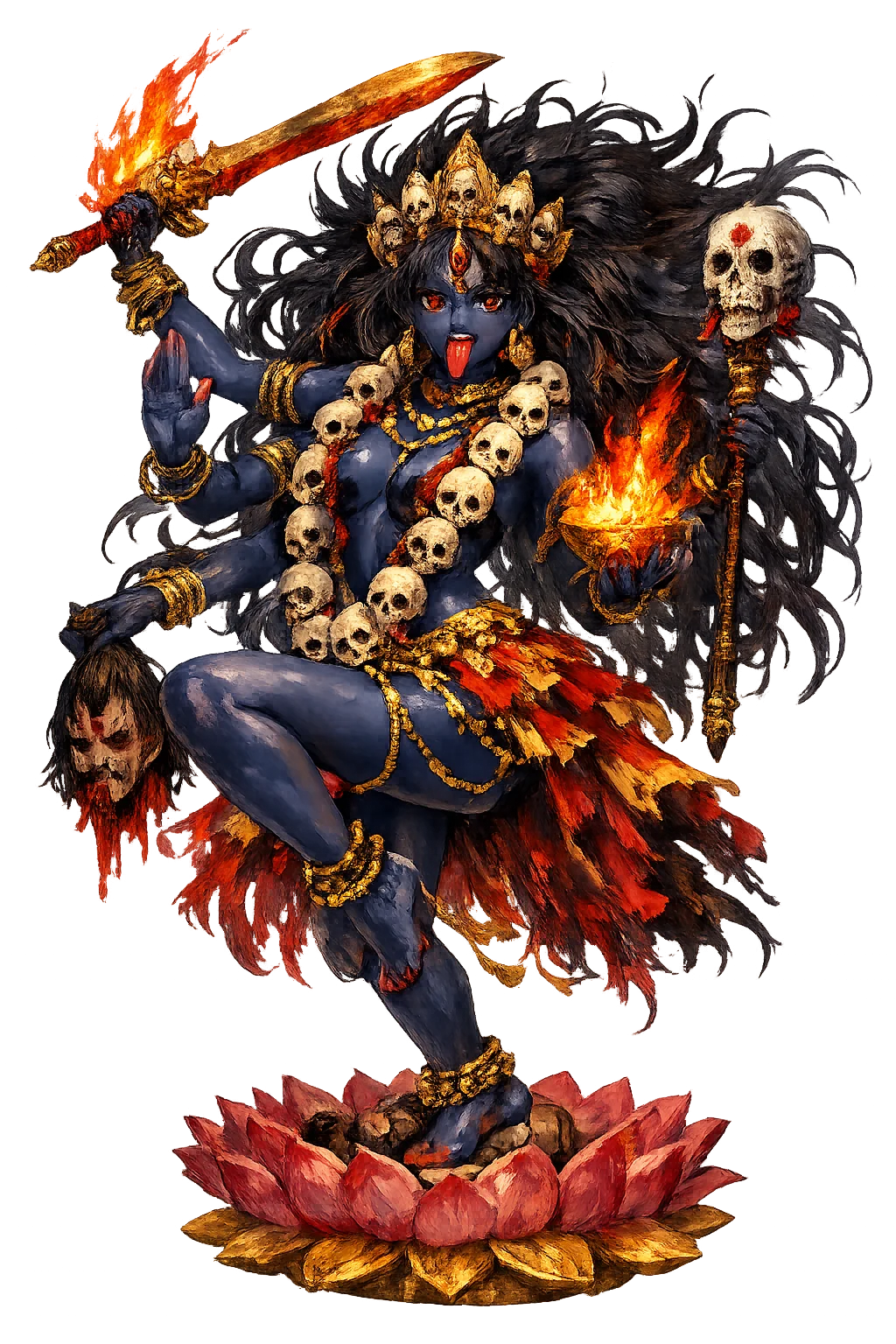
How Kālī was rebuilt, mark by mark
The workshop file for Kālī. Every rejected form is recorded here too — that is the point of keeping notes.
What We Found
The attestation runs through the tradition's own sources: काली. Meaning: "The Black One — the fierce goddess of time and destruction, consort of Śiva (fem. of kāla)".
The figure behind the name: Kālī enters scripture mid-battle, leaping from Durgā's brow in the seventh chapter of the Devī-Māhātmya, and she never quite leaves.
What the Name Carried In
From the Brow of Durgā. In the war against Śumbha and Niśumbha, the demon Raktavīja seemed unkillable: every drop of his blood that touched the ground spawned another warrior as strong as the first, and Caṇḍikā's arrows multiplied him faster than she could cut him down. Then, as the Devī-Māhātmya (ch.
The Demon Only a Woman Could Kill. The Kālikā Purāṇa, the great scripture of Assamese Śāktism, tells of Dāruka, a demon so favored by his austerities that the gods could not touch him — until a flaw in his boon was found: only a woman could kill him. As he tormented the worlds, Kālī went to war, and the text lingers on her armies, her weapons, and her fury.
A spelling that has to carry stories like these is not a label. It is equipment.
Where It Stood Before Us
Kālī's archaeological footprint grows in medieval Bengal and the Deccan. Pala-Sena stone and terracotta images from Bengal and Bihar (10th–12th centuries CE) show her with protruding tongue, skull garland, and severed head. The Kālīghāṭ temple in Kolkata and the Dakṣiṇeśwar Kālī temple built by Rani Rashmoni (1855) anchor her modern cult. Kerala's Bhadrakālī temples preserve blood-offering rites, and Nepalese sculptures display her Tantric iconography. The bench inherits all of it — the web temple is the newest site, not the first.
What We Kept
The evidence, mark by mark — 2 features the keyboard form kali cannot hold:
- a → ā — Macron: long a. Kept.
- i → ī — Macron: long i. Kept.
What We Rejected
The plain ASCII kali — admissible as a fallback, never as the primary. A wrong accent would have been worse: the rulebook is explicit that a misplaced mark is worse than none.
What We Set Down
Kālī — The restoration preserves more than the ASCII form can express — stress, length, or a letter the Latin keyboard lost — which places it, mechanically, in Tier-1.
For the voice: 'KAH-lee' — both vowels are long and clear, the first like the 'a' in 'father' held out, the second like 'lee'.
The temple stands at /kali/ — the notes above are public in its Scholarly Edition, sources and all.
At a Glance
- Restored name: Kālī
- ASCII form: kali
- Meaning: "The Black One — the fierce goddess of time and destruction, consort of Śiva (fem. of kāla)"
- Domain of influence: Time, Destruction, Empowerment
- Pantheon: Sanskrit
- Classification: Tier 1
- Original script: काली
- Series: The Restoration Files, No. 253 of 546
The File Continues
The temple's founding dispatch tells the name's story; its Resonance File reads the myths into the industries; the blog index holds the whole archive.
Continue the series — previous file: Kai (read it here) · next file: Kamapuaa (read it here).
The Restoration Files are written from the same canonical record as the temples themselves: the lexicon, the lore catalog, the pattern atlas, and the cited scholarly sources. If a file ever disagrees with its temple, the temple is right — tell us, and the file will be corrected.