Stories of Kai
Kai's mythology lives in the oldest stratum of Welsh Arthurian tradition: Culhwch ac Olwen gives him the tale's largest dossier after Arthur himself, and the fragmentary dialogue poem Pa Gur remembers exploits the prose never told. The later Latin and French traditions kept the man and quietly spent the magic.
When Culhwch comes to Arthur's court to win Olwen daughter of Ysbaddaden Chief Giant, Arthur grants him help, and the first companion named is Cei son of Cynyr. The warrior-list fixes his peculiarities in one breath: nine nights and nine days he could be under water; nine nights and nine days he could go without sleep; a wound from Cei's sword no physician could heal. Cei the Tall — when it pleased him he could make himself as tall as the tallest tree in the forest. And the list adds the attribute the whole fellowship depended on: when the rain was heaviest, whatever he carried in his hand stayed dry for a handbreadth above and below, so great was his heat; and when the cold was hardest on his companions, he was fuel to them to light their fire. The list also preserves his mother's prophecy that his heart would be cold — the oldest trace of the coldness the later romances turned to mockery.
Two of the hardest anoethau — the 'things hard to get' that Ysbaddaden sets as the bride-price — fall to Cei. To free Mabon son of Modron from his prison at Caer Loyw, the company follows the oldest animals to the Salmon of Llyn Llyw, and Cei and Bedwyr ride up the Severn on the salmon's shoulders; while Arthur's men assault the fort from the front, Cei carries Mabon away on the salmon's back. And when Arthur's band comes to the hall of Wrnach the giant, whose sword is needed to hunt the boar Twrch Trwyth — no guest had ever left that hall alive — Cei claims to be a master polisher of swords. Admitted, he burnishes the giant's blade, asks to hold it to test the work, and strikes Wrnach's head off with his own sword; the company destroys the fortress. The wonder-hero's greatest feats in the tale are won with a craftsman's hands, not a charge of horse — a hint of how the tradition will later make him the man who keeps the tools, not the one who swings them.
The beard of Dillus the Bearded was wanted to make a leash for the whelp Drudwyn, and Cei and Bedwyr found the giant alone. Cei dug a pit, tricked Dillus into it, plucked his beard out with wooden tweezers, and killed him afterward — and Arthur, watching, sang an englyn mocking Cei for making a leash from a living beard he could never have taken from a healthy man. Cei answered nothing, but the tale records the consequence in a line: because of that englyn there was enmity between Cei and Arthur ever after. The tale gives him no further feat of note; the fellowship's first companion becomes its first estrangement. The closing tally keeps the ending: Gwyddog son of Menestyr slew Cei, and Arthur slew Gwyddog and his brothers to avenge him — the rift repaired only in vengeance, and too late for either of them to enjoy it. It is the oldest Arthurian story about how a court breaks: not by siege, but by a joke aimed at the wrong man's pride.
The fragmentary dialogue poem Pa Gur yv y Porthaur?, preserved in the Black Book of Carmarthen, shows Arthur and the gatekeeper Glewlwyd Mighty-grasp trading boasts, and the boasts are Cei's: Cei pierced nine witches, and Cei the Fair went to Anglesey to destroy the monster the Welsh called Cath Palug — the gigantic cat that the triads say was born of the sow Henwen and raised by the sons of Palug as one of the island's plagues. The poem breaks off in the middle of that account, and scholars read the torn ending as the oldest trace of Cei's own death-fight. The early verse remembers him where the prose does not: as the champion sent against the things no one else would face — witches in their coven, a cat the size of a calf on an island shore. Behind the steward of the romances stands this older figure, the one whose dossier needed only a fragment to prove it: where the road was worst, the tall man went first.
Geoffrey of Monmouth, writing about 1136, Latinizes him as Caius dapifer — Kay the steward — and gives him the seneschal's office and the province of Anjou at Arthur's plenary court at Caerleon, while Bedwerus the cupbearer receives Normandy. In Geoffrey's Roman war Kay fights as duke, is killed in the great battle against Lucius, and dies; Geoffrey says he was buried at Chinon, the castle he himself had built, mourned by the whole army. The magic is gone — no nine days' breath, no fire in the hands — but the office Geoffrey fixed to the name proved more durable than any peculiarity: from this book onward, Kay is the steward of Arthur's court in every language that tells the story. What the Welsh gave as a wonder, the Normans received as a job title — and the job title is what survived, in French, English, German, and every retelling since, a thousand years of comic stewards standing on the shoulders of the tall man who kept the fire.
The Nine Days' Breath, the Fire in His Hands, and the Sword No Physician Can Heal
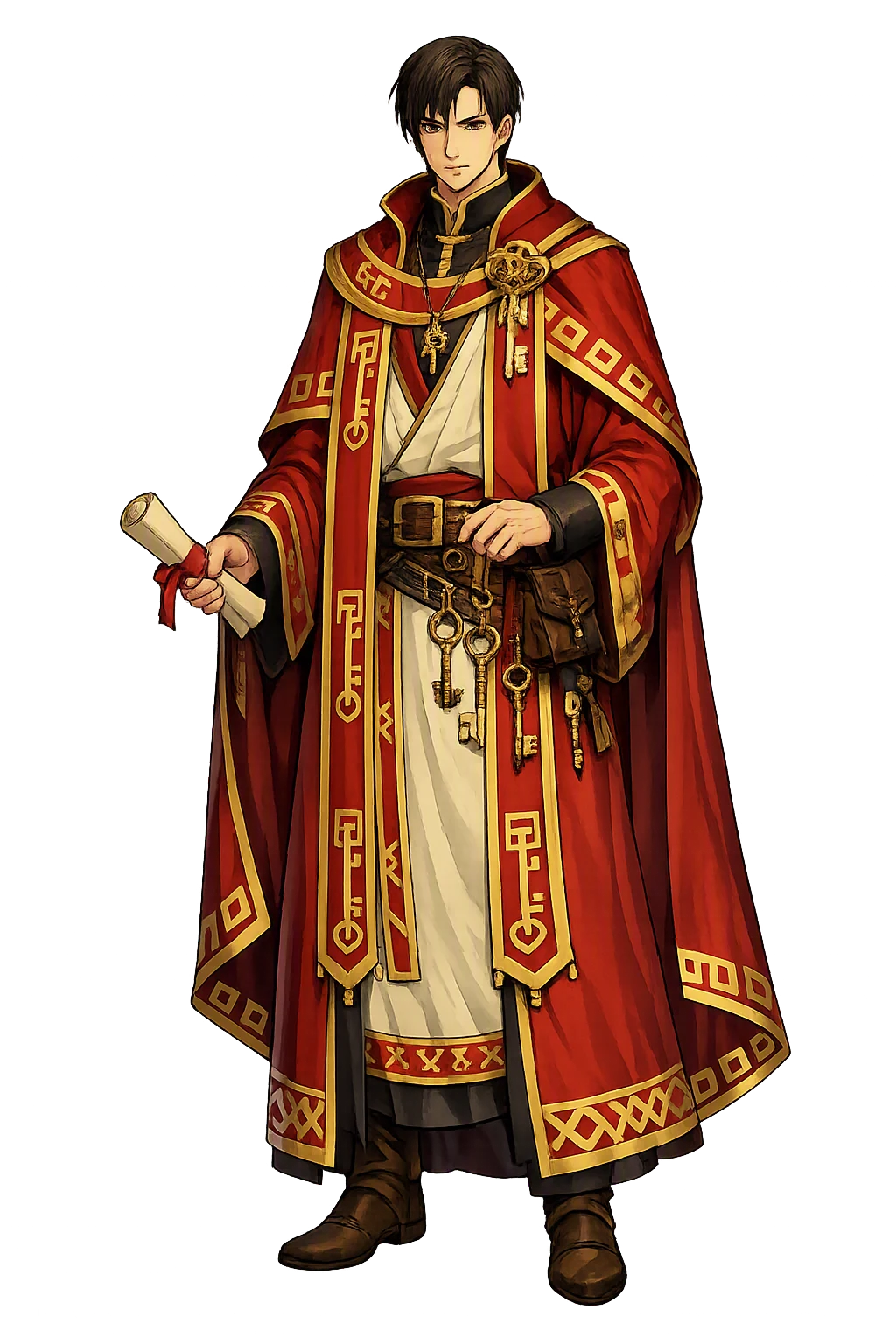
Cei son of Cynyr is the first companion Arthur assigns to Culhwch: the tall man of the Mabinogion's oldest Arthurian tale, who could hold his breath nine nights and nine days under water, go nine nights and nine days without sleep, deal a wound no physician could heal, grow as tall as the tallest tree in the forest, and carry so much heat in his body that rain dried a handbreadth above and below his hand and his companions lit their fires from him in the cold. Centuries of romance would remember him as the steward of the court — the seneschal Kay.
Nine nights and nine days under water; nine nights and nine days without sleep — the Mabinogion's measure of the tall man's endurance.
His heat kept his hand dry a handbreadth in the hardest rain; in the bitterest cold he was fuel for his companions' fire.
A wound from Cei's sword no physician could heal — and the sword of Wrnach the giant came into Arthur's hand by Cei's trickery.
Geoffrey of Monmouth's Caius dapifer — steward of Arthur's household, given Anjou, buried at Chinon: the office the later romances never let him leave.
From the original script to the living URL
Kai
The name survives in scholarly transliteration. Kai is the standard Celtic romanisation, documented in academic sources — “Unknown”. Because the spelling uses only Latin letters, the form is the same in both ASCII and Unicode.
No indigenous writing system is securely attested for individual celtic names. The form shown is a modern scholarly transliteration.
kai
The plain kai form is identical to the Unicode restoration. Because this name is already written in Latin letters, no diacritics, stress, or script information were lost — only capitalization differs.
Kai
The Unicode restoration does not need to recover lost marks for Kai. Its value is canonical spelling and consistent cataloguing, not the reconstruction of erased orthography. The domain is readable as-is to both DNS and humanity.
Kai.com
This restoration is written entirely in ASCII letters — no Punycode encoding stands between Kai and the DNS. The domain reads identically to machines and to human eyes.
Owned, ideal, and ASCII forms of Kai
Kai
The full Unicode restoration. kai.com is not in the PuniCodex collection — it is watched for release; if it drops, this temple upgrades to an owned flagship.
How Kai was spoken
How Kai is preserved in writing
No indigenous writing system is securely attested for individual celtic names. The form shown is a modern scholarly transliteration.
Contribute scholarly provenance →The lore you have read is the living myth. Extended Lore opens the scholarly vault beneath it: the cult and its material remains, a history of the image, the name after antiquity, a meditation on what the name still means, and the full scholarly apparatus — etymology, orthography, sources.
Enter Extended Lore