PuniCodex

Extended Lore

조왕신 (竈王神) Jowangshin

Etymology · Orthography · Cult · Iconography · Reception · Sources

Tier 2 Jowangshin
Jowangshin — Kitchen, Hearth
01

Quick Facts

Essential information about Jowangshin, Kitchen, Hearth

Original Script조왕신 (竈王神)
Unicode RestorationJowangshin
Reconstructed Pronunciation/tɕo.waŋ.ʃin/
PantheonKorean
DomainKitchen, Hearth
MeaningKitchen king spirit
ClassificationTier 2
Primary DomainJowangshin
Sacred SymbolsHearth fire, Cooking pot, Water, Malt taffy (yeot), Clean kitchen cloth
02

Etymology & Word Family

From original script to Unicode restoration

Original Script 조왕신 (竈王神) Jowangshin — "Kitchen king spirit"
Unicode Restoration Jowangshin Canonical scholarly spelling — ASCII-identical
Modern ASCII jowangshin Plain-ASCII fallback

The name Jowangshin reaches the modern world through scholarly transliteration of the korean tradition. Because the conventional spelling uses only Latin letters, its Unicode and ASCII forms coincide — the tradition it carries is in the name itself, not in diacritics.

03

Unicode Character Breakdown

Character-by-character philological analysis

CharacterUnicodeNameBlockPhonetic Role
JU+004ALatin Capital Letter JBasic LatinSame, capitalized
oU+006FLatin Small Letter OBasic LatinSame
wU+0077Latin Small Letter WBasic LatinSame
aU+0061Latin Small Letter ABasic LatinSame
nU+006ELatin Small Letter NBasic LatinSame
gU+0067Latin Small Letter GBasic LatinSame
sU+0073Latin Small Letter SBasic LatinSame
hU+0068Latin Small Letter HBasic LatinSame
iU+0069Latin Small Letter IBasic LatinSame
nU+006ELatin Small Letter NBasic LatinSame

The Tier 2 classification here reflects fidelity to the attested tradition, not recovered diacritics: every character of Jowangshin already survives in ASCII. What the restoration preserves is the canonical spelling itself — the form scholarship standardised.

04

Cult & Worship

How the sacred was kept — rites, sanctuaries, remains

The Cult

Jowangshin's cult was the smallest sanctuary in Korea — a paper god-image on the kitchen wall or a shelf above the stove, tended without priests, temples, or any professional at all. The rites were women's work and daily work: fresh water set out each morning, the hearth kept clean, the first of the rice offered before the family ate. At the year's end came Songje, the sending-off — the household smeared malt taffy on the old image's lips so its report to heaven would come out sweet, burned the paper so the spirit could ascend, and pasted up a new god with the new year. Moving house meant gosa, the rite that installs the kitchen spirit at a new hearth. On Jeju, the myth itself was the liturgy, the Munjeon Bonpuri chanted by simbang at the household rite. Every rule of the cult serves one physics: keep the watcher warm, fed, and sweetened.

In the Earth

No temple of Jowangshin exists, and none ever did: her cult is domestic by definition, so her material record lives in ordinary things. The National Folk Museum of Korea in Seoul preserves the domestic paraphernalia of the cult — paper god-images of the kind burned at Songje, gosa tables photographed across the twentieth century, and the kitchen shrine shelves still stocked in older houses and restaurants. The richest textual sites are the shamanic manuscripts of Jeju — the bonpuri chants transcribed by Akamatsu Keisuke and Akiba Takashi in 1938, which first pinned the Munjeon Bonpuri to paper — and the Chosŏn-period household calendars that schedule Songje. The hearth itself, rebuilt from wood fire to gas stove to induction, has carried the cult across a century of technology: the fire changed; the watcher stayed.

05

Iconography

How Jowangshin was imaged across the ages

The Image

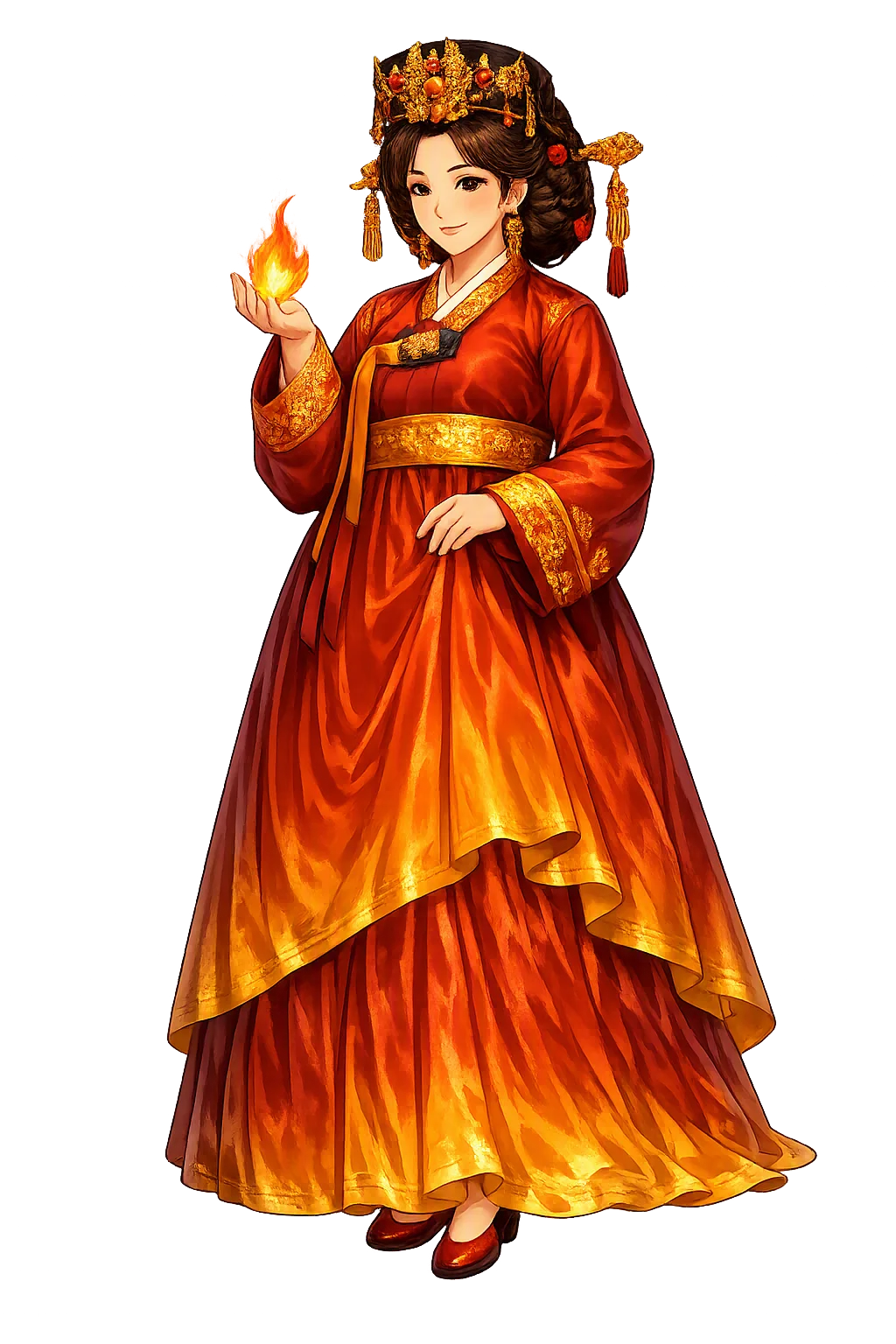
Jowangshin is the rare deity whose entire iconography fits in a matchbox. The image was a woodblock-printed paper god — a seated magistrate in the robe and black hat of a celestial official, a brush or record-scroll in hand, sometimes flanked by his wife, the business of heaven written on his face — bought in the market for a few coins, pasted above the stove, and burned at the year's end. Joseon-era print shops turned these sheets out by the thousands, and the genre still lives in restaurant kitchens, where a calendar-print Jowang watches the rice cookers. There is no statue and almost no painting: the shamanic painting tradition honored the great mountain and tutelary gods on silk, but the kitchen god stayed on paper — humble, replaceable, and deliberately perishable, an image designed to be retired, like a report, once its year was done. On Jeju, where the epic is chanted, the goddess is not pictured at all; she is sung.

06

Reception & Transformation

The name after its own age — transmission, translation, survival

Afterlives

Jowangshin's biography as a figure of record is short, and it runs through the twentieth century. The cult itself is an old import from China — her name translates the Stove God's title, and Chosŏn-period household calendars already scheduled her rites — but she lived so far below the notice of court chroniclers that almost nothing written about her survives from before modern times. The ethnographers found her first: the colonial-era scholars Akamatsu Keisuke and Akiba Takashi, transcribing Jeju's chants in 1938, pinned the Munjeon Bonpuri to paper just as the old kitchen fires began to change. After the war Korea's own scholarship took over — the National Folk Museum's Encyclopedia of Korean Folk Beliefs (2015) gave her a standard entry — and the Jeju shamanic tradition that carries her epic was inscribed on UNESCO's Representative List in 2009. Western scholarship, above all Laurel Kendall's Korean fieldwork of the 1970s and 80s, reframed her as evidence of how women's household labor becomes religion. The watcher the chronicles never bothered with is now documented, recorded, and heritage-listed.

Identifications Across Traditions

Jowangshin is closely parallel to the Chinese Zao Jun (Kitchen God), and the two figures influenced each other across a thousand years of Sino-Korean exchange — the Korean name itself is a translation of the Chinese title, and the Songje date sits near the Chinese 'Little New Year' sending-off of the Stove God on the twenty-third of the twelfth month. Yet the Korean figure has her own origin epic, the Munjeon Bonpuri, and is embedded in a distinct shamanic ritual world. Along the parallel track, Japan's kamado-gami — the hearth deities enshrined beside the stove — show how widespread the 'watched kitchen' is in East Asian religion. Confucian households domesticated the cult by assigning it to women's observance, while Buddhist temples sometimes honoured the hearth spirit as a protector. Today Jowangshin survives in household customs, year-end rituals, and the lingering sense that the kitchen is the moral centre of the home.

Modern Legacy

Jowangshin continues to shape Korean domestic culture. The kitchen remains a symbol of family care and moral order, and traces of the hearth-spirit cult appear in New Year customs, housewarming rituals, and the reverence shown to elders who cook. The Munjeon Bonpuri is performed in Jeju shamanic rituals and is recognized as part of Korea's intangible cultural heritage; Jeju's shamanic tradition itself is inscribed on UNESCO's Representative List. Scholars study Jowangshin as an example of how women's labour is sacralised and how the household becomes a microcosm of cosmic justice — a heaven that audits conduct, headquartered in the kitchen.

07

The Meditation

What Jowangshin means — beyond the dictionary

Jowangshin is surveillance made kind — or at least made negotiable. Few religions install an inspector in the most ordinary room of the house, and fewer still let the household bribe him with candy. The kitchen god's report is the mythic form of a real question every family lives with: who sees what we do when no one important is watching? The Korean answer: the hearth does — and the hearth is important. What saves the theology from menace is that the watcher is a wronged mother, a woman whose own household failed her and who was given, in compensation, every household. Jowangshin sacralizes the labor on which civilization quietly depends and rarely honors: the daily cooking, cleaning, and keeping-warm that are the invisible infrastructure of family life. To restore her name in full form — Jowangshin, the Kitchen King Spirit — is to restore the dignity of that labor, one syllable at a time.

08

Frequently Asked Questions

Common questions about Jowangshin, Kitchen, Hearth, and Unicode restoration

01How do you pronounce Jowangshin?

In reconstructed pronunciation, Jowangshin is /tɕo.waŋ.ʃin/ — approximately 'joh-WAHNG-sheen' — The first consonant is an unaspirated affricate; the second syllable carries the Sino-Korean word for king. The name designates the spirit who rules the kitchen hearth.

02What does Jowangshin mean?

Jowangshin means Kitchen king spirit in the korean tradition.

03What are the symbols of Jowangshin?

Jowangshin is associated with Hearth fire (The sacred fire that transforms raw food into nourishment and wards off danger.), Cooking pot (The vessel of abundance; the place where family sustenance is prepared.), Water (The partner of fire in the kitchen, balancing the elements and enabling cooking.), Malt taffy (yeot) (The sticky offering given at Songje so that the spirit's report would come out sweet.), Clean kitchen cloth (A sign of respect and order that invites the spirit's blessing.).

04Why restore Jowangshin in Unicode?

Jowangshin is written entirely in ASCII letters, so its restoration is about canonical fidelity rather than recovered diacritics: the temple fixes the name in its scholarly standard spelling, attested in the source tradition, instead of leaving it to drift.

05What is the most important myth about Jowangshin?

“The Munjeon Bonpuri: Yeosan Buin's Death and Return” — the Jeju epic story that anchors the mythology of Jowangshin, told in full on the lore page.

09

Scholarly Sources

The philological foundations of this restoration

Every claim on this page is grounded in established scholarship. The orthographic restorations follow disciplinary convention. The etymological chain follows the best available reference works. This is not invention — it is resurrection through scholarship.

◈

Lexicography & Philology

  • Korean folklore
  • Shamanic texts
◎

Primary Texts

  • Primary sources in the korean tradition for Jowangshin.
◉

Archaeology & Art History

  • Material evidence — iconography, inscriptions, and temple archaeology — for Jowangshin and related cults.
✦

Religious Studies

  • National Folk Museum of Korea, Encyclopedia of Korean Folk Beliefs (2015), s.v. Jowang.
  • Kendall, Laurel, Shamans, Housewives, and Other Restless Spirits: Women in Korean Ritual Life (University of Hawaii Press, 1985).
  • Walraven, Boudewijn, Songs of the Shaman: The Ritual Chants of the Korean Mudang (Kegan Paul International, 1994).
  • Akamatsu Keisuke and Akiba Takashi, Chōsen fuzoku no kenkyū (1938) — first transcriptions of the Munjeon Bonpuri from Jeju simbang.
Return

The Surface Awaits

You have traced the name from its earliest attestation to its Unicode restoration. Now return to the myth. The story is where the name lives.

Back to Lore
Jowangshin mascot