Stories of Izanagi
Izanagi's mythology is the creation narrative of the Kojiki and Nihon Shoki: the making of the land, the founding of death, and the birth of the gods who rule heaven and earth. It is also the story of a husband who could not bring his wife back — and of what he made instead.
When heaven and earth had parted but the land below floated like oil and drifted like a jellyfish, the heavenly kami commanded Izanagi and Izanami to make it solid. Standing upon the Floating Bridge of Heaven, they lowered the jeweled spear Ame-no-Nuboko and stirred; when they drew it up, brine dripped from the tip and piled up, congealing into the island of Onogoroshima (Kojiki 1). Descending, they built a heavenly pillar and a hall eight fathoms long and prepared to beget the land. The image is the Japanese creation at its most elegant: the cosmos is not spoken or fought into being but stirred — order precipitating out of the world-ocean like salt from brine. Everything that follows, from the imperial line to the boundary of death, crystallizes from that single drip.
To seal their union, Izanagi and Izanami were to circle the heavenly pillar, he from the left and she from the right, meeting on the far side. But Izanami spoke first in greeting — a breach of ritual order — and though they coupled, their first child was Hiruko, the leech-child, boneless and adrift, whom they set loose in a reed boat (Kojiki 1). Consulting the heavenly kami, they learned the error: the man's voice must come first. They redid the circuit in the correct order, and Izanami bore the eight great islands of Japan. The myth encodes a whole ritual theory — words spoken out of sequence pollute outcomes — and plants cosmic law inside the smallest unit of ceremony: who speaks first at the pillar. No other creation story makes grammar itself a generative force.
Giving birth to the fire god Kagutsuchi, Izanami was burned so badly that she died. Grieving, Izanagi followed her to Yomi and found her at the castle-hall, where she warned him not to look until she had consulted the gods of that land. He waited — but broke his promise, lit a tooth of his comb, and saw his beloved rotting, maggot-crowned, with eight thunder-kami raging on her body. Horror-struck, he fled; the hags of Yomi and the thunders pursued him to the slope Yomotsu-hirasaka, where he hurled peaches at the pursuers and finally rolled a great boulder into the pass, crying: henceforth let no living cross to the dead (Kojiki 1). Behind the stone, Izanami pronounced the curse of daily death. The myth does not flinch: grief violates the boundary it cannot abolish, and from that violation the world gains both its funerals and its peaches.
Blaming Kagutsuchi for his wife's death, Izanagi drew his ten-hand blade and cut the fire god's neck. From the blood on the blade's tip leaped the sword-gods Iwasaku and Nesaku; from the blood falling on the boulders leaped the mountain-smith deities Kanayamahiko and Kanayamahime, patrons of metal and stone (Kojiki 1). He then committed Izanami's corpse to the mountains — the chronicle names her burial place as Mount Hiba in the land of Kibi — and, weeping, uttered the chronicle's first poem of mourning, from which later scholars read the very word kami as 'that which withdraws.' Even in vengeance the creation does not pause: every drop of the fire child's blood becomes a power of the forge. The myth binds grief to technology — the volcano that kills is the mountain that yields ore.
Returning from Yomi polluted, Izanagi purified himself at the river-mouth of Tachibana in Hyūga, casting off his accessories one by one — each became a kami, twelve in all, the patrons of ritual purification. Washing his left eye he begot Amaterasu, his right eye Tsukuyomi, his nose Susanoo (Kojiki 1). Then Izanagi, his work complete, 'dwelt at the palace of Taga,' and the chronicle adds that some say he departed at last to the land of the dead. The misogi he performed stands at the head of every Shinto ablution to this day. The creation ends not with a throne but with a bath: the maker of the world must wash off the world before he can rest — purity, not power, is the final gift of the creator.
Creator of the Islands, Father of the Gods
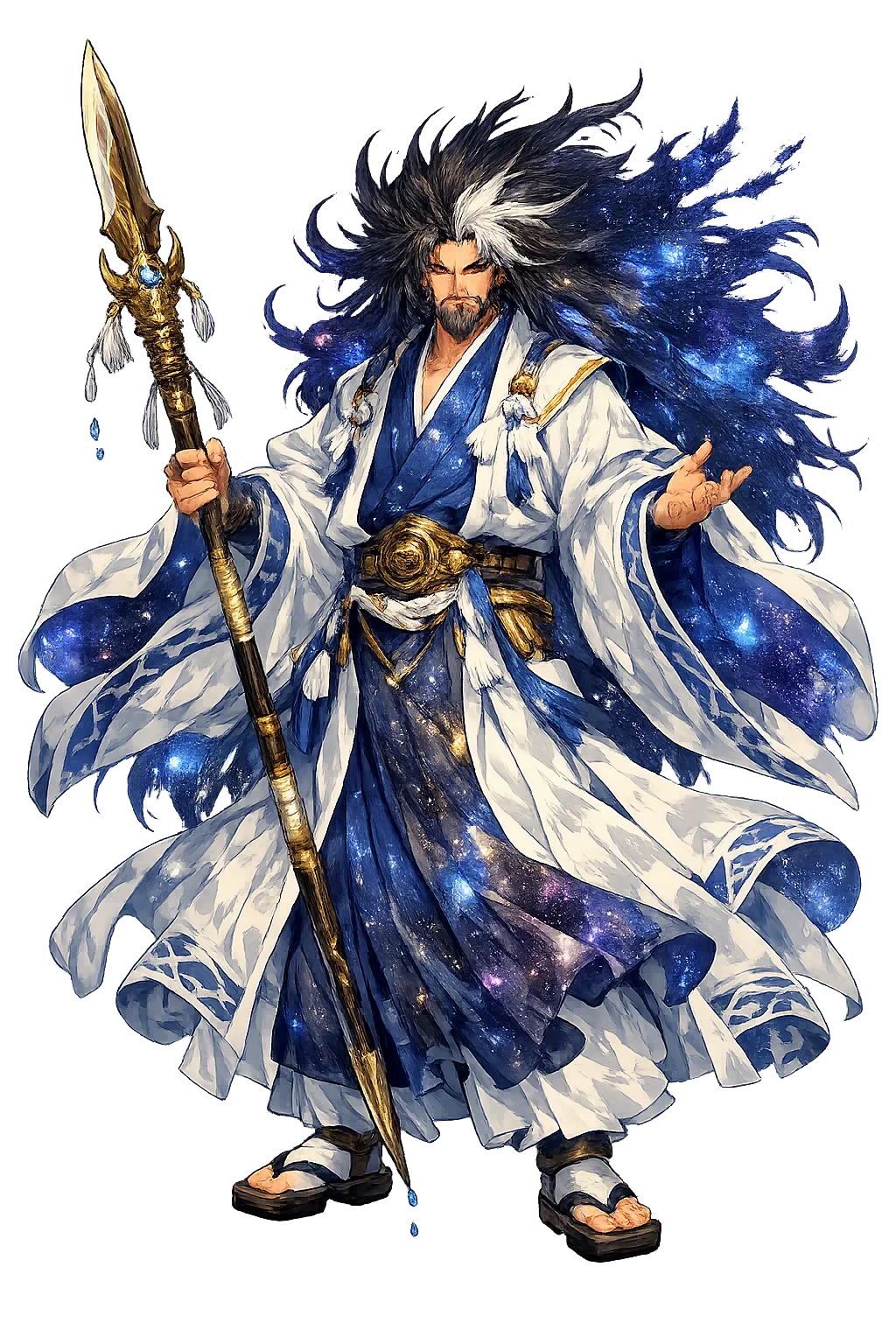
Izanagi is the male half of the primordial creator pair. With his sister-wife Izanami he stirred the world-ocean with the jeweled spear and raised the islands of Japan; his failed rescue of her from Yomi founded the boundary of death; and his river purification afterward gave birth to the three rulers of heaven, night, and sea — including Amaterasu herself.
With Izanami, he stirred the ocean with the jeweled spear and raised the eight great islands.
Ame-no-Nuboko, the jeweled spear; the brine dripping from its tip became the first island.
His misogi bath produced Amaterasu, Tsukuyomi, and Susanoo.
He descended to the underworld to retrieve Izanami and sealed its door behind him.
From the original script to the living URL
伊邪那岐
The name in its original Japanese form. Izanagi (伊邪那岐) is attested in the source tradition — “He who invites”. Its original diacritics and script distinctions carry the full phonetic and orthographic weight of the source tradition.
izanagi
The plain izanagi form is identical to the Unicode restoration. Because this name is already written in Latin letters, no diacritics, stress, or script information were lost — only capitalization differs.
Izanagi
The Unicode restoration does not need to recover lost marks for Izanagi. Its value is canonical spelling and consistent cataloguing, not the reconstruction of erased orthography. The domain is readable as-is to both DNS and humanity.
Izanagi.com
This restoration is written entirely in ASCII letters — no Punycode encoding stands between Izanagi and the DNS. The domain reads identically to machines and to human eyes.
Owned, ideal, and ASCII forms of Izanagi
Izanagi
Restores 伊邪那岐. The full Unicode restoration. izanagi.com is not in the PuniCodex collection — it is watched for release; if it drops, this temple upgrades to an owned flagship.
How Izanagi was spoken
How Izanagi is preserved in writing
A bespoke provenance study for Izanagi is being prepared by the PUNICODEX scholarly team.
Contribute scholarly provenance →The lore you have read is the living myth. Extended Lore opens the scholarly vault beneath it: the cult and its material remains, a history of the image, the name after antiquity, a meditation on what the name still means, and the full scholarly apparatus — etymology, orthography, sources.
Enter Extended Lore