PuniCodex

Extended Lore

IVPPITER Iūpiter

Etymology · Orthography · Cult · Iconography · Reception · Sources

Tier 1 Iūpiter.com
Iūpiter — Sky, Thunder, Sovereignty
01

Quick Facts

Essential information about Iūpiter, Sky, Thunder, Sovereignty

Original ScriptIVPPITER
Unicode RestorationIūpiter
Reconstructed Pronunciation/ˈjuː.pi.ter/
PantheonRoman
DomainSky, Thunder, Sovereignty
Meaning'Sky-father' (from *Dyēu-pater)
ClassificationTier 1
Primary DomainIūpiter.com
Sacred SymbolsThe thunderbolt, The eagle, The oak, The flint
02

Etymology & Word Family

From original script to Unicode restoration

Original Script IVPPITER Iūpiter — "'Sky-father' (from *Dyēu-pater)"
Unicode Restoration Iūpiter Restored stress, length, and script
Modern ASCII iuppiter Plain-ASCII fallback

The name Iūpiter carries the orthographic signature of the roman tradition: IVPPITER. Unicode restoration recovers what ASCII flattens.

03

Unicode Character Breakdown

Character-by-character philological analysis

CharacterUnicodeNameBlockPhonetic Role
IU+0049Latin Capital Letter IBasic LatinSame, capitalized
ūU+016BLatin Small Letter U with MacronLatin Extended-AMacron: long /uː/ (Iūpiter)
pU+0070Latin Small Letter PBasic LatinSame
—N/ADropped characterRoman orthographySingle-p spelling (Iūpiter, not Iuppiter)
iU+0069Latin Small Letter IBasic LatinSame
tU+0074Latin Small Letter TBasic LatinSame
eU+0065Latin Small Letter EBasic LatinSame
rU+0072Latin Small Letter RBasic LatinSame

The Tier 1 classification reflects how much of the original phonology this restoration preserves — stress and vowel length for Greek names, distinctive letters and diacritics for every other tradition.

04

Cult & Worship

How the sacred was kept — rites, sanctuaries, remains

The Cult

Iūpiter's cult was the state religion concentrated into one hill. His Capitoline temple, vowed by Tarquinius Superbus and dedicated in 509 BCE, held the terracotta statue Vulca of Veii made for it, red-faced like terracotta itself, and every September the Lūdī Rōmānī filled the Circus below with games in his honor. War and worship ran together: generals vowed temples to him mid-battle, crowned their triumph at his altar with white oxen, and hung captured armor in his cella until the porch read as a museum of victories. His priest was the flāmen Diālis, highest of the flamines, hedged by a rulebook of taboos — no raw flesh, no iron on his person, no night spent outside the city, no army arrayed in his sight, no corpse in his arms. Once a year the Latin peoples kept his common feast, the Fēriae Lātīnae, on the Alban Mount. And when Rome staged the lectisternium of 399 BCE — twelve gods on twelve draped couches — Iūpiter's couch stood first.

In the Earth

The Capitoline temple of Iuppiter Optimus Maximus — vowed in the first year of the Republic and dedicated in 509 BCE, burned and rebuilt again and again — survives most concretely in its massive tuff podium beneath the Palazzo Caffarelli on the Capitol and in the triple-cella plan described by Pliny and Dionysius of Halicarnassus. The Jupiter-columns of the German provinces, topped by the god on horseback trampling giants, survive in reconstructions at Mainz and Stuttgart. Legions of his aquilae fill the museums of two continents, and votive hands, thunderbolt-wreaths, and Dolichenus altars from the frontier forts trace the god's provincial career in bronze and stone.

05

Iconography

How Iūpiter was imaged across the ages

The Image

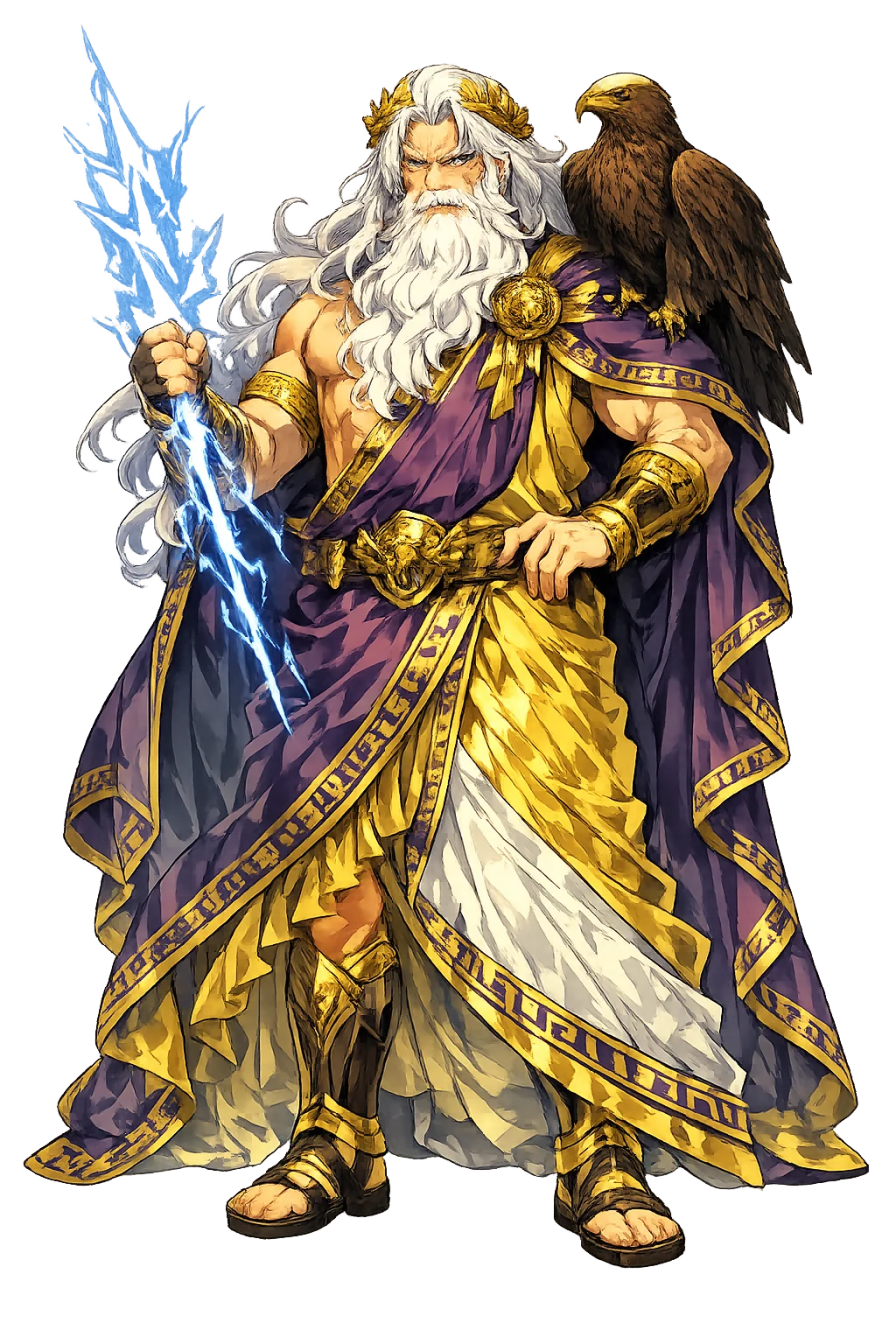
Iūpiter's image is the oldest in the family: an enthroned father, thunderbolt in the right hand, eagle at his feet. The Capitoline cult statue — terracotta, by Vulca of Veii, red-faced with minium — is lost, but it survives on coins struck when the temple burned, and its type descends from Phidias' gold-and-ivory Zeus at Olympia, the chryselephantine archetype of every enthroned god, known today through Roman copies such as the colossal Zeus of Otricoli in the Vatican. Two regional iconographies branch from that throne. On the Rhine frontier the Jupiter columns raise him on horseback, cloak blown, trampling a giant beneath the hooves; in the eastern forts Dolichenus stands rigid in scale armour upon a bull. And everywhere the small signs ruled: the eagle on the legion's standard, the thunderbolt on the soldier's ring — the watching sky distilled to a badge.

06

Reception & Transformation

The name after its own age — transmission, translation, survival

Afterlives

Iūpiter outlived his temple by becoming the sky itself. Martianus Capella's fifth-century Marriage of Philology and Mercury — a school text read for a thousand years — opens with him summoning the gods, and through that book medieval classrooms kept the father of the gods as an allegory of cosmic order; the astrologers' children of Jupiter grew up jovial. Humanism re-read him in Virgil and Ovid, and the printed mythographies of Conti and Cartari supplied painters a standardized father: storm-beard, bolt, eagle. So Correggio painted him dissolving into cloud to possess Iō, Titian made him a shower of gold in the Danaë painted for Philip II, and Rembrandt darkened the whole bargain in the Ganymede now in Dresden. The antiquarians of the eighteenth and nineteenth centuries recovered his provincial columns along the Rhine and his temples' podia in Rome, and the comparative philologists of the Grimms' generation made 'Jupiter' the paradigm of what a sky god's name should look like — the antique father reborn as a key to prehistory.

Identifications Across Traditions

Everywhere Rome went, Iūpiter wore local faces. In the Greek East he was simply Zeús; at Siwa he was Ammon, the ram-horned father Alexander claimed as his own; in North Africa he absorbed the Carthaginian Baʿal Ḥammon as Iuppiter Ammon; on the Rhine frontier his columns show him riding down giants beside a wheel-bearing Taranis; and in the legionary forts from Britain to the Danube he was Dolichenus — a storm god in iron scale-armour standing on a bull. Each identification was a diplomatic act: to recognize the local maximum god as Iūpiter was to admit the town into Rome's heaven. His very name is the syncretism that precedes all others — Zeús, Dyaus, Tiwaz, and Iūpiter are one father spoken in four dialects — and the empire merely extended the principle from language to cult.

Modern Legacy

'By Jove' keeps the oath in English, and Plautus' characters were already crying pro Iuppiter on the Roman stage. Dies Iovis gives English Thursday, French jeudi, Italian giovedì; his planetary temperament survives in 'jovial.' Astronomy gave him the largest planet — fittingly, for Galileo's discovery of Jupiter's four moons in 1610 was the observation that cracked the geocentric cosmos, the sky father presiding over the demotion of the earth. Every appeal to supreme authority in the Western tradition — every oath of office, every sworn treaty, every 'so help me God' — is still, etymologically, an appeal to the father sky: the oldest theonym in the family of languages keeps taking new jobs.

07

The Meditation

What Iūpiter means — beyond the dictionary

Iūpiter is the god of the spoken bond. Lightning, empire, and law are one idea in his name: that the highest power is the one by which promises are kept. Every signature, every oath of office, every treaty signed before witnesses rehearses the per Iovem Lapidem — the appeal to a witness greater than the parties.

And the oaths continue, translated but recognizable. The courtroom's 'the whole truth,' the inauguration's raised hand, the international treaty witnessed by flags — all are his architecture: the sky as witness, the word as bond, the bolt as the penalty for perjury of the soul. Even the republic that executed its kings kept his temple as its archive of treaties; even the church that called him a demon swore its concordats by a Father in heaven. The Romans' insight stands unimproved: promises between mortals need a sky to be sworn by, or they are only weather.

08

Frequently Asked Questions

Common questions about Iūpiter, Sky, Thunder, Sovereignty, and Unicode restoration

01How do you pronounce Iūpiter?

In reconstructed pronunciation, Iūpiter is /ˈjuː.pi.ter/ — approximately YOO-pi-ter, with a long ū.

02What does Iūpiter mean?

Iūpiter means 'Sky-father' (from *Dyēu-pater) in the roman tradition.

03What are the symbols of Iūpiter?

Iūpiter is associated with The thunderbolt (The sky's verdict; sovereignty as sudden light), The eagle (The highest flier, the king of birds for the king of gods), The oak (The tree of strength that shelters; the civic crown of the man who saved a fellow citizen's life), The flint (Iuppiter Lapis, the stone by which oaths were sworn — the god's body in the courtroom of nations).

04Why restore Iūpiter in Unicode?

Plain ASCII iuppiter strips the stress, length, and script that make the name specific. Unicode restoration returns the name to its original written dignity.

05What is the most important myth about Iūpiter?

“Iovem Lapidem” — the Livy 1.24; Festus story that anchors the mythology of Iūpiter, told in full on the lore page.

09

Scholarly Sources

The philological foundations of this restoration

Every claim on this page is grounded in established scholarship. The orthographic restorations follow disciplinary convention. The etymological chain follows the best available reference works. This is not invention — it is resurrection through scholarship.

◈

Lexicography & Philology

  • Lewis & Short
  • Ennius
◎

Primary Texts

  • Virgil
  • Plutarch, Life of Marcellus 8; Dio Cassius 51.24 (the blocked fourth spolia opima)
◉

Archaeology & Art History

  • Material evidence — iconography, inscriptions, and temple archaeology — for Iūpiter and related cults.
✦

Religious Studies

  • Livy 1.24 (the fetial oath), 1.10 (Romulus and Acron), 4.19–20 (Cossus)
  • Pliny, Natural History 33.111 (the triumphator's painted face)
  • Tertullian, Apologeticum 33.4 (the whispering slave)
  • Tacitus, Annals 1.60–61, 2.25 (the lost and recovered eagles)
  • Macrobius, Saturnalia 3.9 (Iuppiter Lapis); Festus, s.v. lapis
Return

The Surface Awaits

You have traced the name from its earliest attestation to its Unicode restoration. Now return to the myth. The story is where the name lives.

Back to Lore
Iūpiter mascot