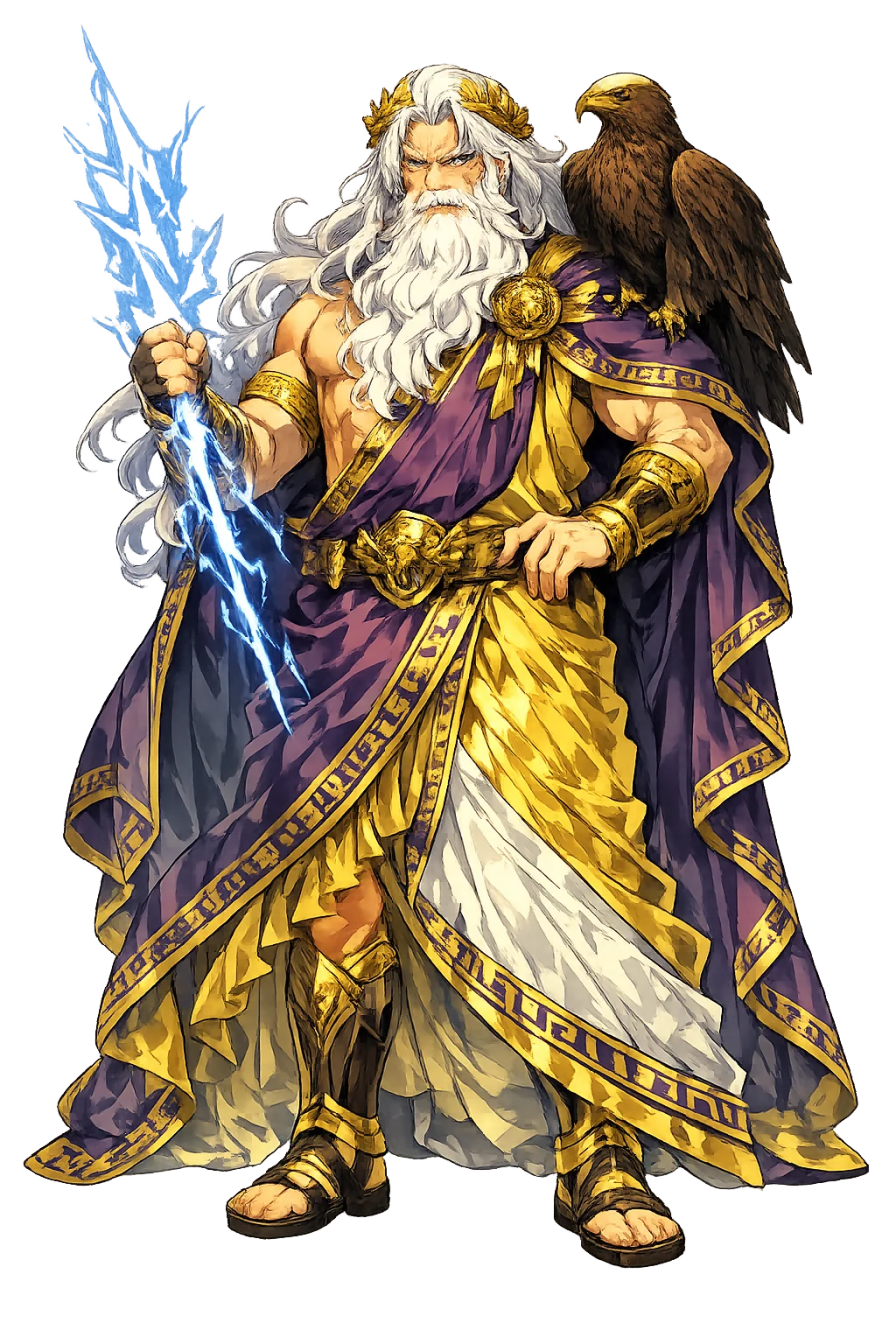
Stories of Iūpiter
Roman myth made Zeús' biography his own, but Iūpiter's truest stories are Roman institutions: the oath, the triumph, the dedication of spoils — religion as constitutional machinery.
The most binding Roman oath was sworn per Iovem Lapidem — by Jupiter the Stone. When the fetial priests concluded a treaty, the pater patratus held a flint from the god's altar and recited the archaic formula while striking a suckling pig dead: si sciens fallo, tum me Dispiter salva urbe arceque bonis eiciat, ut ego hunc porcum hic hodie feriam — 'if I knowingly deceive, then may Father Dis and Jupiter cast me from city and citadel with the loss of all good things, as I strike this pig today' (the rite survives in Livy's account of the Alba Longa treaty, 1.24, and in Festus' gloss on lapis). Macrobius (Saturnalia 3.9) explains the stone: what better guarantor than flint, the thing that sparks? Law, treaty, and contract all rested on his witness; the stone was the god's body in the courtroom of nations. The theology is exact — an oath requires a being above the oath-takers, and Rome made that being small enough to hold in the hand.
In the triumph, the victorious general rode through the streets of Rome in Iūpiter's own regalia — the purple and gold, the four-horse chariot, the face painted red with minium, 'Jupiter's own colour,' like the terracotta of the god's Capitol statue (Pliny, Natural History 33.111) — while a slave in the chariot held the crown and whispered respice post te; hominem te esse memento: 'look behind you; remember you are a man' (Tertullian, Apologeticum 33.4). The city staged its greatest day as a rehearsal of sovereignty: for one afternoon a mortal wore the sky father's face, and the god, through his priesthood of slaves and magistrates, reminded him to give it back. Rome's theology of empire is compressed into that whisper — power is real, but it is borrowed, and the borrower is mortal.
The rarest honour in Rome belonged to Iūpiter Feretrius, whose little temple Romulus himself had vowed: the spolia opima, 'rich spoils,' the arms stripped when a Roman commander killed the enemy king in single combat. It was won three times in seven centuries — by Romulus over Acron of Caenina (Livy 1.10), by Aulus Cornelius Cossus in the fifth century BCE (Livy 4.19–20), and by Marcus Claudius Marcellus, who slew the Insubrian chief Viridomarus at Clastidium in 222 BCE (Plutarch, Marcellus 8) — and never again. When M. Licinius Crassus, consul of 30 BCE, felled an enemy king and claimed the fourth, Augustus blocked him on a technicality (Dio 51.24): the honour was too royal for an emperor's subject. Some doors, once a dynasty exists, cannot be allowed to open again — the temple kept Rome's oldest trophy and its newest lesson.
Every legion carried his aquila into battle, and its loss was the deepest disgrace Rome knew. When Varus' three legions were destroyed in the Teutoburg Forest in 9 CE, their eagles passed into Germanic cult centers as trophies of the sky father's defeat. Rome spent a generation recovering them: Germanicus' campaigns of 15–16 CE brought the first standards back from the Bructeri and the last from the Marsi, and Tacitus (Annals 1.60–61, 2.25) treats each recovery as an omen read across the empire. The three eagles were finally displayed in the new temple of Mars Ultor in 2 BCE — dead birds, avenged. The sky father marched, in bronze, at the head of the army that built the Mediterranean's order; and when the order broke, it was his face the Romans demanded back.
Oaths, Triumphs, and the Capitol
Iūpiter is the god in whose name Rome swore: Optimus Maximus, 'best and greatest,' the witness of every treaty, the dedicatee of every victory, and the direct linguistic heir of the Indo-European sky father — the oldest divine name the West still speaks.
His weapon and signature — the bolt that marks where sovereignty lands.
His great temple, dedicated in 509 BCE — the year of the Republic's own beginning.
The bird at the head of every legion; to lose its standard was Rome's deepest shame.
The general robed as the god for one day — and the slave whispering mortality in his ear.
From the original script to the living URL
IVPPITER
The name in its original Roman form. Iūpiter (IVPPITER) is attested in the source tradition — “'Sky-father' (from *Dyēu-pater)”. Its macron-length vowels carry the full phonetic and orthographic weight of the source tradition.
iuppiter
Reduced to plain iuppiter, the name loses everything that made it specific: macron-length vowels. What remains is an ASCII string that machines can parse but that no longer speaks with its original voice.
Iūpiter
The Unicode restoration recovers what ASCII flattened. Iūpiter restores macron-length vowels, returning the name to its original written dignity. The domain encodes to Punycode, but the browser displays the truth.
Iūpiter.com → xn--ipiter-bmb.com
The non-ASCII characters in Iūpiter are encoded while the ASCII remains visible. To the DNS, it is Punycode. To humanity, it is Iūpiter.
Owned, ideal, and ASCII forms of Iūpiter
Iūpiter
Restores IVPPITER. The live temple domain — iūpiter.com.
iuppiter
Flattens IVPPITER. The plain ASCII fallback — what DNS and legacy systems see.
How Iūpiter was spoken
How Iūpiter travels from ancient script to the modern URL
The lore you have read is the living myth. Extended Lore opens the scholarly vault beneath it: the cult and its material remains, a history of the image, the name after antiquity, a meditation on what the name still means, and the full scholarly apparatus — etymology, orthography, sources.
Enter Extended Lore