
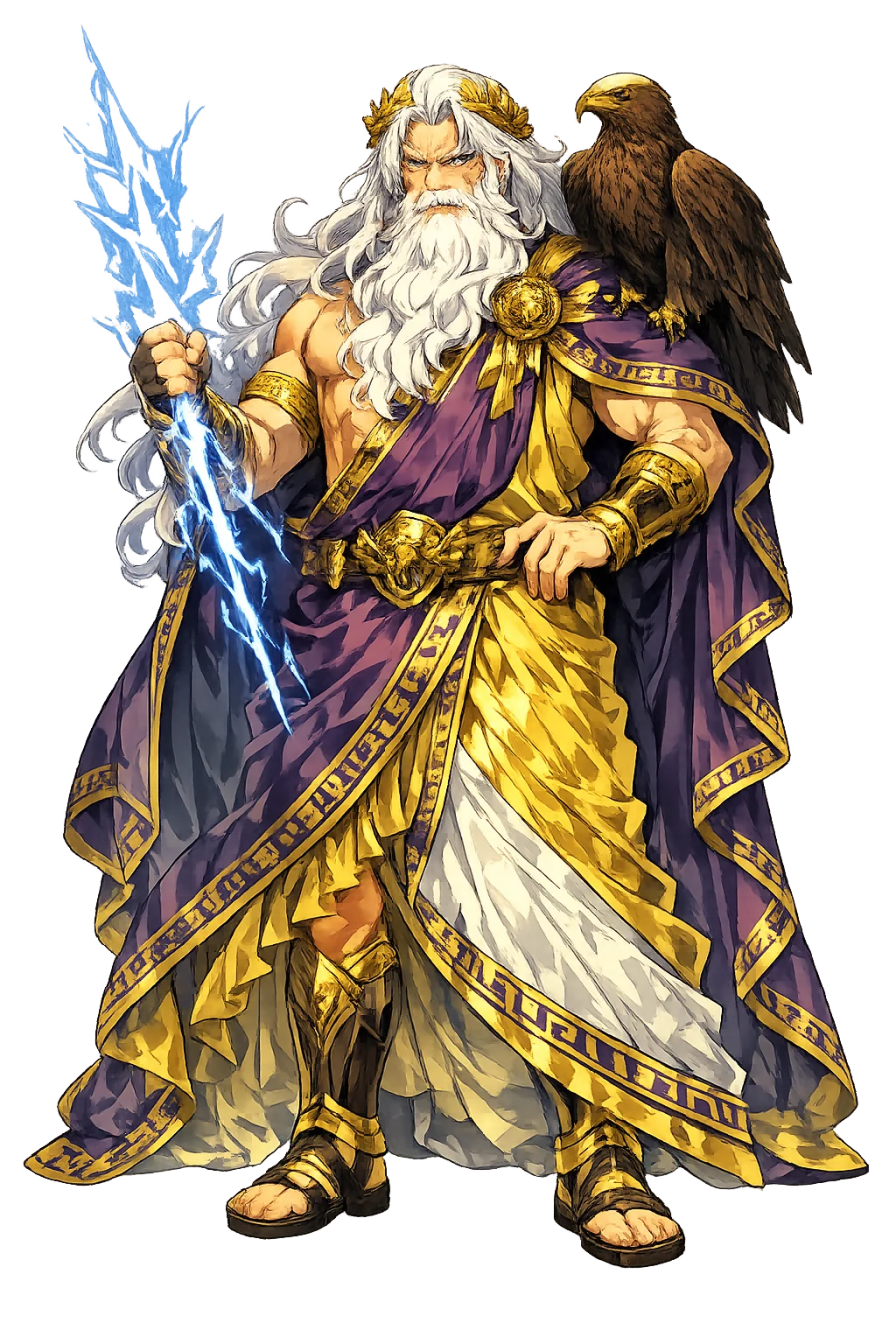
Iūpiter: the stories first, then the spelling
The marks in Iūpiter make the most sense standing next to the myths they have to carry. So the myths come first.
The Stories That Carry the Name
Iovem Lapidem. The most binding Roman oath was sworn per Iovem Lapidem — by Jupiter the Stone. When the fetial priests concluded a treaty, the pater patratus held a flint from the god's altar and recited the archaic formula while striking a suckling pig dead: si sciens fallo, tum me Dispiter salva urbe arceque bonis eiciat, ut ego hunc porcum hic hodie feriam — 'if I knowingly deceive, then may Father Dis and Jupiter cast me from city and citadel with the loss of all good things, as I strike this pig today' (the rite survives in Livy's account of the Alba Longa treaty, 1. 24, and in Festus' gloss on lapis).
The Borrowed Face. In the triumph, the victorious general rode through the streets of Rome in Iūpiter's own regalia — the purple and gold, the four-horse chariot, the face painted red with minium, 'Jupiter's own colour,' like the terracotta of the god's Capitol statue (Pliny, Natural History 33. 111) — while a slave in the chariot held the crown and whispered respice post te; hominem te esse memento: 'look behind you; remember you are a man' (Tertullian, Apologeticum 33. 4).
Opima Spolia. The rarest honour in Rome belonged to Iūpiter Feretrius, whose little temple Romulus himself had vowed: the spolia opima, 'rich spoils,' the arms stripped when a Roman commander killed the enemy king in single combat. It was won three times in seven centuries — by Romulus over Acron of Caenina (Livy 1. 10), by Aulus Cornelius Cossus in the fifth century BCE (Livy 4.
And Here Is What the Spelling Preserves
The restoration keeps one feature the ASCII form iuppiter cannot show:
- u → ū — Macron: long /uː/ (Iūpiter): how long the vowel is held.
A storyteller pronouncing the name would restore every one of them by instinct. The file only writes down what the voice already knows.
At a Glance
- Restored name: Iūpiter
- ASCII form: iuppiter
- Meaning: "'Sky-father' (from *Dyēu-pater)"
- Domain of influence: Sky, Thunder, Sovereignty
- Pantheon: Roman
- Classification: Tier 1
- Original script: IVPPITER
- Series: The Restoration Files, No. 241 of 546
The Name Travels
Everywhere Rome went, Iūpiter wore local faces. In the Greek East he was simply Zeús; at Siwa he was Ammon, the ram-horned father Alexander claimed as his own; in North Africa he absorbed the Carthaginian Baʿal Ḥammon as Iuppiter Ammon; on the Rhine frontier his columns show him riding down giants beside a wheel-bearing Taranis; and in the legionary forts from Britain to the Danube he was Dolichenus — a storm god in iron scale-armour standing on a bull.
The Address It Earned
The temple of Iūpiter stands at /iuppiter/ — lore, scholars, patterns — because a name carrying this much story deserves more than a parking page. The restoration preserves more than the ASCII form can express — stress, length, or a letter the Latin keyboard lost — which places it, mechanically, in Tier-1.
The Sources Are Open
The myths above are retold from the temple's record; the primary voices are in the Sacred Texts: Metamorphoses. Nothing in this file outranks them.
The File Continues
Read the founding dispatch for the name's full story, the Resonance File for the archetype at work — or the whole archive in one sitting.
Continue the series — previous file: Iūnō (read it here) · next file: Izanagi (read it here).
The Restoration Files are written from the same canonical record as the temples themselves: the lexicon, the lore catalog, the pattern atlas, and the cited scholarly sources. If a file ever disagrees with its temple, the temple is right — tell us, and the file will be corrected.