PuniCodex

Extended Lore

Iūnō — The Deeper Record

Etymology · Orthography · Cult · Iconography · Reception · Sources

Preserves vowel length Iūnō.com
Iūnō — Queenship, Marriage, Sky
01

At a Glance

Iūnō — every fact links to its home

PantheonRoman
DomainQueenship, Marriage, Sky
Attested345 BCE
Original ScriptIVNO →
Primary Sources4 cited →
02

Etymology & Word Family

From original script to Unicode restoration — the full etymology page →

Original Script IVNO Iūnō — "From the same root as Iuppiter, the bright sky"
Unicode Restoration Iūnō Restored stress, length, and script
Modern ASCII iuno Plain-ASCII fallback

The name Iūnō carries the orthographic signature of the roman tradition: IVNO. Unicode restoration recovers what ASCII flattens.

03

Unicode Character Breakdown

Character-by-character philological analysis

CharacterUnicodeNameBlockPhonetic Role
IU+0049Latin Capital Letter IBasic LatinSame letter
ūU+016BLatin Small Letter U with MacronLatin Extended-AMacron marks the long vowel
nU+006ELatin Small Letter NBasic LatinSame letter
ōU+014DLatin Small Letter O with MacronLatin Extended-AMacron marks the long vowel

The restoration of Iūnō preserves what it can of the original phonology — stress and vowel length for Greek names, distinctive letters and diacritics for every other tradition.

04

Cult & Worship

How the sacred was kept — rites, sanctuaries, remains

The Cult

Jūnō was worshipped wherever Roman women lived, and her calendar was theirs. Every Kalends was hers — the flāminica, wife of the flāmen Diālis, made offering to her in the Regia on the first of each month — and the Kalends of March was the Mātrōnālia, when married women processed to the Esquiline temple of Jūnō Lūcīna to pray for their marriages and their children. On the Nōnae Caprōtīnae in July, female slaves feasted beneath the wild fig tree, a rite archaic even to the Romans themselves. Her great sanctuaries anchored whole cities: at Lānuvium, Jūnō Sōspita's sacred snake was fed by a maiden while Roman magistrates came down each year to sacrifice; on the Aventine stood the Rēgīna carried from Veii; and on the Arx, Monēta's temple kept Rome's mint beside the goddess of warning, her sacred geese still kept in the precinct — an alarm that had become a liturgy. Votive deposits at Lānuvium and Falerii record a continuous clientele from archaic Latium onward.

In the Earth

The temple of Iūnō Moneta stood on the Arx of the Capitol, vowed in 345 BCE during the Auruncian war (Livy 7.28) and dedicated in 344 BCE, where the church of Santa Maria in Aracoeli now rises; the mint's location beside it is the accepted explanation of her name's fortune. Veii's Portonaccio temple — the probable home of the defected Regina — preserves its Etruscan terracottas in the Villa Giulia. Inscribed curses and votives from her Italic sanctuaries (especially at Lanuvium, with its famous serpent cult) document her continuous worship from Latium's earliest towns.

05

Iconography

How Iūnō was imaged across the ages

The Image

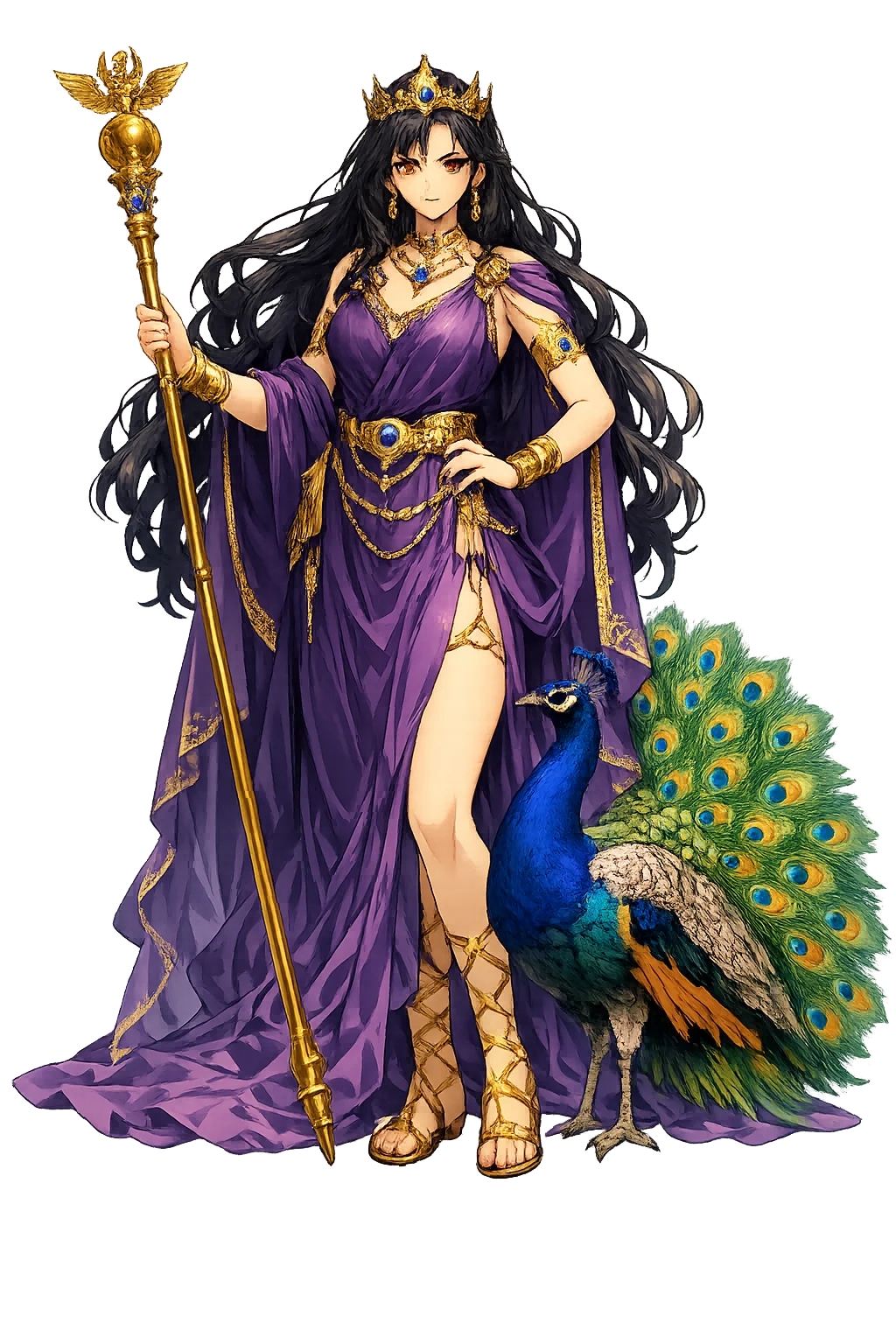
To recognize Jūnō, look for sovereignty worn like clothing: the high diadem, the long veil, the sceptre, the patera, and — in later art — the peacock at her feet, the hundred eyes of Argus set in its tail. Her earliest images are Etruscan: Uni appears on engraved bronze mirrors of the fourth and third centuries BCE, most touchingly nursing her grown son Hercle at the gods' command, and the terracotta antefixes of her sanctuaries gave her the archaic smile of old Latium. Rome absorbed the Greek image of the draped, enthroned matron, and the type froze there — imperial coinage minted in her name shows exactly that queen, bolt-upright and veiled. The colossal seated goddess long called the Jūnō Ludovisī, now usually read as another enthroned goddess and kept in Rome's Palazzo Altemps, shows what the type aspired to. Rarer and stranger is Jūnō Sōspita of Lānuvium, the Warrior: goat-skin headdress, brandished spear, striding forward on republican coins.

06

Reception & Transformation

The name after its own age — transmission, translation, survival

Afterlives

Jūnō's transmission ran through the grammarians and the mythographers. When her temples closed in the late fourth century, her name was already mortised into the calendar and the dictionary; medieval allegory, punning her Greek name with Greek aer, made her the element of air, and the Ovide moralisé read her myths as moral instruction. The Renaissance rebuilt her from manuscripts: Boccaccio's Genealogia assembled her stories for humanist readers, Natale Conti's Mythologiae (1551) codified her attributes for painters, and the great translations of Ovid — Golding's Metamorphosis (1567), Sandys' 1626 version — carried Io and Argus into English verse. On canvas she regained her queenliness: Rubens painted her milking the sky into the Milky Way, and Rembrandt's Juno, painted around 1662 for Amsterdam's new town hall, enthrones her with peacock and sceptre — the antique type reborn as civic allegory. The astronomers took her last: Karl Harding named the third asteroid, 3 Juno, in 1804, and her name still rides the map of the sky.

Identifications Across Traditions

Her Etruscan form Uni was Rome's first loan: the Capitoline triad itself (Iūpiter, Iūnō, Minerva) is the Etruscan Tinia-Uni-Ménrva. Through evocatio she accumulated the identities of every conquered city's queen — Iūnō Caelestis of Carthage was worshipped in Rome after Carthage burned — and her African form survived into Augustine's polemics. In the Greek East she was simply Hēra again: the empire made her portable in both directions.

Modern Legacy

Her titles became common nouns: "money" and "monetary" descend from the mint in Moneta's temple; June (Iūnius) bears her name on every calendar; "junoesque" still describes stately beauty. The evocatio — winning by inviting the other side's gods to defect — remains the strangest instrument in the history of religious warfare, and scholars cite it in every discussion of Roman imperialism's flexibility.

09

The Original Script Note

What the written record preserves — and what it does not

Original Script

Latin inscriptions write IVNO, and they write it everywhere: at her ancient cult centre of Lanuvium, at Veii, on the Capitol beside Iuppiter and Minerva as the third of the Capitoline triad, and across the provinces wherever Roman settlement went. The quantity of the ū — the one feature the temple's form Iūnō marks — is guaranteed by metre and by the grammarians, since Latin epigraphy carves no length signs. Roman etymology already disagreed about her: some derived the name from iuvare, 'to help' (she is Iūnō Iuga, who joins bride to bridegroom), some from the same bright root as Jānus and Diāna. The inscriptions settle the spelling; the meaning they leave open.

10

The Meditation

What Iūnō means — beyond the dictionary

Iūnō is the power that must be persuaded, never merely defeated. Rome's deepest political insight is carved into her story: that legitimacy — of marriage, of money, of the state — is not seized but transferred, and only by consent. Her geese still wake at night in every institution that survives by vigilance rather than force.

11

Frequently Asked Questions

Deep-dives into the cult, attestation, reception, and sources of Iūnō

01How do we know how Iūnō was worshipped?

The temple of Iūnō Moneta stood on the Arx of the Capitol, vowed in 345 BCE during the Auruncian war (Livy 7.28) The full cult record →

02Where do the earliest attestations of Iūnō come from?

The record rests on Virgil, Aeneid 1.8–12; 12.806–828, Livy 5.21–22 (evocatio); 5.47 (the geese); 7.28 (temple of Moneta), Ovid, Fasti 3 (the Kalends of March); Metamorphoses 1.568–746 (Io and Argus), among 6 cited works. The full source apparatus →

03How did later traditions reinterpret Iūnō?

Jūnō's transmission ran through the grammarians and the mythographers. Reception & transformation →

04What do the surviving images of Iūnō actually show?

To recognize Jūnō, look for sovereignty worn like clothing: the high diadem, the long veil, the sceptre, the patera, and — in later art — the peacock at her feet, the hundred eyes of Argus set in its tail. The iconography →

05What does the written record of Iūnō actually preserve?

Latin inscriptions write IVNO, and they write it everywhere: at her ancient cult centre of Lanuvium, at Veii, on the Capitol beside Iuppiter and Minerva as the third of the Capitoline triad, and across the provinces wherever Roman settlement went. The Original Script note →

12

Scholarly Sources

The philological foundations of this restoration

Every claim on this page is grounded in established scholarship. The orthographic restorations follow disciplinary convention. The etymological chain follows the best available reference works. This is not invention — it is resurrection through scholarship.

◈

Lexicography & Philology

  • Lewis & Short
◎

Primary Texts

  • Virgil
  • Ovid
  • Virgil, Aeneid 1.8–12; 12.806–828
  • Ovid, Fasti 3 (the Kalends of March); Metamorphoses 1.568–746 (Io and Argus)
◉

Archaeology & Art History

  • Strong, D. Roman Art; Ramage, N., & Ramage, A. Roman Art.
✦

Religious Studies

  • Livy 5.21–22 (evocatio); 5.47 (the geese); 7.28 (temple of Moneta)
  • Varro, De lingua Latina 5.67 (Moneta and “money”)
  • Macrobius, Saturnalia 3.9 (the evocatio formula)
  • Lewis & Short, A Latin Dictionary, s.v. Iūnō
Return

The Surface Awaits

You have traced the name from its earliest attestation to its Unicode restoration. Now return to the myth. The story is where the name lives.

Back to Lore
Iūnō mascot