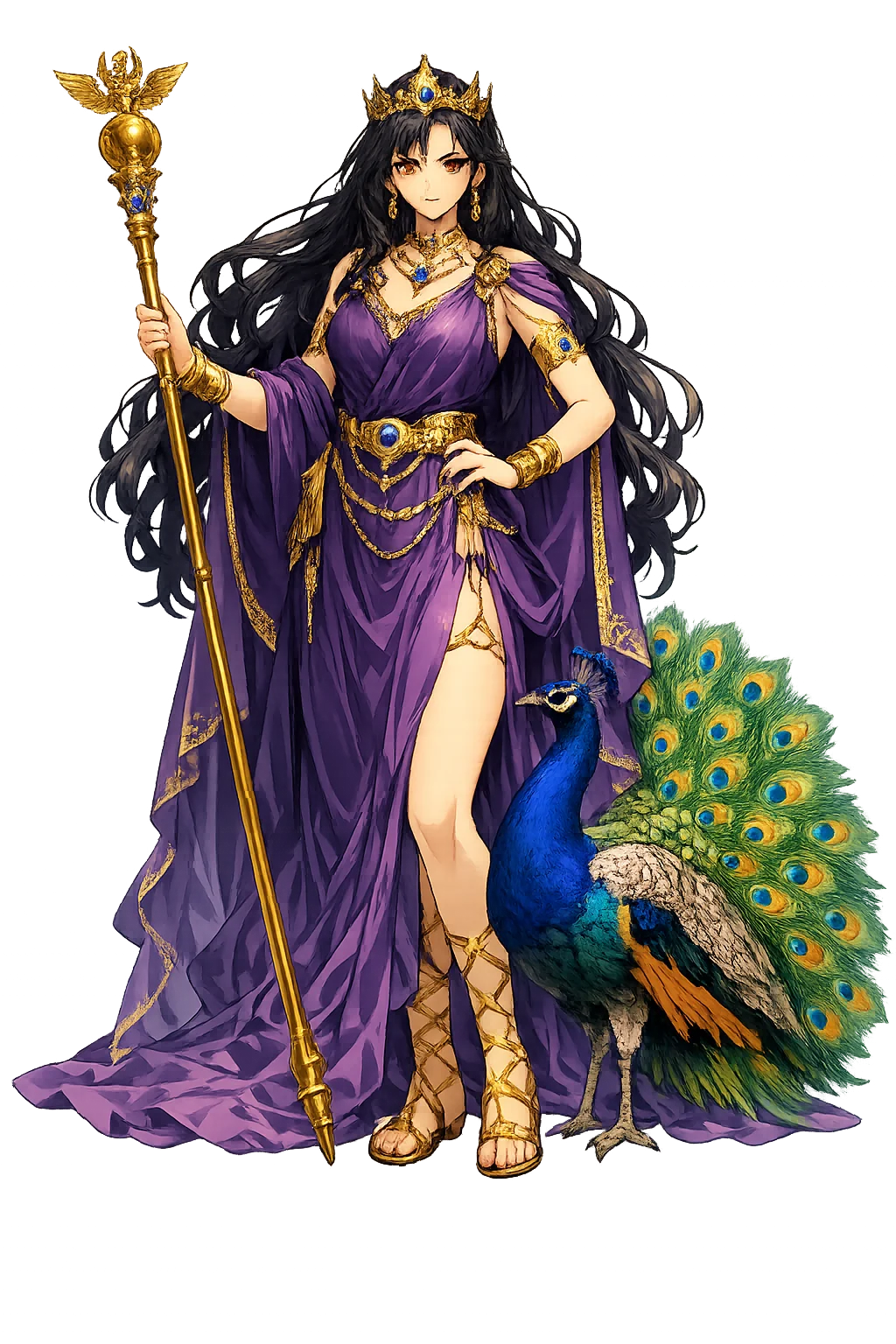
Stories of Iūnō
Roman Iūnō inherits Hēra's jealousy plots but outgrows them: in Rome she is less the wronged wife than the state's queen — a power that must be ritually persuaded, city by city, to change sides.
Virgil opens the Aeneid with the question that is her mythology's whole argument: “Tantaene animis caelestibus irae?” — “Can heavenly minds hold wrath so great?” (Aeneid 1.11). For seven books she is the storm against Aeneas: she bribes Aeolus to sink his fleet, sends the Fury Allecto to madden Queen Amata and the shepherd Turnus, opens the Gates of War, and keeps Iulus's line from Latium as long as a goddess can. Yet the epic's close is a negotiation, not a victory: Jupiter sends Iris to tell her that fate outranks hatred, and she yields — on a condition all her own, that the Trojan name die out and only Roman remain (Aeneid 12.806–828). The Aeneid thus ends by honoring the very power that opposed it: Rome exists because its bitterest enemy consented to let it. Iūnō's anger is the proof of Rome's worthiness.
Livy (5.21–22) tells how Rome took Veii in 396 BCE not only by siege but by liturgy: before the assault, the dictator Camillus performed the evocatio, formally inviting Veii's Iūnō Regina to abandon a doomed city for a worthier seat in Rome. The statue, Livy says, nodded assent when addressed; the Romans carried her gently across the Tiber and installed her on the Aventine. Macrobius preserves the archaic formula of the rite (Saturnalia 3.9). It is the strangest weapon in Roman religious warfare: victory achieved not by destroying the enemy's goddess but by poaching her — and the willing transfer of the goddess proved the transfer of heaven's favor. Iūnō became, in effect, the empire's most portable argument for legitimacy, and the conquered cities of Italy learned that her favor, once courted, could be carried anywhere the legions went.
When the Gauls scaled the Capitoline cliff by night in 390 BCE, the guard dogs slept — but the sacred geese of Iūnō, kept beside her temple, heard the climbers and set up such a clamour that Marcus Manlius woke, hurled the first Gaul from the rock, and saved the citadel (Livy 5.47). Rome kept the lesson liturgically: the geese were honoured in procession, the dogs crucified. And the temple beside the geese gave the world a word: vowed in 345 BCE and dedicated in 344 (Livy 7.28), Iūnō's Capitoline temple was called Moneta, “the Warner,” because her birds had warned the city; the Roman mint was established beside it around 269 BCE, and Varro hands our “money” down from her name (De lingua Latina 5.67). The myth turns on the smallest irony in Roman religion: the goddess's vigilance out-saw the professional watchmen, and her reward was to guard the Republic's coinage.
On the first of March — the old New Year's Day — Rome kept the Matronalia, the feast of Iūnō Lucina, “she who brings to light” (Ovid, Fasti 3, the Kalends of March; Festus, s.v. Matronalia). Matrons crowned the Esquiline temple of Lucina with flowers, received gifts from husbands, feasted the household slaves, and prayed for easy childbirth; the kalends of every month were sacred to her, but March belonged to her fully. Tradition held that the temple itself was vowed in a season of barrenness, when the collective prayers of Roman women lifted the plague of stillbirths. The feast made the politics of the household visible: once a year the married women of Rome appeared in public as a body, with their own goddess, their own procession, and their own claims on the city's gratitude. Iūnō Lucina is the reminder that Rome's wars and laws rested on births — and that the women who bore them knew it.
Greek story, Roman telling: Iuppiter loved Io, and Ovid's Iūnō answers with surveillance (Metamorphoses 1.568–746). She transforms the girl into a heifer, sets the hundred-eyed Argus to guard her — eyes that sleep in shifts, never all at once — and when Mercury pipes the watcher to his death, she completes the memorial herself: Argus's hundred eyes are set into the tail of her peacock, where they blaze to this day. The genealogy of her iconography is a vindication of watching: the queen converts the instrument of jealousy into her own splendour, and the bird that spreads its tail across Roman floors and frescoes carries, in each eyespot, a fallen guardian. Where the Greek Hēra's wrath reads as vindictive, Ovid's Iūnō is architectural: she builds her own emblems out of whatever betrayal leaves behind, and every peacock in Pompeii is her trophy.
Marriage, the Mint, and the Watching Geese
Iūnō is not "Hēra with a Latin accent" but a sovereign in her own right: protector of women in every life-stage, keeper of the state's financial memory on the Capitoline, and the one goddess Rome's enemies learned to fear as the will behind the legions.
Iūnō Lucina, "she who brings to light" — the goddess women call in childbirth.
"The Warner" — her Capitoline title; Rome's mint stood in her temple, giving the world the word "money."
Her sacred geese that woke the Capitol in 390 BCE when the Gauls climbed by night.
The Queen — third of the Capitoline triad with Iūpiter and Minerva, enthroned on the city's heart-hill.
From the original script to the living URL
IVNO
The name in its original Roman form. Iūnō (IVNO) is attested in the source tradition — “From the same root as Iuppiter, the bright sky”. Its macron-length vowels carry the full phonetic and orthographic weight of the source tradition.
iuno
Reduced to plain iuno, the name loses everything that made it specific: macron-length vowels. What remains is an ASCII string that machines can parse but that no longer speaks with its original voice.
Iūnō
The Unicode restoration recovers what ASCII flattened. Iūnō restores macron-length vowels, returning the name to its original written dignity. The domain encodes to Punycode, but the browser displays the truth.
Iūnō.com → xn--in-wra2j.com
The non-ASCII characters in Iūnō are encoded while the ASCII remains visible. To the DNS, it is Punycode. To humanity, it is Iūnō.
Owned, ideal, and ASCII forms of Iūnō
Iūnō
Restores IVNO. The live temple domain — iūnō.com.
iuno
Flattens IVNO. The plain ASCII fallback — what DNS and legacy systems see.
How Iūnō was spoken
How Iūnō travels from ancient script to the modern URL
The lore you have read is the living myth. Extended Lore opens the scholarly vault beneath it: the cult and its material remains, a history of the image, the name after antiquity, a meditation on what the name still means, and the full scholarly apparatus — etymology, orthography, sources.
Enter Extended Lore