
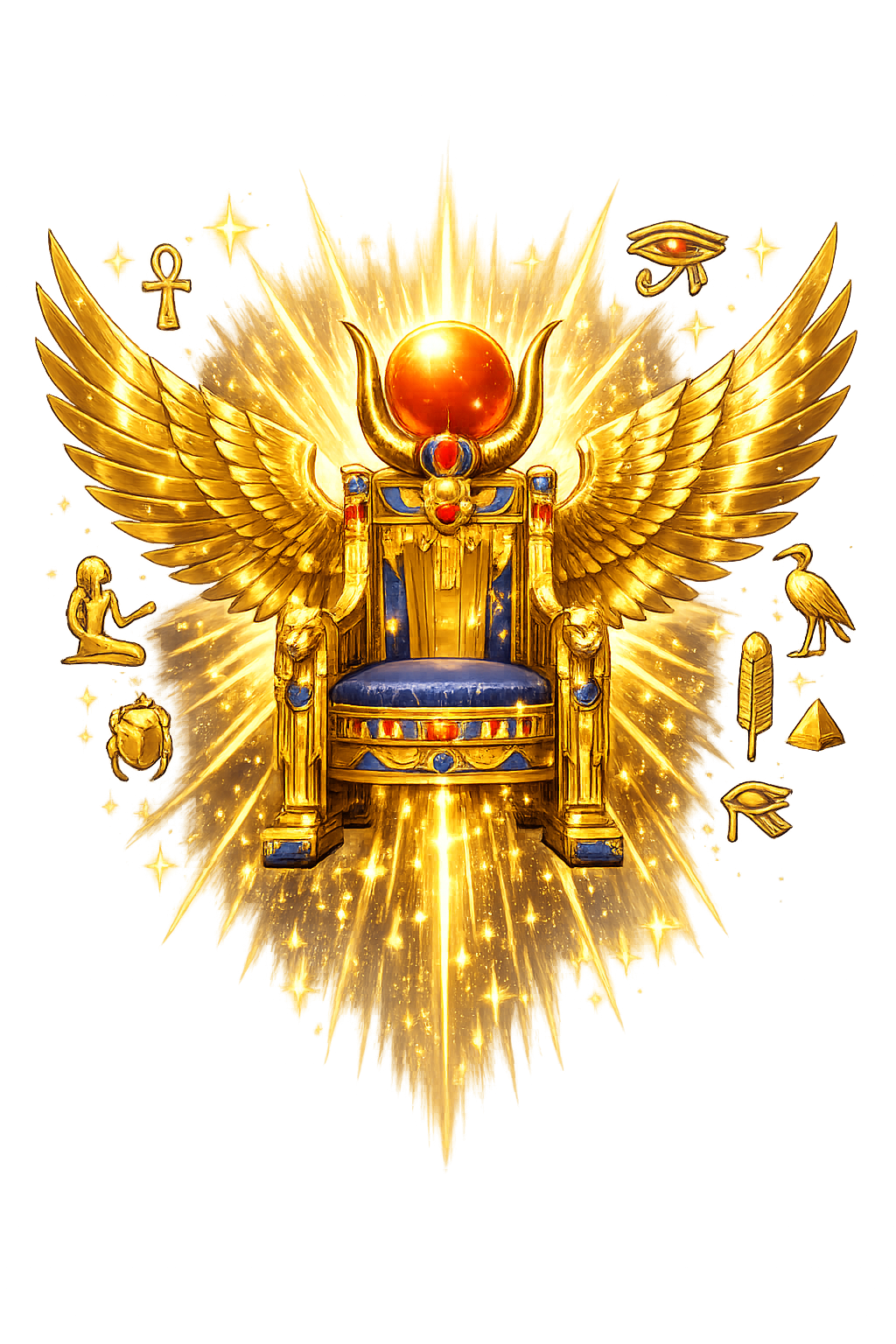
Ꜣst: the stories first, then the spelling
Before the spelling, the story. Ꜣst earns its restoration the old way — through what was actually told.
The Stories That Carry the Name
The Lament and the Search. When Set murdered Osiris, dismembered the body, and scattered the pieces across the nomes, Isis did what no other power in the cosmos would do: she went looking. The Pyramid Texts (Utterances 364 and 593) already picture her and Nephthys keening beside the bier at Busiris, and the Late Period ritual Lamentations of Isis and Nephthys (Berlin Papyrus 3008) expands the mourning into antiphonal liturgy. Plutarch (On Isis and Osiris 13–19) gives the fullest narrative: piece by piece, nome by nome, Isis recovered her husband — all but one member, lost to the Nile fish, which is why, his priests said, the river's flood itself is fertile.
Chemmis. Pregnant and hunted by Set's agents, Isis fled to the marshes of Chemmis in the Delta, where she gave birth to Horus in secret (Plutarch, On Isis and Osiris 19; the tradition is far older, staged across the Horus-stelae of the first millennium BCE). She hid the child in the papyrus thickets, nursed him, and fought off scorpions, snakes, and sickness; the great Metternich Stela tells of her all-night vigil, reciting spells over the stricken child until the sun itself stood still in sympathy. From this refuge came the image that conquered the ancient world: Isis lactans, the goddess seated on her throne suckling the divine child — an icon so potent that early Christian artists borrowed its posture for Mary and the Christ child without changing a line.
The Secret Name. The tale of the Secret Name of Re survives in its fullest copy on Papyrus Bremner-Rhind (British Museum EA 10188, fourth century BCE), though the story is older than the manuscript by a millennium. Isis, knowing that Re's hidden name is the source of his supremacy, fashions a serpent from the sun-god's own spittle and the earth he spurned, and sets it on his path. The bite is beyond any cure but hers, and she exacts the price: his true name, spoken into her ear alone.
And Here Is What the Spelling Preserves
At a Glance
- Restored name: Ꜣst
- ASCII form: isis
- Meaning: "Throne (Egyptian ꜣst)"
- Domain of influence: Magic, Motherhood, Throne
- Pantheon: Egyptian
- Classification: Tier 1
- Original script: 𓊨𓏏𓆇
- Series: The Restoration Files, No. 238 of 546
The Name Travels
Ꜣst absorbed or was identified with many goddesses: Hathor in her solar-mother aspect, Mut as consort of Amun, and Serqet in protective magic. Greeks identified her with Demeter, both searching goddesses of grain and mourning, and with Aphrodite in her erotic power.
The Address It Earned
The temple of Ꜣst stands at /isis/ — lore, scholars, patterns — because a name carrying this much story deserves more than a parking page. Tier-1 is not a compliment; it is a measurement. This restoration keeps something the ASCII form provably loses, and the measurement is repeatable.
The Sources Are Open
The myths above are retold from the temple's record; the primary voices are in the Sacred Texts: The Book of the Dead. Nothing in this file outranks them.
The File Continues
Read the founding dispatch for the name's full story, the Resonance File for the archetype at work — or the whole archive in one sitting.
Continue the series — previous file: Ištar (read it here) · next file: Ītzpāpālōtl (read it here).
The Restoration Files are written from the same canonical record as the temples themselves: the lexicon, the lore catalog, the pattern atlas, and the cited scholarly sources. If a file ever disagrees with its temple, the temple is right — tell us, and the file will be corrected.