Stories of Ise
Ise's mythology is inseparable from the mythology of Amaterasu and the imperial house. The city exists because the sun goddess needed a dwelling worthy of her.
According to tradition, the imperial princess Yamatohime-no-mikoto traveled for twenty years searching for a permanent dwelling for Amaterasu. She finally received an oracle at Ise, where the goddess declared her love for the place. The Inner Shrine was established there, and the imperial house has maintained it ever since.
The shikinen-zōtai tradition requires that the shrine buildings be reconstructed on adjacent plots every twenty years. The old structures are dismantled, and their timber is distributed to branch shrines. This cycle ensures that the architecture remains fresh and that the skills of sacred carpentry are passed down through generations.
In the Edo period, mass pilgrimages to Ise called okage-mairi swept the country. Villages would pool their resources and send representatives — sometimes whole communities — to walk the Ise-kaidō. These pilgrimages expressed popular devotion to Amaterasu and shaped the culture of travel in early modern Japan.
The mirror enshrined at Ise enters myth at the crisis of the Kojiki: when the storm god Susano-o's rampages drove Amaterasu to hide in the heavenly cave, Ama-no-Iwato, the world went dark, the eight hundred myriad gods assembled in council, and Ama-no-Uzume danced an outrageously comic dance on an upturned tub. The gods roared with laughter; Amaterasu, curious, peered out — and saw her own radiance reflected in the mirror Yata-no-Kagami hung on a sakaki tree. Drawn out by what was, in the end, her own light, the sun returned to the sky and Susano-o was punished with exile (Kojiki; Nihon Shoki). Tradition holds that this same mirror rests at the Ise Inner Shrine, where Amaterasu has dwelt since the imperial princess Yamatohime received her oracle there. The shrine's holiest object is thus a device for seeing the sun: Shinto's deepest sanctuary keeps, at its center, the story of how light was persuaded back into the world — by laughter, and by a reflection.
Shrine, Pilgrimage, and the Heart of Shinto
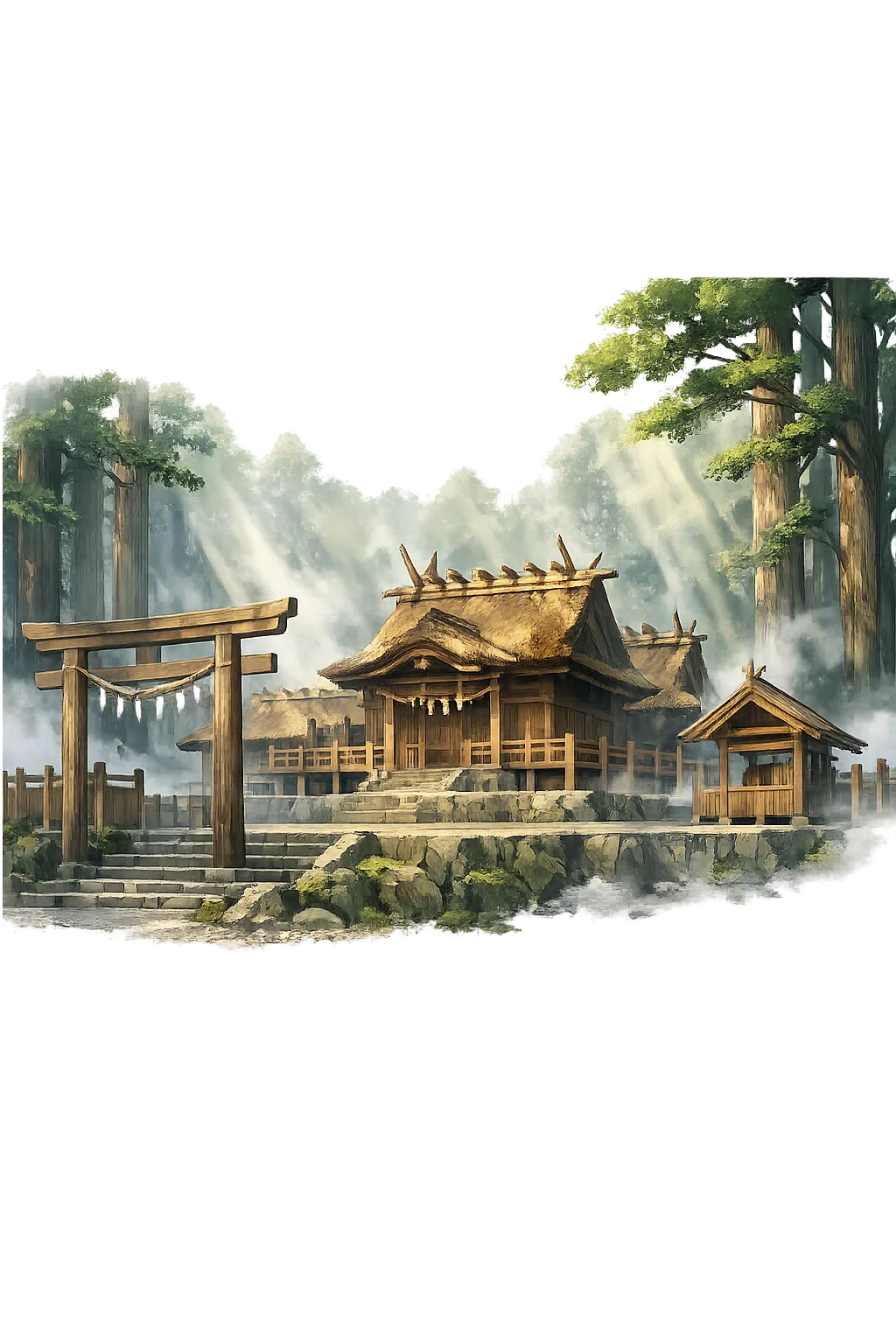
Ise is not merely a place; it is the spiritual center of Shinto and the home of Amaterasu, the sun goddess and ancestor of the imperial house. For more than a thousand years, the Ise Grand Shrine has been rebuilt every twenty years in an unbroken cycle of renewal, making Ise a city where architecture, nature, and divine presence are continuously reborn.
The most sacred Shinto complex, rebuilt every twenty years in the shikinen-zōtai tradition.
The Inner Shrine houses the mirror, one of the Three Imperial Regalia.
For centuries pilgrims traveled the Ise-kaidō to visit the shrines.
The shrines are rebuilt from new cypress in a cycle of death and rebirth.
From the original script to the living URL
伊勢
The name in its original Japanese form. Ise (伊勢) is attested in the source tradition — “Ancient province”. Its original diacritics and script distinctions carry the full phonetic and orthographic weight of the source tradition.
ise
The plain ise form is identical to the Unicode restoration. Because this name is already written in Latin letters, no diacritics, stress, or script information were lost — only capitalization differs.
Ise
The Unicode restoration does not need to recover lost marks for Ise. Its value is canonical spelling and consistent cataloguing, not the reconstruction of erased orthography. The domain is readable as-is to both DNS and humanity.
Ise.com
This restoration is written entirely in ASCII letters — no Punycode encoding stands between Ise and the DNS. The domain reads identically to machines and to human eyes.
Owned, ideal, and ASCII forms of Ise
Ise
Restores 伊勢. The full Unicode restoration. ise.com is not in the PuniCodex collection — it is watched for release; if it drops, this temple upgrades to an owned flagship.
How Ise was spoken
How Ise is preserved in writing
A bespoke provenance study for Ise is being prepared by the PUNICODEX scholarly team.
Contribute scholarly provenance →The lore you have read is the living myth. Extended Lore opens the scholarly vault beneath it: the cult and its material remains, a history of the image, the name after antiquity, a meditation on what the name still means, and the full scholarly apparatus — etymology, orthography, sources.
Enter Extended Lore