PuniCodex

Extended Lore

Inti

Etymology · Orthography · Cult · Iconography · Reception · Sources

Tier 2 Inti
Inti — Sun, Empire, Agriculture
01

Quick Facts

Essential information about Inti, Sun, Empire, Agriculture

Scholarly TransliterationInti
Unicode RestorationInti
Reconstructed Pronunciation/ˈin.ti/
PantheonIncan
DomainSun, Empire, Agriculture
MeaningSun
ClassificationTier 2
Primary DomainInti
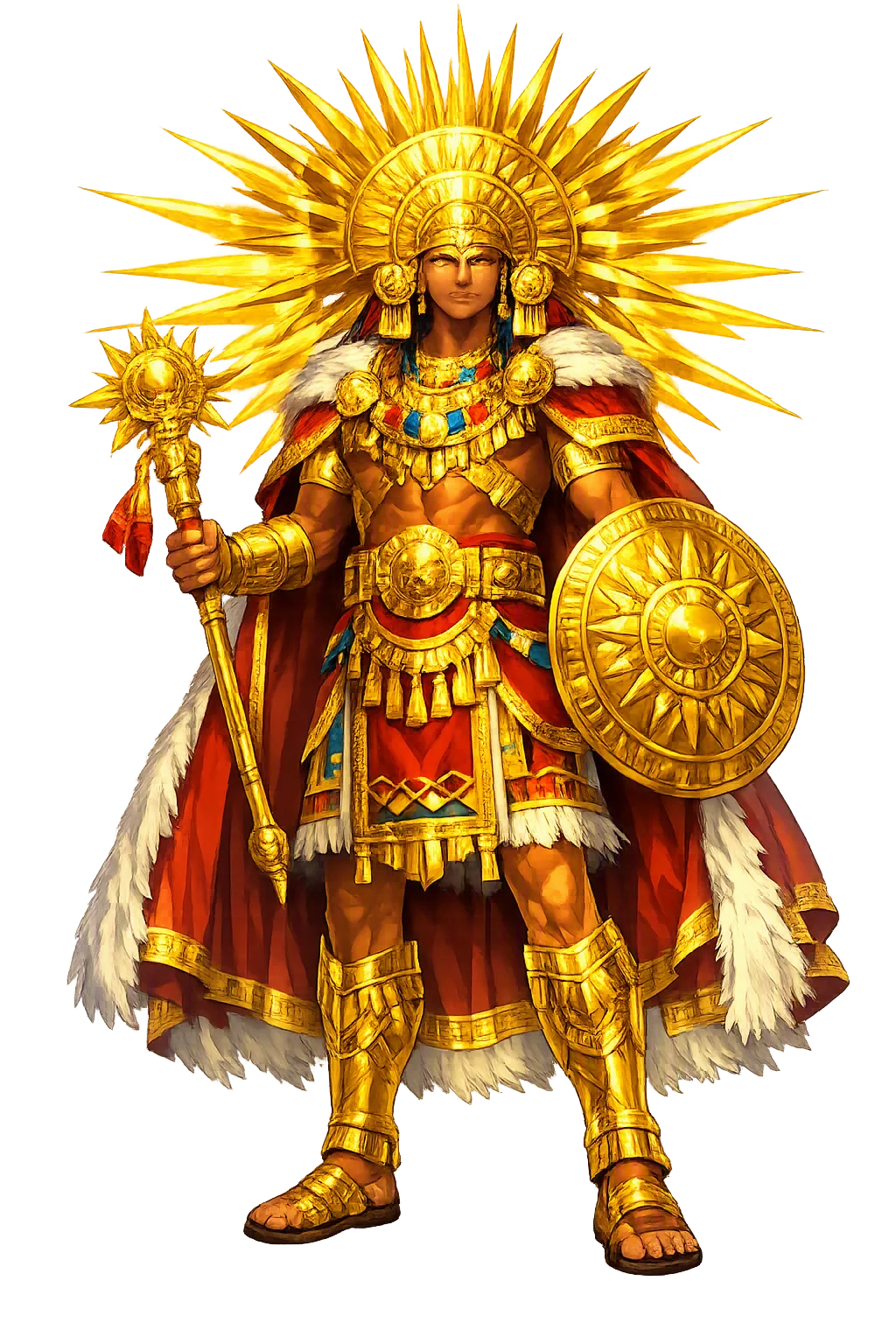
Sacred SymbolsThe Punchao idol, The Maskaypacha, Golden maize and llamas, The gilded eastern wall, The June solstice
02

Etymology & Word Family

From original script to Unicode restoration

Scholarly Transliteration Inti Inti — "Sun"
Unicode Restoration Inti Canonical scholarly spelling — ASCII-identical
Modern ASCII inti Plain-ASCII fallback

The name Inti reaches the modern world through scholarly transliteration of the incan tradition. Because the conventional spelling uses only Latin letters, its Unicode and ASCII forms coincide — the tradition it carries is in the name itself, not in diacritics.

03

Unicode Character Breakdown

Character-by-character philological analysis

CharacterUnicodeNameBlockPhonetic Role
IU+0049Latin Capital Letter IBasic LatinSame
nU+006ELatin Small Letter NBasic LatinSame
tU+0074Latin Small Letter TBasic LatinSame
iU+0069Latin Small Letter IBasic LatinSame

The Tier 2 classification here reflects fidelity to the attested tradition, not recovered diacritics: every character of Inti already survives in ASCII. What the restoration preserves is the canonical spelling itself — the form scholarship standardised.

04

Cult & Worship

How the sacred was kept — rites, sanctuaries, remains

The Cult

Inti's cult was a household enlarged to imperial scale, and its daily rhythm is unusually well documented because Spanish friars wrote it down before it vanished. In the Coricancha, the temple staff — led, the chroniclers say, by the villac-umu, high priest second only to the Sapa Inca — woke the Punchao each morning, washed and dressed it, and offered chicha and food as to a living father; the mummified dead emperors sat beside it as senior members of the family. Beyond the great June Inti Raymi, Cobo enumerates a festival in nearly every month, including the Situa, a city-wide purification of fasting, washing, and new fire. The cult reached beyond Cuzco through capacocha, the state rite that consecrated children on remote mountain peaks — frozen shrines at Llullaillaco and elsewhere have been excavated in our own time — and through the acllas, chosen women who wove the Sun's cloth and brewed his beer. Provincial worship rose on the usnu platforms of Vilcashuamán and Huánuco Pampa: the same father, fed from a thousand hearths.

In the Earth

The Coricancha — the Golden Enclosure — survives as foundations: the curved wall with the Twelve-Angled Stone (Hatunrumiyoc street) and the trapezoidal doorways and niches now enclosed by Santo Domingo. Nothing of the gold survives; the chroniclers' inventories (Cobo, Murúa) are its only catalogue. Platform-shrines called usnu at Vilcashuamán and Huánuco Pampa mark the provincial stages of the solar cult. The Island of the Sun in Lake Titicaca preserves Inca shrines at the myth's supposed source, including the sacred rock from which the founding siblings were sent. And at Sacsayhuamán above Cuzco the June sun still rises over the terrace where the modern Inti Raymi is performed — here the archaeology is partly a calendar.

05

Iconography

How Inti was imaged across the ages

The Image

The Inca sun was made of gold, so none of it survives to be imaged: Inti's iconography is a description of melted masterpieces. Cobo says the Coricancha bore a great gold plaque of the sun with a face and radiating rays, and that the Punchao itself — enthroned, human-sized, its face and rays of beaten gold, flanked by golden maize and llamas — was paraded on its litter at festivals. The sole near-contemporary picture of that procession is a watercolor in Martín de Murúa's illustrated chronicle, now at the Getty Museum, drawn from eyewitness memory within a generation of the conquest. Around these descriptions the Andean image of the sun froze early into its lasting form: a stern face ringed by alternating straight and wavy rays. That face drifts through colonial church decoration and Cuzco-school painting, and where pre-Columbian gold sun-faces surface in modern collections their provenance is usually debated. What is certain is what the image was for: not art in our sense, but an occupied body of the god.

06

Reception & Transformation

The name after its own age — transmission, translation, survival

Afterlives

Inti reached the modern world only on paper, and the paper is extraordinary. Betanzos (1557) wrote down what his wife's people told him; Sarmiento de Gamboa (1572) took formal testimony from the learned men of Cuzco; Murúa (1616) painted; Cobo (1653) condensed eyewitness sources now lost. Through these chronicles — and through Garcilaso de la Vega's Royal Commentaries (1609–17), which made the Inca a noble ancestor for European readers — the solar cult entered Western letters, where the Enlightenment filed it as the paradigmatic case of statecraft wearing a halo. The eighteenth-century bishop Martínez de Compañón sent Madrid a watercolor encyclopedia of Andean life, and in the nineteenth century romanticism crowned the Inca as the Americas' noble ancestor while Clements Markham's Hakluyt Society volumes made the chronicles readable in English. Twentieth-century scholarship converted lore into evidence: John Rowe's synthesis, R. T. Zuidema's ceque-system geometry of Cuzco's shrines, and the landscape archaeology of the past half-century have made the Sun's temple a problem of space, calendar, and roads — a research program still re-mapping how the empire fed its father.

Identifications Across Traditions

The conquest did not end Inti; it translated him. Spanish missionaries deliberately identified the sun with the Christian God, and the great church of Santo Domingo was planted directly on the Coricancha's foundations, its colonial vaults rising around the curved Inca walls that still hold them up. Extirpation campaigns under the viceroyalty hunted the surviving cult, and the last great idols of the old religion were destroyed in the 1570s. Yet the translation ran both ways: in the Andean highlands the sun kept his ancient festival day, and in 1944 the Cusco teacher Faustino Espinoza Navarro staged the first modern Inti Raymi at Sacsayhuamán — a theatrical revival, partly invented, that has grown into one of South America's great public rituals, drawing hundreds of thousands each June. The Inca sun survives less as doctrine than as performance: a name the conquest could not melt, re-lit every solstice above the city he founded.

Modern Legacy

Inti's name still circulates as money and memory. Peru's currency from 1985 to 1991 was the inti, and the sol that replaced it remembers the same sun. Cusco's civic emblems carry solar imagery, and the restored Inti Raymi has made the June solstice the city's defining modern feast, performed now in Quechua before an audience of the world. Across Bolivia and Ecuador the sun appears in indigenous political symbolism, and the vocabulary of Inca statehood — Sapa Inca, Coricancha, the sun's own child — remains the standard language of Andean identity. For scholarship, Inti is the paradigm case of religion as statecraft: a god engineered, with extraordinary sophistication, to make empire feel like family.

07

The Meditation

What Inti means — beyond the dictionary

Most sun gods are clocks or lamps. Inti is something rarer: a sun who is also a father, a title, and a border. To be his child was to hold an office; to hold the office was to be luminous by definition; and the whole astonishing apparatus of Inca civilization — the terraces, the storehouses, the road that runs along the equator — can be read as a household administered by the sun's eldest son. The theology solved the oldest problem of government: legitimacy. If the emperor is the sun's son, rebellion is not politics but eclipse, a darkness no subject can afford. Yet there is tenderness in it too: the Inca greeted his father each morning, feasted him at each solstice, and carried his image into battle as a banner of gold. The name restored here is the shortest genealogy in the Americas: Inti — the sun who adopted a nation.

08

Frequently Asked Questions

Common questions about Inti, Sun, Empire, Agriculture, and Unicode restoration

01How do you pronounce Inti?

In reconstructed pronunciation, Inti is /ˈin.ti/ — approximately 'IN-tee' — two even syllables with the weight on the first; the vowels are pure, the t light and unaspirated.

02What does Inti mean?

Inti means Sun in the incan tradition.

03What are the symbols of Inti?

Inti is associated with The Punchao idol (The great golden statue of Inti kept in the Coricancha: a round face with rays and a ceremonial fringe, tended each morning like a waking king (Cobo, Historia del Nuevo Mundo 13.14).), The Maskaypacha (The crimson tassel-fringe worn on the Sapa Inca's forehead, read as the sun's own rays — kingship made visible as light.), Golden maize and llamas (Life-sized gold offerings in the Coricancha's garden of the Sun: the staple crop and beast of burden presented to Inti in his own metal.), The gilded eastern wall (The sanctuary's eastern wall was a sheet of gold, catching the first light of the June solstice and setting the whole house of the Sun ablaze.), The June solstice (The pivot of Inti Raymi: the sun stands still, the emperor stands before it, and the year is renewed by being witnessed.).

04Why restore Inti in Unicode?

Inti is written entirely in ASCII letters, so its restoration is about canonical fidelity rather than recovered diacritics: the temple fixes the name in its scholarly standard spelling, attested in the source tradition, instead of leaving it to drift.

05What is the most important myth about Inti?

“Inti, Child of the Creator” — the Theogony story that anchors the mythology of Inti, told in full on the lore page.

09

Scholarly Sources

The philological foundations of this restoration

Every claim on this page is grounded in established scholarship. The orthographic restorations follow disciplinary convention. The etymological chain follows the best available reference works. This is not invention — it is resurrection through scholarship.

◈

Lexicography & Philology

  • Cerrón-Palomino
◎

Primary Texts

  • Primary sources in the incan tradition for Inti.
◉

Archaeology & Art History

  • Material evidence — iconography, inscriptions, and temple archaeology — for Inti and related cults.
✦

Religious Studies

  • Juan de Betanzos, Suma y Narración de los Incas (1557)
  • Pedro Sarmiento de Gamboa, Historia Indica (1572)
  • Bernabé Cobo, Historia del Nuevo Mundo (1653), books 13–14
  • Martín de Murúa, Historia general del Piru (1616)
  • D'Altroy, Terence N., The Incas (2002)
  • Bauer, Brian S., The Sacred Landscape of the Inca (1998)
Return

The Surface Awaits

You have traced the name from its earliest attestation to its Unicode restoration. Now return to the myth. The story is where the name lives.

Back to Lore
Inti mascot