PuniCodex

Extended Lore

इन्द्र Indra

Etymology · Orthography · Cult · Iconography · Reception · Sources

ASCII-equivalent form Indra
Indra — Storms, War, Kingship
01

Quick Facts

Essential information about Indra, Storms, War, Kingship

Original Scriptइन्द्र
Unicode RestorationIndra
Reconstructed Pronunciation/ˈɪndrə/
PantheonSanskrit
DomainStorms, War, Kingship
Meaningthe god of the atmosphere and sky
ClassificationASCII-equivalent form
Primary DomainIndra
Sacred SymbolsThe Vajra, Slayer of Vritra, Lord of Soma, The Thousand-Eyed
02

Etymology & Word Family

From original script to Unicode restoration

Original Script इन्द्र Indra — "the god of the atmosphere and sky"
Unicode Restoration Indra Canonical scholarly spelling — ASCII-identical
Modern ASCII indra Plain-ASCII fallback

The name Indra reaches the modern world through scholarly transliteration of the sanskrit tradition. Because the conventional spelling uses only Latin letters, its Unicode and ASCII forms coincide — the tradition it carries is in the name itself, not in diacritics.

03

Unicode Character Breakdown

Character-by-character philological analysis

CharacterUnicodeNameBlockPhonetic Role
IU+0049Latin Capital Letter IBasic LatinSame
nU+006ELatin Small Letter NBasic LatinSame
dU+0064Latin Small Letter DBasic LatinSame
rU+0072Latin Small Letter RBasic LatinSame
aU+0061Latin Small Letter ABasic LatinShort /a/

This restoration reflects fidelity to the attested tradition, not recovered diacritics: every character of Indra already survives in ASCII. What the restoration preserves is the canonical spelling itself — the form scholarship standardised.

04

Cult & Worship

How the sacred was kept — rites, sanctuaries, remains

The Cult

The Vedic cult of Indra centred on the soma-pressing: the great ritual whose three daily pressings were the engine of the storm-god’s power. His festival, the Indra-dhvaja, raised his banner at the monsoon’s onset — the ritual ancestor of every monsoon festival in the subcontinent.

In the Earth

No Indra temples survive in India — the Vedic cult was fire and libation, not image. But his name is carved across Southeast Asia: the seventh-century Sanskrit inscriptions of Cambodia invoke him as royal ancestor, and Borobudur’s reliefs show Śakra attending the Buddha.

05

Iconography

How Indra was imaged across the ages

The Image

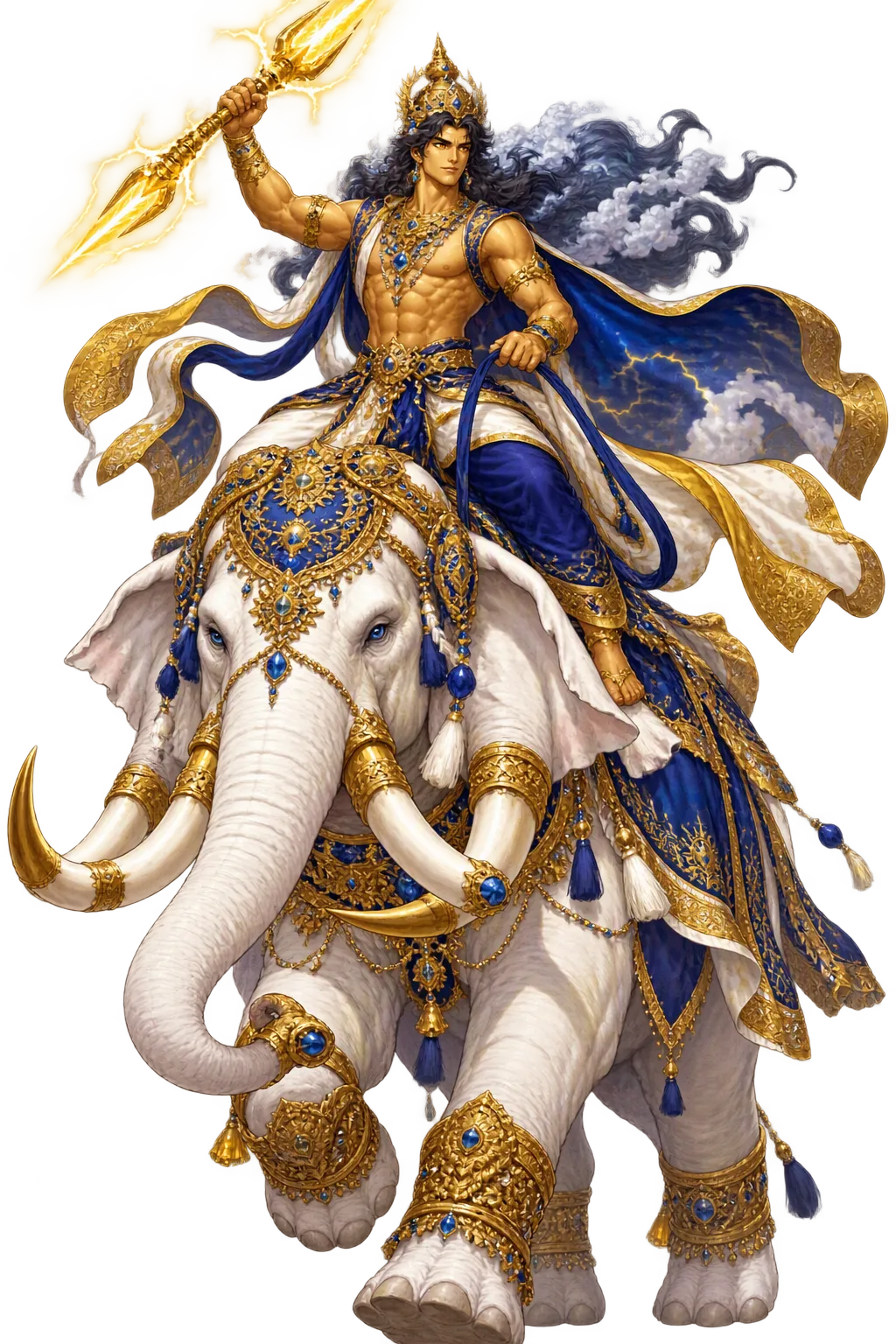
The thunderbolt in the raised right hand, the bow in the left; four arms in later iconography adding the goad and the lotus; his mount the white elephant Airāvata, his skin golden like the storm-light. The thousand eyes mark his body across his skin like stars.

06

Reception & Transformation

The name after its own age — transmission, translation, survival

Afterlives

Comparative mythology made Indra its cornerstone: the Vritra-combat mapped onto Thor’s, Zeus’, and Marduk’s victories established the field’s methods. In modern India, Indra survives in the monsoon’s personification, in the army’s missile named for his bolt, and in the unbroken recitation of the Rigveda itself — the oldest worship still vocally performed on earth.

Identifications Across Traditions

In Buddhism Indra becomes Śakra, lord of the Trāyastriṃśa heaven, subservient to the Buddha and guardian of the dharma — the storm-god converted into a devotee. In Jainism he is a class of heaven-rulers. Greek observers heard Zeus in him; modern comparative philology confirmed the kinship: Indra and Zeus descend from the same Proto-Indo-European sky-father’s thunderbolt.

Modern Legacy

He is embedded in the oldest Indo-European poetry extant — every study of dragon-slaying, thunder-gods, or soma/haoma ritual begins with him. The word ‘Indra’ entered Southeast Asian royal names (Indravarman, Indrapura) carried by Hindu expansion; and the Vajra passed east into Tibetan Buddhism as the thunderbolt-sceptre of the vajrayāna itself.

07

The Meditation

What Indra means — beyond the dictionary

Indra: a name with no diacritics because it never needed any — the retroflex consonants of the Vedic hymns sit quietly inside plain letters, as they have since the first singer pressed soma. To restore him in ASCII is to hand the thunderbolt back to the oldest god who still answers to the spelling a schoolchild would guess.

08

Frequently Asked Questions

Common questions about Indra, Storms, War, Kingship, and Unicode restoration

01How do you pronounce Indra?

In reconstructed pronunciation, Indra is /ˈɪndrə/ — approximately “IN-druh” — the final vowel breathes rather than lands.

02What does Indra mean?

Indra means the god of the atmosphere and sky in the sanskrit tradition.

03What are the symbols of Indra?

Indra is associated with The Vajra (The thunderbolt forged from the bones of the sage Dadhichi — Indra’s irresistible weapon against the dragon.), Slayer of Vritra (He split the dragon that held the waters captive, and the rivers ran free — the founding victory of cosmic order.), Lord of Soma (The sacred draught that makes gods gods: Indra drinks the soma press before every battle.), The Thousand-Eyed (His body bears a thousand eyes — the marks of the gods’ curse and his redemption; the sky’s innumerable lights.).

04Why restore Indra in Unicode?

Indra is written entirely in ASCII letters, so its restoration is about canonical fidelity rather than recovered diacritics: the temple fixes the name in its scholarly standard spelling, attested in the source tradition, instead of leaving it to drift.

05What is the most important myth about Indra?

“The Slaying of Vritra” — the Rigveda 1.32 story that anchors the mythology of Indra, told in full on the lore page.

09

Scholarly Sources

The philological foundations of this restoration

Every claim on this page is grounded in established scholarship. The orthographic restorations follow disciplinary convention. The etymological chain follows the best available reference works. This is not invention — it is resurrection through scholarship.

◈

Lexicography & Philology

  • MW
  • KEWA
◎

Primary Texts

  • Rigveda 1.32 (the Vritra combat)
  • Rigveda 8 (soma hymns to Indra)
  • Rigveda 10.119 (the intoxication hymn)
  • Śatapatha Brāhmaṇa 1.6.3 (the Dadhichi legend)
◉

Archaeology & Art History

  • Material evidence — iconography, inscriptions, and temple archaeology — for Indra and related cults.
✦

Religious Studies

  • Mahābhārata & Purāṇic Indra-cycle
Return

The Surface Awaits

You have traced the name from its earliest attestation to its Unicode restoration. Now return to the myth. The story is where the name lives.

Back to Lore
Indra mascot