The Living Myth
Storms, War, Kingship · The Storm, the Vajra, King of the Gods · the god of the atmosphere and sky
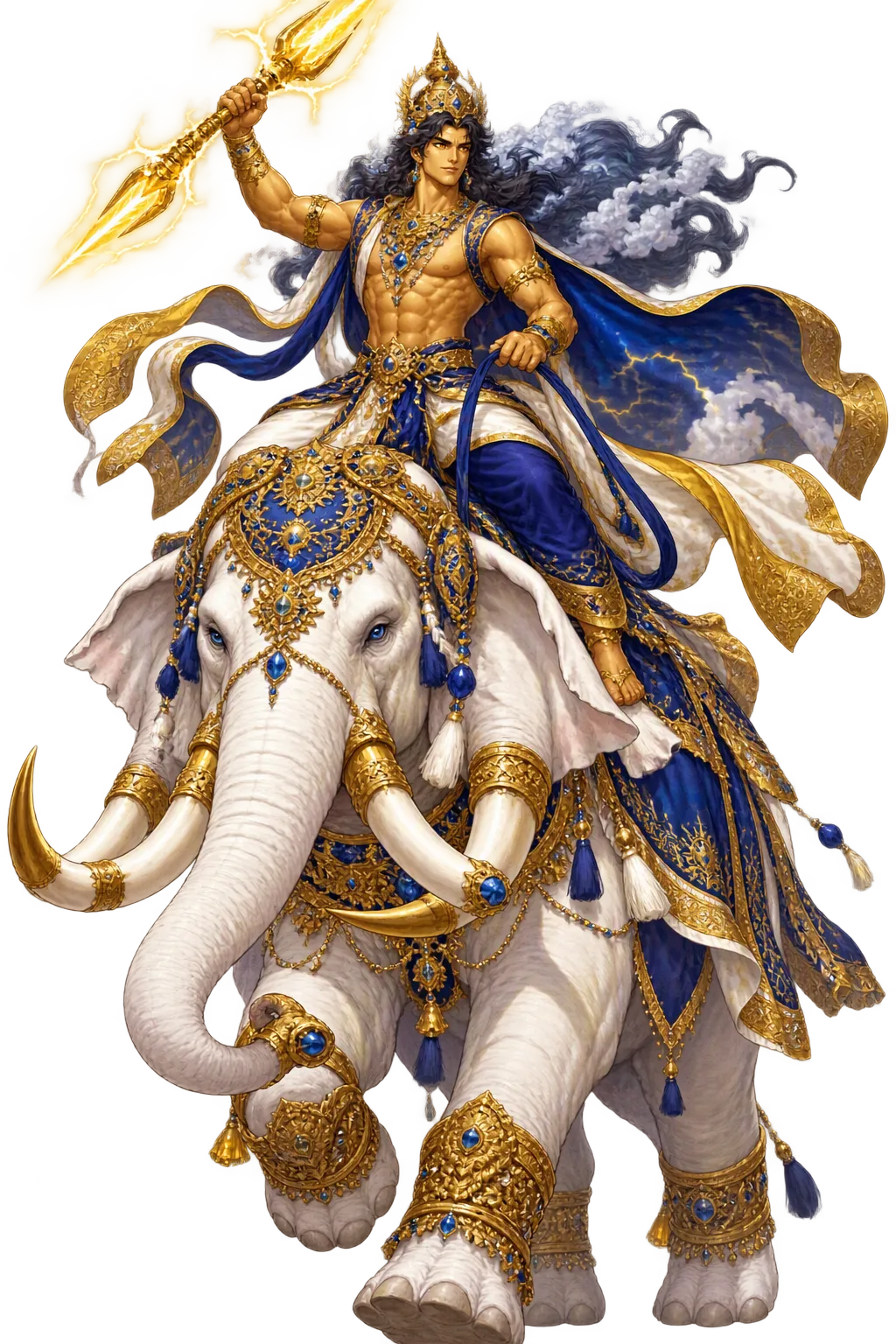
Stories of Indra
The Indra of the Rigveda is a storm in divine form: mighty, boisterous, sometimes embarrassed, always central. His one great myth — the combat with Vritra — is the Vedic creation story: the waters of life imprisoned by the dragon, the thunderbolt that splits the mountains, the rivers released. Everything else in his mythology is commentary on that victory.
Vritra, the “Enveloper”, coiled about the world’s waters and held them fast in his mountain caves. Indra, armed with the vajra forged by Tvashtri from Dadhichi’s bones, struck the dragon on its flank; the waters burst free and flooded to the sea. ‘Like lowing cows the waters rushed’ — the oldest dragon-slaying in recorded literature, and the template for every one after it.
Before the combat, Indra drinks three lakes of soma pressed by the priests; filled with the draught, his strength is irresistible and his belly vast. The hymns taunt and flatter him by turns — the Vedic poets knew their storm-god was vain, and loved him for it. Soma is both his fuel and his fee.
The most human hymn in the Rigveda: Indra speaks in the first person, drunk on soma, boasting — ‘I will break the earth’s two halves apart, like a gourd I will break the two worlds’. The gods’ king, for one hymn, sounds like a warrior at the feast, and the poets let him.
In the later epics the balance shifts: Vishnu’s avatars take the great victories, and Indra becomes the anxious king who sins — the seducer of Ahalyā, the raider of Triparu, the god who must yield his throne’s preeminence. The Purāṇas preserve a dignity-muted Indra, still lord of the eastern quarter and of the storm, but no longer the cosmos’ protagonist.
The Dragon-Slayer of the Rigveda
Indra is the king of the Vedic gods: the thunderbolt-bearer who slew the dragon Vritra and released the rivers, the drinker of soma who roars into battle, the thousand-eyed lord of the sky. Two hundred and fifty hymns of the Rigveda are addressed to him — more than to any other deity — making him the best-documented god of the ancient world.
The thunderbolt forged from the bones of the sage Dadhichi — Indra’s irresistible weapon against the dragon.
He split the dragon that held the waters captive, and the rivers ran free — the founding victory of cosmic order.
The sacred draught that makes gods gods: Indra drinks the soma press before every battle.
His body bears a thousand eyes — the marks of the gods’ curse and his redemption; the sky’s innumerable lights.
From the original script to the living URL
इन्द्र
The name in its original Sanskrit form. Indra (इन्द्र) is attested in the source tradition — “the god of the atmosphere and sky”. Its original diacritics and script distinctions carry the full phonetic and orthographic weight of the source tradition.
indra
The plain indra form is identical to the Unicode restoration. Because this name is already written in Latin letters, no diacritics, stress, or script information were lost — only capitalization differs.
Indra
The Unicode restoration does not need to recover lost marks for Indra. Its value is canonical spelling and consistent cataloguing, not the reconstruction of erased orthography. The domain is readable as-is to both DNS and humanity.
Indra.com
This restoration is written entirely in ASCII letters — no Punycode encoding stands between Indra and the DNS. The domain reads identically to machines and to human eyes.
The attested spelling family of Indra
Indra
Restores इन्द्र. The full Unicode restoration. indra.com is not in the PuniCodex collection — it is watched for release; if it drops, this temple upgrades to an owned flagship. Attested by MW, KEWA.
How Indra was spoken
How Indra travels from ancient script to the modern URL
The lore you have read is the living myth. Extended Lore opens the scholarly vault beneath it: the cult and its material remains, a history of the image, the name after antiquity, a meditation on what the name still means, and the full scholarly apparatus — etymology, orthography, sources.
Enter Extended Lore