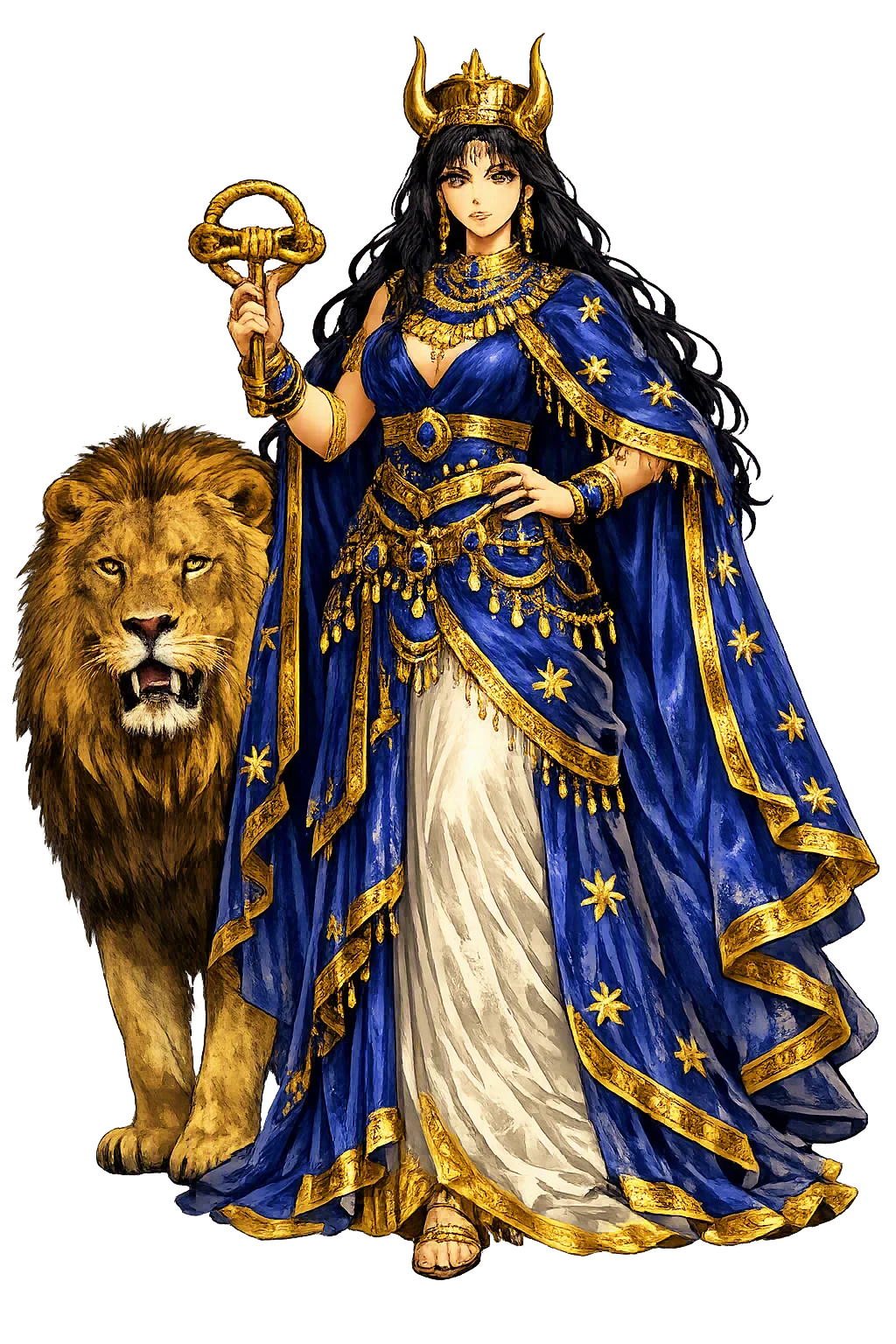
Stories of Inanna
Inanna's myths are stories of extremity and transformation. She descends into the underworld, demands the impossible, and returns from death. She chooses a shepherd-king as her bridegroom and then sends him to the realm of the dead for half the year. Her narratives are not morality tales; they are meditations on sovereignty, desire, death, and the price of rebirth.
In the Sumerian Descent of Inanna (ETCSL c.1.4.1), the goddess abandons heaven and earth to descend to the netherworld ruled by her sister Ereškigal. At each of the seven gates the gatekeeper Neti strips her of a garment or ornament — crown, scepter, beads — until she stands naked before the throne of the dead. Ereškigal fixes on her the eye of death; Inanna is killed and hung on a hook. Her faithful servant Ninšubur, waiting at the gate, pleads with Enlil and Nanna and is refused; Enki answers, creating from the dirt of his fingernails two beings, gala-tura and kur-jara, fashioned without male or female parts, who slip past the underworld's guardians and revive her with the food and water of life. But the judges of the dead will not let her go free: someone must take her place, and the one she finds sitting unmourned on her throne is Dumuzi. The myth is a meditation on death, sovereignty, and the price of rebirth: she who went below returns with the dead man's shadow attached to her, and the underworld keeps its claim.
The sacred-marriage songs celebrate the union of Inanna and Dumuzi, the shepherd-king: 'my honey-man, my honey-man sweetens me always', runs one of the bridal hymns of Uruk, among the earliest love poetry known. Their lovemaking ensures the fertility of the land and the legitimacy of the king, whose reign was ritually ratified as the goddess's marriage. In the Descent, however, the bride becomes the judge: Inanna fastens on Dumuzi the eye of death and sends him below for half the year, while his devoted sister Geštinanna offers to share the doom, so the two alternate, each six months in the realm of the dead. The myth explains the cycle of the seasons and the alternating presence of life and death in the agricultural year — but it also refuses the sentimental reading: the same desire that raises the king to his throne hands him over to the pit.
The tale survives fragmentarily, on school tablets of the Old Babylonian period, and was reconstructed by S. N. Kramer from its broken lines. Inanna plants a huluppu tree — a willow-like species, unidentified — in her holy garden at Uruk, and tends it for the throne and bed she means to cut from its trunk. But three beings take it: the serpent 'who could not be charmed', the storm-bird Anzu, and the dark maid Lilith (the ki-sikil-lil-la-ke of the Sumerian). Inanna appeals to Gilgameh: the hero slays the serpent with his axe, and the bird and the maid flee into the desolate places. From the freed wood Inanna fashions her throne and bed — the furniture of sovereignty. The story links the goddess to kingship, the civilising of wild nature, and the dangerous thresholds between order and chaos; its heroines and monsters were still moving westward three thousand years later, when the Lilith of this tale surfaced in Talmudic and Kabbalistic legend.
In Inanna and Enki (ETCSL c.1.3.1), the goddess sails the Boat of Heaven to Eridu to visit her father Enki, the god of wisdom. He receives her with a banquet; the beer and wine flow, Enki grows merry, and to each toast he grants a gift — the me, the divine powers and norms that constitute civilization: kingship, priesthood, truth, the crafts, the making of music, sexual arts, and the rules of city life, over a hundred of them. When Enki sobers and regrets his largesse, the me are already loaded on Inanna's boat and bound for Uruk. He sends the monsters of sea and land to seize the cargo; one after another they bar the way, and Inanna answers each with cunning until the Boat of Heaven reaches her city, where she is acclaimed. Enki concedes at last: 'What has been spoken cannot be unsaid.' The myth is Uruk's charter of cultural primacy — wisdom walks out of Eridu as a party trick — and its heroine's method is the point: civilization is not guarded by the wisest but seized by the boldest.
In the epic Enmerkar and the Lord of Aratta (ETCSL c.1.8.2.3), Inanna favours the king of Uruk and supports his campaign to subdue the legendary city of Aratta, whose lord commands the mountains and claims the goddess for his own. The two kings trade riddling challenges through a messenger, and Enmerkar, guided by dreams and by Inanna's counsel, presses his rival to submission without a single battle in the surviving text. The tale dramatises her role as divine patron of kings and the strategic advantage conferred by her cult centre at Uruk: a king with Inanna's ear holds, in effect, the ear of heaven. Its interest for readers is the portrait of sovereignty it assumes — power resolved by wit, message, and divine favour more than by the sword — with the goddess as the umpire both kings must persuade.
Love, War, and the Morning Star
Inanna is the Sumerian great goddess whose domain stretches across the heavens and the human heart. She is the planet Venus as both morning and evening star, the force of sexual desire and fertility, the frenzy of battle, and the sovereign power that legitimises kings. No other deity of ancient Mesopotamia so thoroughly refuses to be one thing: she is the lover and the warrior, the bride and the conqueror, the star that crosses from the eastern to the western horizon and back again.
Venus in the dawn sky; Inanna is the celestial sign whose rising marks time, royalty, and the renewal of desire.
Sacred marriage, reproductive power, and the life-giving force that turns desire into offspring and fields into harvest.
She rides into battle with weapons at her shoulders; kings invoke her as patron of campaigns and conquest.
The goddess who bestows and withdraws kingship; her favour is the divine charter of Sumerian rulers.
From the original script to the living URL
𒀭𒈹
The name in its original Mesopotamian form. Inanna (𒀭𒈹) is attested in the source tradition — “Lady of heaven”. Its original diacritics and script distinctions carry the full phonetic and orthographic weight of the source tradition.
inanna
The plain inanna form is identical to the Unicode restoration. Because this name is already written in Latin letters, no diacritics, stress, or script information were lost — only capitalization differs.
Inanna
The Unicode restoration does not need to recover lost marks for Inanna. Its value is canonical spelling and consistent cataloguing, not the reconstruction of erased orthography. The domain is readable as-is to both DNS and humanity.
Inanna.com
This restoration is written entirely in ASCII letters — no Punycode encoding stands between Inanna and the DNS. The domain reads identically to machines and to human eyes.
Owned, ideal, and ASCII forms of Inanna
Inanna
Restores 𒀭𒈹. The full Unicode restoration. inanna.com is not in the PuniCodex collection — it is watched for release; if it drops, this temple upgrades to an owned flagship.
How Inanna was spoken
How Inanna travels from ancient script to the modern URL
Sumerian nin-an-na “lady of heaven"; the goddess was worshipped at Uruk and later syncretised with Akkadian Ištar.
The lore you have read is the living myth. Extended Lore opens the scholarly vault beneath it: the cult and its material remains, a history of the image, the name after antiquity, a meditation on what the name still means, and the full scholarly apparatus — etymology, orthography, sources.
Enter Extended Lore