PuniCodex

Extended Lore

𒀭𒈹 Inanna

Etymology · Orthography · Cult · Iconography · Reception · Sources

Tier 2 Inanna
Inanna — Love, War, Venus
01

Quick Facts

Essential information about Inanna, Love, War, Venus

Original Script𒀭𒈹
Unicode RestorationInanna
Reconstructed Pronunciation/iˈnan.na/
PantheonMesopotamian
DomainLove, War, Venus
MeaningLady of heaven
ClassificationTier 2
Primary DomainInanna
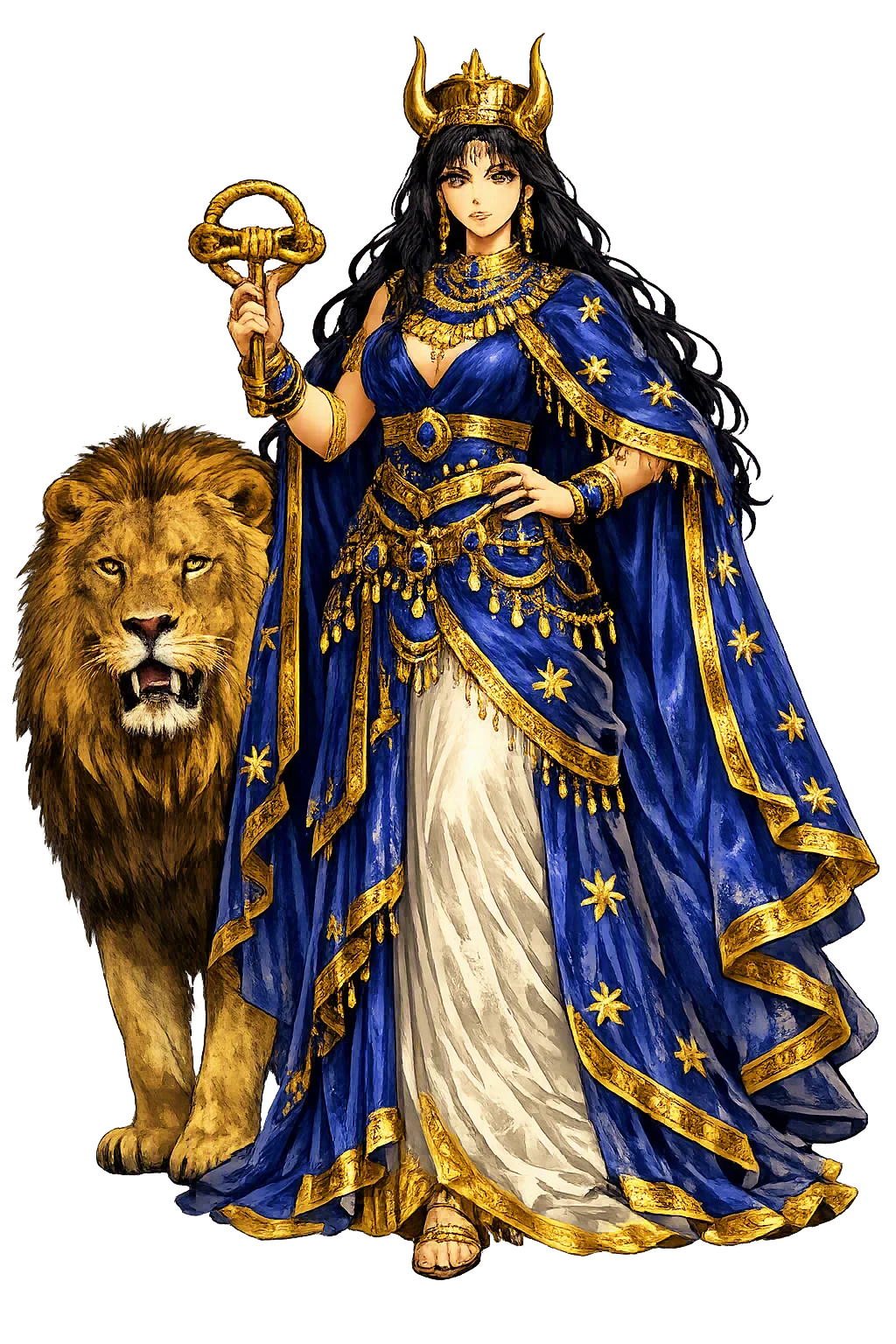
Sacred SymbolsEight-pointed star, Lion, Reed bundle, Rosette
02

Etymology & Word Family

From original script to Unicode restoration

Original Script 𒀭𒈹 Inanna — "Lady of heaven"
Unicode Restoration Inanna Canonical scholarly spelling — ASCII-identical
Modern ASCII inanna Plain-ASCII fallback

The name Inanna reaches the modern world through scholarly transliteration of the mesopotamian tradition. Because the conventional spelling uses only Latin letters, its Unicode and ASCII forms coincide — the tradition it carries is in the name itself, not in diacritics.

03

Unicode Character Breakdown

Character-by-character philological analysis

CharacterUnicodeNameBlockPhonetic Role
IU+0049Latin Capital Letter IBasic LatinSame, capitalized
nU+006ELatin Small Letter NBasic LatinSame
aU+0061Latin Small Letter ABasic LatinSame
nU+006ELatin Small Letter NBasic LatinSame
aU+0061Latin Small Letter ABasic LatinSame

The Tier 2 classification here reflects fidelity to the attested tradition, not recovered diacritics: every character of Inanna already survives in ASCII. What the restoration preserves is the canonical spelling itself — the form scholarship standardised.

04

Cult & Worship

How the sacred was kept — rites, sanctuaries, remains

The Cult

Inanna’s sanctuary was the Eanna, ‘House of Heaven,’ at Uruk — excavated from 1912 by the German Oriental Society, its temple sequence running unbroken from the Uruk period into the Seleucid age. There the goddess received the king as bridegroom: the sacred-marriage hymns of Iddin-Dagan of Isin and Šulgi of Ur made the union of goddess and sovereign the charter of fertility and rule. Her personnel included the gala, lamentation-priests whose liturgies addressed her in the first person, and her household consumed vast rations — the archaic tablets from Uruk already tally barley for her cult. Votive life was dense: cylinder seals by the thousand pressed her star, lion, and rosette into clay, and worshippers left figurines and plaques at her shrines from the fourth millennium onward. Her star watched the sky; her house anchored the city that became the first city — and credited her.

In the Earth

The Eanna precinct at Uruk — 'House of Heaven' — preserves the sequence of Inanna temples from the Uruk period onward, source of the archaic cylinder seals that first display her star, lion, and rosette. Thousands of personal names, royal inscriptions, and incantations attest her presence in daily religion from the third millennium to the last generations of cuneiform scribes.

05

Iconography

How Inanna was imaged across the ages

The Image

The eight-pointed star is her signature: Venus reduced to geometry, crowning her tiara and stamped on seals from the late fourth millennium onward. Around it gathered a fixed kit — the reed-bundle sign that writes her name, the rosette of fertility, and the lion she strides upon or grips on leashes. The earliest full narrative image is the Warka Vase (c. 3200–3000 BCE, Iraq Museum): on its top register the horned goddess, framed by reed-ring posts, receives a procession of nude priests bearing offerings — Inanna’s cult rendered in alabaster. The marble ‘Lady of Uruk’ head, found beside her precinct, is often called her portrait; the identification is attractive but unproven. Later kudurru boundary stones set her star among the gods’ emblems, Neo-Assyrian art pairs it with rampant lions, and the so-called Queen of the Night relief (British Museum) was long read as Inanna-Ištar, though many scholars now argue for Ereškigal. Her image, like her cult, is a palimpsest — every era sharpening the same star.

06

Reception & Transformation

The name after its own age — transmission, translation, survival

Afterlives

Inanna’s transmission is the longest continuous career of any deity in these pages: she never disappeared, she changed languages. Sumer sang her; Akkad renamed her Ištar and carried the hymns to Babylon, Assur, and Nineveh; the West Semites said Astarte and planted her from Tyre to the Bible’s condemned ‘Queen of Heaven’ of Jeremiah. Herodotus (1.105) already knew the oldest sanctuary of Aphrodite Urania at Ascalon and traced the cult’s road to Cyprus. Then the cuneiform line went dark — until the nineteenth century, when Botta’s and Layard’s Assyrian palaces, Rawlinson’s decipherment, and George Smith’s reading of the Gilgamesh flood (1872) put Ištar back on the page. The two descents — the Akkadian and the Sumerian original — were edited in the decades around 1900; Thorkild Jacobsen’s Treasures of Darkness (1976) gave Sumerian theology its modern classic form, and Wolkstein and Kramer’s Inanna (1983) carried her poems to a general readership. What traveled through it all is one brilliant, mobile complex — the star, the descent, the sovereign bride — proof that a name can be translated out of one language and still keep rising.

Identifications Across Traditions

Inanna was so thoroughly identified with the Akkadian Ištar from the Old Akkadian period onward that the two are now treated as a single deity across most of Mesopotamian history. Through Ištar she was equated with the West Semitic Astarte, the Hurrian Šauška, and the Egyptian Qudshu, and she contributed features to the Iranian goddess Anāhitā. The Greeks identified her with Aphrodítē in her eastern, armed form. In the Hebrew Bible, her star and cult shadow the 'Queen of Heaven' denounced by Jeremiah.

Modern Legacy

Inanna's afterlife is inseparable from that of Ištar/Astarte. Her eight-pointed star persists in Near Eastern and occult symbolism, and her Descent has been read as a precursor to later underworld journeys from Orpheus to Christ. In modern scholarship she has become a central figure in feminist re-readings of ancient religion, admired for her autonomous sexuality and her refusal to accept the limits imposed by gods or mortals. Her sacred-marriage hymns, some of the earliest love poetry known, continue to be translated and performed.

07

The Meditation

What Inanna means — beyond the dictionary

Inanna asks us to hold opposites together. She is the morning star and the evening star, the bride and the warrior, the goddess who descends into death and returns clothed in her own power. In a world that likes its deities sorted by function, she is a reminder that the most ancient sacred forces were polymorphous: desire and violence, fertility and mourning, all braided into a single brilliant light.

To restore the name Inanna is to refuse the flattening of the feminine divine into mere beauty or mere nurturing. She is the terror of the battlefield and the tenderness of the bridal chamber; the goddess who weeps for the flood's victims and sends the Bull of Heaven to avenge her pride. Her star still rises.

08

Frequently Asked Questions

Common questions about Inanna, Love, War, Venus, and Unicode restoration

01How do you pronounce Inanna?

In reconstructed pronunciation, Inanna is /iˈnan.na/ — approximately 'ee-NAHN-nah' — stress the second syllable, keep the vowels bright, and let the double n sound like a held tongue against the ridge.

02What does Inanna mean?

Inanna means Lady of heaven in the mesopotamian tradition.

03What are the symbols of Inanna?

Inanna is associated with Eight-pointed star (The sign of Venus, her planet; the star disk crowns her tiara and writes her name in cuneiform.), Lion (Her warlike aspect and royal mount; she stands upon lions as mistress of battle.), Reed bundle (The cuneiform sign 𒈹 that writes her name, a stylised bundle of reeds linking her to the marshes of Sumer.), Rosette (The fertility emblem attached to her cult from the Uruk-period cylinder seals onward.).

04Why restore Inanna in Unicode?

Inanna is written entirely in ASCII letters, so its restoration is about canonical fidelity rather than recovered diacritics: the temple fixes the name in its scholarly standard spelling, attested in the source tradition, instead of leaving it to drift.

05What is the most important myth about Inanna?

“Inanna's Descent to the Netherworld” — the The Descent story that anchors the mythology of Inanna, told in full on the lore page.

09

Scholarly Sources

The philological foundations of this restoration

Every claim on this page is grounded in established scholarship. The orthographic restorations follow disciplinary convention. The etymological chain follows the best available reference works. This is not invention — it is resurrection through scholarship.

◈

Lexicography & Philology

  • ETCSL
  • Black-Green
◎

Primary Texts

◉

Archaeology & Art History

  • Material evidence — iconography, inscriptions, and temple archaeology — for Inanna and related cults.
✦

Religious Studies

  • Electronic Text Corpus of Sumerian Literature, Oxford Oriental Institute, 1998.
  • Black & Green, Gods, Demons and Symbols of Ancient Mesopotamia.
  • Jacobsen, The Treasures of Darkness: A History of Mesopotamian Religion.
  • Kramer, The Sumerians.
  • George, The Babylonian Gilgamesh Epic: Introduction, Critical Edition and Cuneiform Texts.
  • Wolkstein & Kramer, Inanna: Queen of Heaven and Earth.
Return

The Surface Awaits

You have traced the name from its earliest attestation to its Unicode restoration. Now return to the myth. The story is where the name lives.

Back to Lore
Inanna mascot