PuniCodex

Extended Lore

Ὑπερίων Hyperíōn

Etymology · Orthography · Cult · Iconography · Reception · Sources

Tier 1 Hyperíōn.com
Hyperíōn — Light, Heavenly Watch
01

Quick Facts

Essential information about Hyperíōn, Light, Heavenly Watch

Original ScriptὙπερίων
Unicode RestorationHyperíōn
Reconstructed Pronunciation/hy.pe.rí.ɔːn/
PantheonGreek
DomainLight, Heavenly Watch
MeaningHe who goes above (from ὑπέρ)
ClassificationTier 1
Primary DomainHyperíōn.com
Sacred SymbolsThe Vault of Heaven, The Sun's Rays, The Chariot of Day, The Three Luminaries, The Watchman's Station
02

Etymology & Word Family

From original script to Unicode restoration

Original Script Ὑπερίων Hyperíōn — "He who goes above (from ὑπέρ)"
Unicode Restoration Hyperíōn Restored stress, length, and script
Modern ASCII hyperion Plain-ASCII fallback

The name Hyperíōn carries the orthographic signature of the greek tradition: Ὑπερίων. Unicode restoration recovers what ASCII flattens.

03

Unicode Character Breakdown

Character-by-character philological analysis

CharacterUnicodeNameBlockPhonetic Role
HU+0048Latin Capital Letter HBasic LatinRough breathing
yU+0079Latin Small Letter YBasic LatinUpsilon
pU+0070Latin Small Letter PBasic LatinPi
eU+0065Latin Small Letter EBasic LatinShort epsilon
rU+0072Latin Small Letter RBasic LatinRho
íU+00EDLatin Small Letter I with AcuteLatin-1 SupplementShort iota
ōU+014DLatin Small Letter O with MacronLatin Extended-AOmega: long omicron
nU+006ELatin Small Letter NBasic LatinNu

The Tier 1 classification reflects how much of the original phonology this restoration preserves — stress and vowel length for Greek names, distinctive letters and diacritics for every other tradition.

04

Cult & Worship

How the sacred was kept — rites, sanctuaries, remains

The Cult

No independent cult of Hyperíōn is attested in the Greek world; Pausanias, who is usually scrupulous about recording altars of even minor figures, gives him none. His presence in ritual was mediated through his son Hēlios, especially at Rhodes, where the Sun received a major state cult and the famous bronze Colossus rose in the harbour. The absence of a sanctuary of his own reflects his purely genealogical role in Hesiod: he is a Titan of light whose luminous function was transferred to his children, Hēlios, Sēlēnē, and Eōs. Any modern commemoration is therefore a literary or astronomical one, not a cultic survival.

In the Earth

No temple, sanctuary, or civic cult of Hyperíōn is securely attested anywhere in the Greek world; Pausanias, who records altars of such Titans as Kronos and Iapetus, offers him no shrine. He was honoured, if at all, within the cult of his son Hēlios — above all at Rhodes, where the Sun received a major state cult and the great bronze Colossus — so his archaeological trace survives only folded into his children's worship. His monument is textual rather than stone: the name that Homer and Hesiod carved into the language of light, and that Greek-speakers used as the sun's most dignified title for a thousand years.

05

Iconography

How Hyperíōn was imaged across the ages

The Image

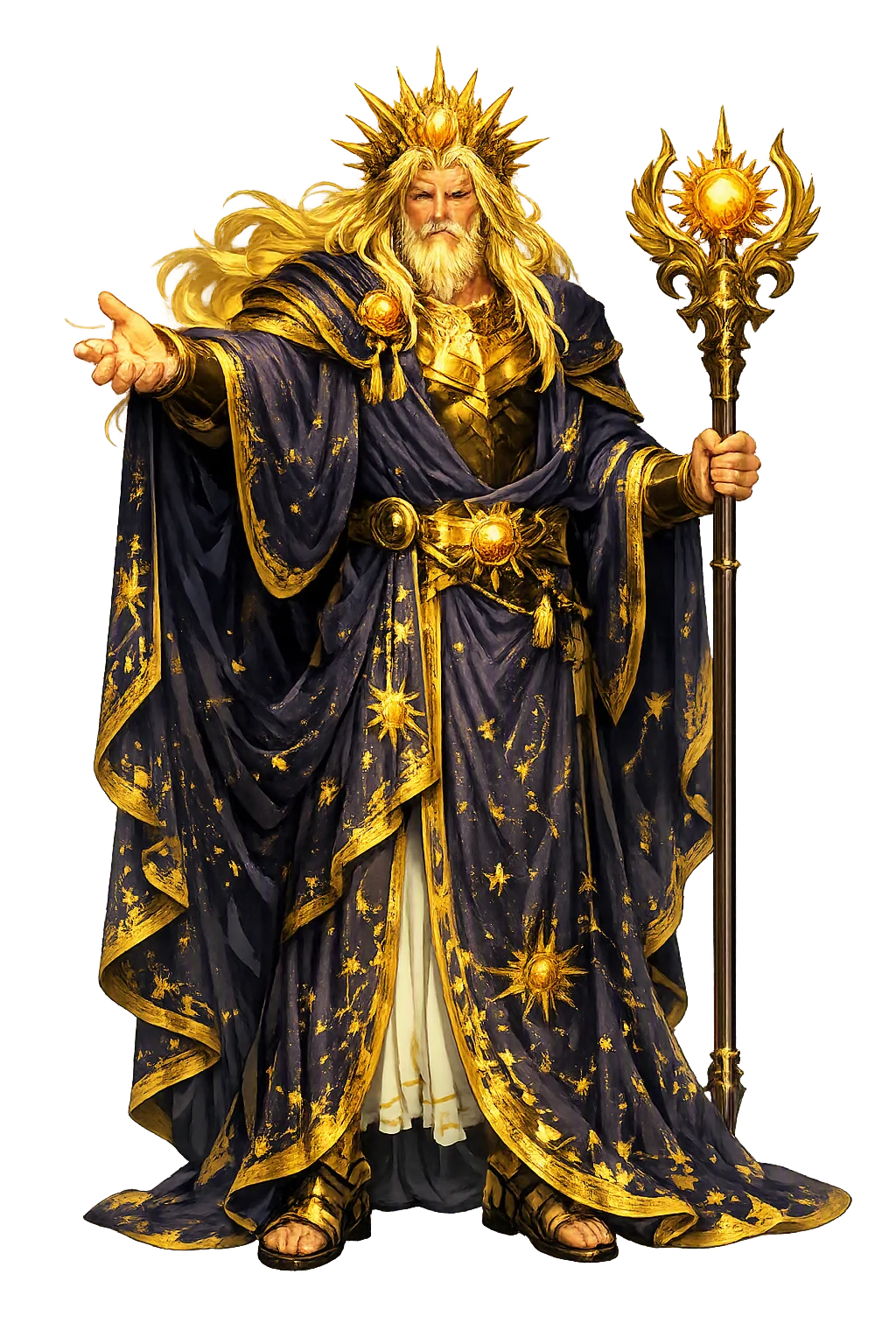
Hyperíōn has almost no independent iconographic tradition. Greek vase painters and sculptors preferred his radiate son Hēlios for the chariot of the sun; Hyperíōn himself remains a name in genealogies rather than a body in art. Occasionally a Titanomachy scene will include an unnamed bearded figure who might be identified with him by modern scholars, but no canonical attribute distinguishes him. His visual afterlife is therefore modern and allegorical — he appears in Romantic and Pre-Raphaelite paintings as a personification of cosmic light, and in contemporary astronomical illustrations as a name attached to moons of Saturn and exoplanets rather than to a recognisable ancient image.

06

Reception & Transformation

The name after its own age — transmission, translation, survival

Afterlives

Hyperíōn's afterlife is overwhelmingly onomastic and literary. The name was reused for one of Saturn's moons, discovered by Bond and Lassell in 1848 and chosen to extend the Saturnian mythological nomenclature begun by Herschel, and it has since been attached to exoplanets, space habitats, and high-energy-physics projects. In English literature the Titan became the title figure of John Keats's unfinished epic Hyperion (1818–1819), a meditation on the fall of the old gods before Apollo, and the name reappears in Friedrich Hölderlin's novel Hyperion (1797–1799), where it signals a Greek longing for lost wholeness. Renaissance and Baroque mythographers listed him dutifully as a Titan of light, but without cult or image he served mainly as a genealogical bridge to Hēlios. Modern fantasy and science fiction continue to borrow the name for ships, planets, and corporations, while classical scholarship treats him as a case study in the reduction of a once-potent cosmic power to a placeholder.

Identifications Across Traditions

Rome produced no native Hyperion; the Titan travelled into Latin letters chiefly as a learned name for the sun itself, the Hesiodic father and the Homeric epithet collapsing into one solar word in the poets. Hyginus still lists him soberly among the Titans born of Earth and Sky (Fabulae, praefatio), but in later epic usage 'Hyperion' rides the sky in place of Sol, and Hellenistic poets — Oppian, Quintus of Smyrna — use the name where Homer would have said 'Helios', keeping the Titan alive as a word long after any cult he never had could have died. What survived of him in the West was thus not a cult but a word — the most elevated name Latin and English poetry knew for the sun, from Homer through Keats to modern astronomical usage.

Modern Legacy

Hyperíōn's deepest modern life is linguistic: the English prefix 'hyper-' (hyperactive, hyperlink, hyperspace) descends from ὑπέρ, the very root of his name — every 'hyper-' word unknowingly repeats 'he who goes above'. The Titan himself was given fresh stature by Keats's unfinished epic Hyperion (1820), which made his fall after the Titanomachy a meditation on the succession of gods and the poet's own eclipse by a newer generation. Astronomers named Saturn's moon Hyperion at its discovery in 1848, and the tallest known living tree on Earth, a coast redwood in California, was named Hyperion in 2006 — the High One still lends his name to things that out-top everything around them.

07

The Meditation

What Hyperíōn means — beyond the dictionary

The Greeks gave Hyperíōn almost no cult, no temple, and no character — and that absence is the datum a scholar should trust. He is less a god one worshipped than a piece of the world's grammar: the name that lets Hesiod explain why the sky has lights, and lets Homer call the sun by its noblest title. There is a quiet ambivalence in him: a defeated Titan, chained in the dark below Tartarus' gates, whose name nevertheless means the summit and whose children are the daily proofs of heaven's order. He endures as the rare Titan whose legacy is not a deed but a direction: upward. When Keats picked him as the tragic figure of a dying generation, he chose the one Titan whose defeat is written in the sky every morning — for the sun, Hyperion's son, rises without fail over the world that defeated his father.

08

Screen & Culture

Where Hyperíōn echoes through film, television, and games — and how

09

Frequently Asked Questions

Common questions about Hyperíōn, Light, Heavenly Watch, and Unicode restoration

01How do you pronounce Hyperíōn?

In reconstructed pronunciation, Hyperíōn is /hy.pe.rí.ɔːn/ — approximately 'hü-peh-REE-ohn' — round the lips for Hy- (the ü of German 'über'), strike the accent hard on -rí-, and let the final -ōn ring long.

02What does Hyperíōn mean?

Hyperíōn means He who goes above (from ὑπέρ) in the greek tradition.

03What are the symbols of Hyperíōn?

Hyperíōn is associated with The Vault of Heaven (His name declares it: from ὑπέρ, 'above', he is 'he who goes above' — the upper sky made personal, the height from which all light descends.), The Sun's Rays (In Iliad 8 (479–481) the rays are 'of Hyperion the Sun' (Ὑπερίονος Ἠελίοιο) — Homer speaks the name as a solar title, whether patronymic or epithet.), The Chariot of Day (Through his son Hēlios, who drives the four-horse chariot across the sky each day; later poets collapse father and son, and 'Hyperion' rides as the sun itself.), The Three Luminaries (Sun, Moon, and Dawn — his children by Theía (Theogony 371–374); his true emblem is genealogical, the whole family of sky-lights.), The Watchman's Station (As the one above, he holds the high lookout of heaven — the Titan whose vantage is the zenith itself, from which nothing on earth is hidden.).

04Why restore Hyperíōn in Unicode?

Plain ASCII hyperion strips the stress, length, and script that make the name specific. Unicode restoration returns the name to its original written dignity.

05What is the most important myth about Hyperíōn?

“A Son of Heaven and Earth” — the Titan Blood story that anchors the mythology of Hyperíōn, told in full on the lore page.

10

Scholarly Sources

The philological foundations of this restoration

Every claim on this page is grounded in established scholarship. The orthographic restorations follow disciplinary convention. The etymological chain follows the best available reference works. This is not invention — it is resurrection through scholarship.

◈

Lexicography & Philology

  • Liddell, H. G., Scott, R., & Jones, H. S. A Greek-English Lexicon. Oxford: Clarendon Press, 9th ed. 1996.
  • Pape, W., & Benseler, G. E. Wörterbuch der griechischen Eigennamen. Braunschweig: Vieweg, 1884.
  • Beekes, R. S. P. Etymological Dictionary of Greek. Leiden: Brill, 2010.
◎

Primary Texts

  • Hesiod
  • Theogony
  • Homer
  • Iliad
  • Odyssey
  • Pindar
◉

Archaeology & Art History

  • Material evidence — iconography, inscriptions, and temple archaeology — for Hyperíōn and related cults.
✦

Religious Studies

  • Hyginus
Return

The Surface Awaits

You have traced the name from its earliest attestation to its Unicode restoration. Now return to the myth. The story is where the name lives.

Back to Lore
Hyperíōn mascot