
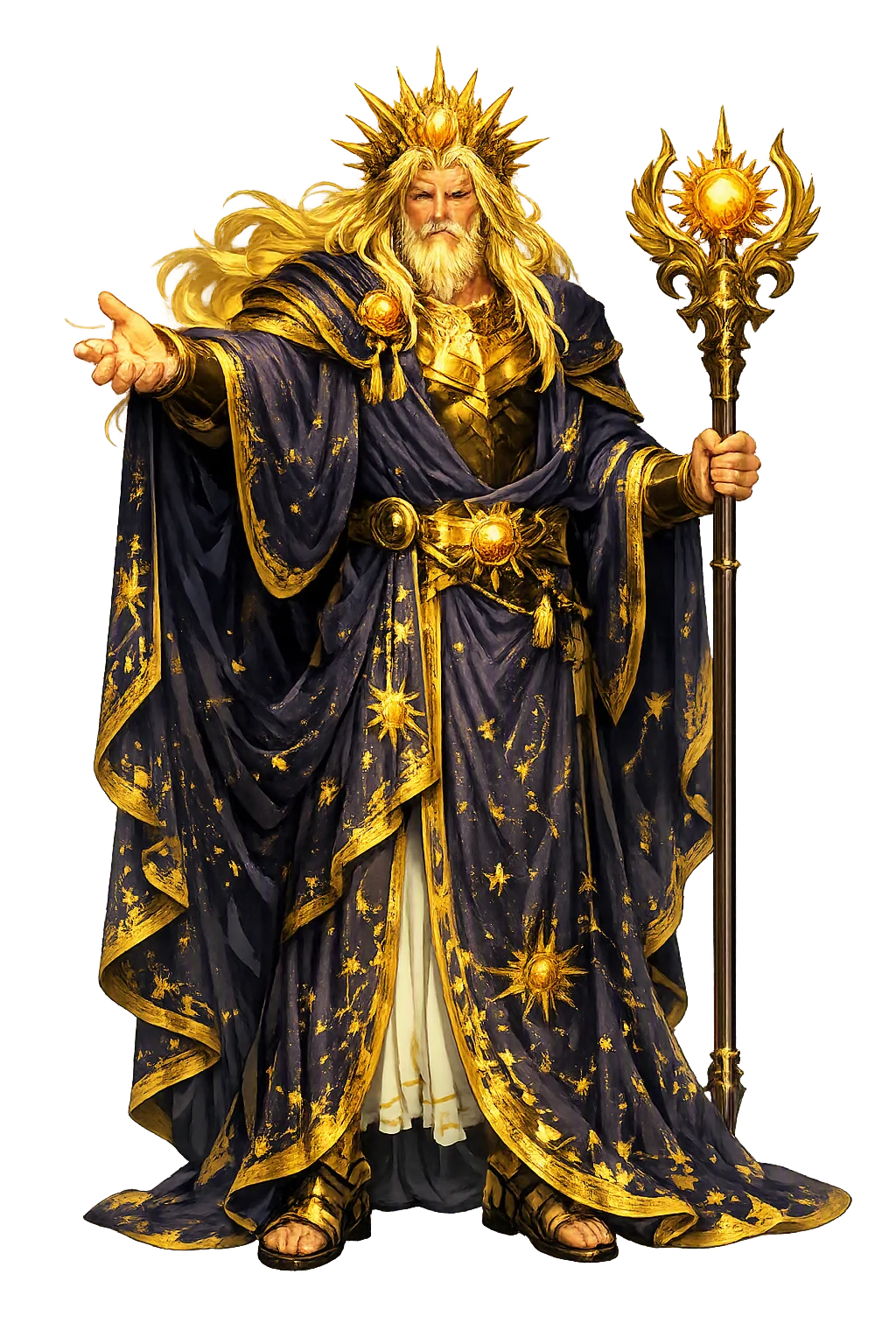
The hidden history behind Hyperiōn
Behind the modern ASCII form hyperion hides a much longer story. Hyperiōn reaches back through manuscripts, inscriptions, and oral tradition long before it ever touched a keyboard, and every mark in the restored spelling is a receipt from that journey. In what follows we trace the name from its Greek attestations through its mythology, its cult, its symbols, and its afterlife in other cultures — and we show how the PuniCodex project turned that philological record into a Unicode domain that resolves today. The history was never lost. It was only waiting for the infrastructure to catch up.
At a Glance
- Restored name: Hyperiōn
- ASCII form: hyperion
- Meaning: "He who goes above (from ὑπέρ)"
- Domain of influence: Light, Heavenly Watch
- Pantheon: Greek
- Classification: Tier 1
- Original script: Ὑπερίων (Greek)
- Live domain: hyperíōn.com
Overview
Hyperiōn (hyperion) — Light, Heavenly Watch · He who goes above (from ὑπέρ) — belongs to the Greek tradition, where it is catalogued under the domain "Light, Heavenly Watch". The name means "He who goes above (from ὑπέρ)".
Hyperíōn is the High One — the Titan whose very name, from ὑπέρ, means 'he who goes above'. Hesiod makes him the bridge between the raw sky and its fires: son of Ouranos and Gaia, husband of Theía, and father of every light that crosses the heavens — Hēlios the Sun, Selḗnē the Moon, and Ēṓs the Dawn (Theogony 371–374). He has almost no story of his own; he is the genealogy of light itself, and in Homer his name is already spoken as a name of the sun.
PuniCodex restores the name as Hyperiōn and serves its temple at hyperíōn.com. The original carries both stress and vowel length, and exactly one historically valid Unicode restoration exists, which places the name in Tier 1. The plain ASCII form hyperion survives as a modern convenience imposed by the early domain-name system; the restoration, not the fallback, is the form the project defends as philologically complete.
The Name
The name is attested in Greek as Ὑπερίων. Etymologically it means "He who goes above (from ὑπέρ)".
The ASCII form hyperion survives only because the early domain-name system could not carry diacritics; it is a technological compromise, not an ancient spelling. The Unicode restoration Hyperiōn recovers the vowel length of the original directly in the address bar. The original carries both stress and vowel length, and exactly one historically valid Unicode restoration exists, which places the name in Tier 1.
The letter-by-letter transformation runs:
- h → H — Rough breathing
- y → y — Upsilon
- p → p — Pi
- e → e — Short epsilon
- r → r — Rho
- i → i — Short iota
- o → ō — Omega: long omicron
- n → n — Nu
Attested and derived spellings of the name:
- Hyperíōn — owned form: Owned domain form — the Greek accent of Ὑπερίων itself (acute on í plus macron on ō)
The project holds the domain hyperíōn.com (xn--hypern-7va28e.com) as the canonical home of this name.
The Original Script
The name is written in Greek as Ὑπερίων. This original script is the form against which the ASCII fallback hyperion and the PuniCodex restoration Hyperiōn are measured: the restoration preserves its vowel quantity of the written form, so that a reader typing the modern address still speaks the ancient name.
Pronunciation
The reconstructed pronunciation of the name is /hy.pe.rí.ɔːn/ — Attic Greek Reconstruction.
Phoneme by phoneme:
- Hy- — Rough breathing plus upsilon: a breathy /h/ before the close front rounded vowel /y/ — a sound English lacks, nearest to French 'tu' or German 'über'.
- -pe- — Unaspirated /p/ followed by a short, open /e/; light and quick, carrying no stress.
- -rí — A trilled /r/ closing on short iota, which bears the acute accent — the high pitch of the word falls here.
- -ōn — Long omega (ω), held roughly twice the length of a short vowel, closed by the final nasal; the length is part of the name, not an ornament.
For the modern speaker, the closest approximation is: 'hü-peh-REE-ohn' — round the lips for Hy- (the ü of German 'über'), strike the accent hard on -rí-, and let the final -ōn ring long.
Kindred and historical forms of the name:
- Greek — ὑπέρ (hyper), 'over, above, beyond' — the name parses as 'he who goes above', the Titan of the upper sky
- PIE — *upér, 'over' — whence Latin super, Sanskrit upári, and English both 'over' and the prefix 'hyper-'
Tier-1: the Greek original Ὑπερίων carries both a stress mark (the acute on the iota) and a long vowel (ω), and the restoration Hyperíōn preserves both — the í keeps the accent where Hesiod's auditors heard it, and the ō keeps the quantity of the omega. Both features survive in the Unicode form; the ASCII 'Hyperion' loses them.
Mythology
Hyperíōn is a Titan of lineage rather than adventure: Hesiod gives him a birth, a marriage, three luminous children, and a fall — and almost nothing else. His myths are the myths of what his name means and of what his name became.
A Son of Heaven and Earth (Titan Blood)
In Theogony (132–136), Hesiod catalogues the children Gaia bore to Ouranos: the deep-swirling Ocean, then Coeus, Crius, Hyperion, and Iapetus, and with them the Titanesses — Theía, Rheía, Thémis, Mnēmosýnē, Phoíbē, and Tēthýs — and finally Krónos, 'crooked-counselled, the most terrible of her children'. Hyperíōn enters the poem with no deed attached, only a station: his name already declares it, from ὑπέρ, 'above'. He is born of the union of Sky and Earth and belongs to the sky's own house. Hesiod's silence about his character is itself telling — this Titan is a fixture of the high order of things, not a personality.
Father of Sun, Moon, and Dawn (The Luminaries)
In Theogony (371–374), Hyperíōn takes his sister Theía — 'the divine one' — to wife, and she bears him Hēlios the Sun, Selḗnē the Moon, and Ēṓs the Dawn, 'who shines on all that dwell on the earth and on the deathless gods who hold broad heaven'. The marriage is a small cosmology in itself: the High One wed to the Divine produces every light that crosses the sky. Pindar opens Isthmian 5 by addressing Theía as 'mother of the Sun, of many names', the hymn-like acknowledgement of this same union. Through his children, Hyperíōn is present at every sunrise, moonrise, and daybreak — he never leaves the sky he fathered onto it.
Hyperion in Homer (Name of the Sun)
Homer never treats Hyperíōn as a separate god: the name arrives already fused with the sun. In Iliad 8 (479–481), Zeus pictures the nether gloom where Iápetos and Krónos sit 'rejoicing neither in the rays of Hyperion the Sun (Ὑπερίονος Ἠελίοιο) nor in the winds', and Odyssey 1 (8) opens the Thrinakía story with the same compound, 'Hyperion the Sun'. Scholars divide honestly on the grammar: is Ὑπερίων here a patronymic — the Sun as 'son of Hyperion' — or an epithet — the Sun himself as 'the one above'? Both readings have ancient defenders, and later Greek and Roman poets simply settle it by usage, letting 'Hyperion' stand alone as the sun. The ambiguity is old and probably unresolvable; it is also the whole point — the Titan's name was always tending toward the light.
Cast into Tartarus (The Fall)
In Theogony (717–720), after ten years of war between the Titans and the Olympians, Zeus and his allies bind the defeated Titans and hurl them into Tartarus, 'as far beneath the earth as heaven is above the earth; for so far is it from earth to murky Tartarus'. Hyperíōn, who stood with the Titans against Zeus, shares that fall; Hesiod names the prisoners collectively and gives him no individual scene. The poetic logic is stark: the one called 'he who goes above' is sent to the deepest below, where the rays that Homer calls his cannot reach. His children ride free overhead — the lights of the sky survive their father's imprisonment.
Symbols & Iconography
The iconography associated with Hyperiōn concentrates in a small set of recurring attributes, each a compressed statement about the name:
- The Vault of Heaven — His name declares it: from ὑπέρ, 'above', he is 'he who goes above' — the upper sky made personal, the height from which all light descends.
- The Sun's Rays — In Iliad 8 (479–481) the rays are 'of Hyperion the Sun' (Ὑπερίονος Ἠελίοιο) — Homer speaks the name as a solar title, whether patronymic or epithet.
- The Chariot of Day — Through his son Hēlios, who drives the four-horse chariot across the sky each day; later poets collapse father and son, and 'Hyperion' rides as the sun itself.
- The Three Luminaries — Sun, Moon, and Dawn — his children by Theía (Theogony 371–374); his true emblem is genealogical, the whole family of sky-lights.
- The Watchman's Station — As the one above, he holds the high lookout of heaven — the Titan whose vantage is the zenith itself, from which nothing on earth is hidden.
- The Chains of Tartarus — After the Titanomachy he shares the Titans' prison 'as far beneath the earth as heaven is above the earth' (Theogony 717–720) — the High One brought low.
Hyperiōn has no iconography of his own: no inscribed vase, no bronze, no relief securely names him among the Titans, and the LIMC catalogs him only under his son. He survives pictorially as inheritance — the attributes of Hēlios are the visual estate of 'the one who goes above.'
- The rising quadriga — Hēlios mounts his four-horse chariot out of the Ocean at dawn; a fixture of Attic black- and red-figure from the sixth century, catalogued under LIMC VII.1, s.v. 'Helios'.
- The Parthenon team — the horses of Hēlios surge from the sea at the corner of the east pediment, Selēnē's sinking opposite (British Museum, c. 438–432 BC): the solar chariot frozen in Pentelic marble.
- The rayed halo — the radiate crown, spikes of light fanning from the head, becomes Hēlios's signature from the fourth century; the facing radiate Sun on Rhodian silver coinage is its earliest mass-produced image.
- The harbor colossus — Chares of Lindos's bronze Sun at Rhodes, seventy cubits high, the cult image par excellence of the solar line Hyperiōn fathers.
- The Roman heir — Sol radiate with globe and whip crowns the imperial age: the Sun tondo of the Arch of Constantine (AD 315) still drives the quadriga of 'the one above.'
Epithets & Cult Titles
The tradition names Hyperiōn through a small set of titles, nearly all of them mediated by his children — he is a god known by relation, not by cult acclamation.
- Ὑπερίων (Hyperíōn) — 'he who goes above'; in the Odyssey the name can belong to the Sun himself, who 'took from them their day of homecoming' — the standing Homeric ambiguity of father and son.
- Ὑπεριονίδης (Hyperionídēs) — 'son of Hyperiōn,' the patronymic under which Hēlios is hymned; the hymn makes Hyperiōn husband of his sister Euryphaessa and father of Ēōs, Selēnē, and Hēlios.
- Τιτήν (Titā́n) — 'the Titan'; fourth of the six Titan sons of Ouranos and Gaia, the brood their father stamps as 'the Strainers, presumptuous' (Τιτῆνας ἀτασθάλους).
- Ὑπεριονίη (Hyperioníē) — Orphic address of the Sun under the father's name outright; the late hymn sings the son as Hyperiōn.
- ὁ ὑπὲρ ἰών (ho hypèr iṓn) — the ancient etymological gloss, 'the one going above' (from ὑπέρ, 'over,' and εἶμι, 'go'), that the lexica preserve for the name.
The Homeric Hymns
No hymn to Hyperiōn survives. The collection of thirty-three addresses nearly every power of the pantheon, but hymnic attention follows the visible god — and the visible god is the son. What we have instead is Homeric Hymn 31, To Helios, a prelude of some nineteen lines that gives Hyperiōn his fullest hymnic notice precisely as a father. The poet bids Calliope sing of the Sun 'whom mild-eyed Euryphaessa, the far-shining, bare to the son of Earth and starry Heaven': Hyperiōn weds his own sister, and she bears rosy-armed Ēōs, rich-tressed Selēnē, and tireless Hēlios, who shines for mortals and immortal gods alike. The genealogy is Hesiod's — Theia, elsewhere named for Euryphaessa, bears the same triple brood to Hyperiōn — compressed into song. The later Orphic tradition completes the merger the hymn implies: its hymn to the Sun addresses him outright as 'Hyperioníē,' collapsing father into son. The absence of a hymn of his own is therefore not a gap to apologize for but the very shape of the god: Hyperiōn is the name behind the light, hymned only through what he fathers.
Oracle Sites & Sanctuaries
No cult of Hyperiōn is anywhere attested: no temenos, no altar, no image, no oracle bears his name. Pausanias, walking the whole of Greece in ten books, records sanctuaries of the Sun only as curiosities within other gods' precincts; of Hyperiōn he is silent, and the silence is diagnostic. The Titans are, in the main, genealogy rather than worship — the generation that is overthrown, not the generation that is prayed to. What sanctity attaches to the name flows entirely through the son. At Rhodes, Hēlios was the island's divine partner: Pindar tells how the god, absent when Zeus portioned out the earth, claimed the island still rising from the sea, and how his Rhodian descendants first offered on the acropolis of Lindos the 'fireless sacrifice,' having forgotten to bring fire. The island's later thanksgiving for that lot was the Colossus, the bronze Sun of Chares of Lindos, seventy cubits high, standing fifty-six years until an earthquake threw it down. Hyperiōn's oracle is thus the sky itself: he is the watcher above, 'he who goes above,' and the Greeks left him there — seen, not consulted.
Archaeology & Evidence
No temple, sanctuary, or civic cult of Hyperíōn is securely attested anywhere in the Greek world; Pausanias, who records altars of such Titans as Kronos and Iapetus, offers him no shrine. He was honoured, if at all, within the cult of his son Hēlios — above all at Rhodes, where the Sun received a major state cult and the great bronze Colossus — so his archaeological trace survives only folded into his children's worship. His monument is textual rather than stone: the name that Homer and Hesiod carved into the language of light.
Realm & Domain
Hyperíōn is the High One — the Titan whose very name, from ὑπέρ, means 'he who goes above'. Hesiod makes him the bridge between the raw sky and its fires: son of Ouranos and Gaia, husband of Theía, and father of every light that crosses the heavens — Hēlios the Sun, Selḗnē the Moon, and Ēṓs the Dawn (Theogony 371–374). He has almost no story of his own; he is the genealogy of light itself, and in Homer his name is already spoken as a name of the sun.
Celestial Light
The Heavenly Watch
Progenitor of the Luminaries
Across Cultures
Rome produced no native Hyperion; the Titan travelled into Latin letters chiefly as a learned name for the sun itself, the Hesiodic father and the Homeric epithet collapsing into one solar word in the poets. Hyginus still lists him soberly among the Titans born of Earth and Sky (Fabulae, praefatio), but in later epic usage 'Hyperion' rides the sky in place of Sol. What survived of him in the West was thus not a cult but a word — the most elevated name Latin poetry knew for the sun.
Kindred figures in the PuniCodex cross-tradition index include Apóllōn, Dažbog, Hēlios, Huītzilōpōchtli, Rꜥ, and Šamaš, each linked through sun / light.
Cultural Legacy
Hyperíōn's deepest modern life is linguistic: the English prefix 'hyper-' (hyperactive, hyperlink, hyperspace) descends from ὑπέρ, the very root of his name — every 'hyper-' word unknowingly repeats 'he who goes above'. The Titan himself was given fresh stature by Keats's unfinished epic Hyperion (1820), which made his fall after the Titanomachy a meditation on the succession of gods. Astronomers named Saturn's moon Hyperion at its discovery in 1848, and the tallest known living tree on Earth, a coast redwood in California, was named Hyperion in 2006 — the High One still lends his name to things that out-top everything around them.
The Scholarly Record
The account of Hyperiōn given in this edition rests on the witnesses and reference works listed below. Lexica and etymological dictionaries secure the form and meaning of the name; the literary and religious texts supply the narrative evidence.
- Liddell-Scott-Jones Greek-English Lexicon, 9th ed. with 1996 supplement, 1940. Full text
- Etymological Dictionary of Greek, 2 vols., Brill, 2010. Full text
- Hesiod, Theogony / Works and Days / Shield, Loeb Classical Library No. 57, 700 BCE. Full text
- Theogony.
- Homer, Iliad / Odyssey, Loeb Classical Library / Oxford Classical Texts, 750 BCE. Full text
- Homer, Iliad, Oxford Classical Texts (Monro & Allen); Loeb, 750 BCE. Full text
- Odyssey.
- Pindar, Victory Odes (Olympian, Pythian, Nemean, Isthmian), Loeb Classical Library, 438 BCE. Full text
- Hyginus.
A Meditation
The Greeks gave Hyperíōn almost no cult, no temple, and no character — and that absence is the datum a scholar should trust. He is less a god one worshipped than a piece of the world's grammar: the name that lets Hesiod explain why the sky has lights, and lets Homer call the sun by its noblest title. There is a quiet ambivalence in him: a defeated Titan, chained in the dark below Tartarus' gates, whose name nevertheless means the summit and whose children are the daily proofs of heaven's order. In Hyperíōn the Greeks caught a truth about succession — the old order falls, but what it fathered goes on shining. He endures as the rare Titan whose legacy is not a deed but a direction: upward.
The Unicode Restoration
Hyperiōn is classified as Tier 1: the original carries both stress and length, and only one valid Unicode restoration exists. The ASCII fallback hyperion still resolves everywhere, but it is the restored form that carries the name's full information. Across the 8 characters of the name, the restoration adjusts 1: 1 mark of length (ō). That is the whole thesis of this temple: the marks are the message.
The Domain Name
The restored name is live as a working domain: hyperíōn.com, which the DNS carries in punycode form as xn--hypern-7va28e.com — an ASCII-compatible encoding that lets a non-ASCII name travel the global network without breaking older infrastructure. The visitor sees Hyperiōn; the machines see the encoding. That duality is the engineering compromise on which the entire restoration rests, and it is why a name written the way its own tradition wrote it in Greek can now be typed into any browser on earth.
Why This Restoration Matters
The story of Hyperiōn did not end in antiquity; it changed medium. Names that survive for millennia do so because each generation finds a new carrier for them — clay, papyrus, print, and now DNS. The PuniCodex restoration simply makes the carrier honest: the spelling that resolves is the spelling the evidence supports. If this post showed anything, it is that hyperion and Hyperiōn are not the same name with different styling. They are a summary and the text it summarizes. The web can now serve the text.
Explore Further
This post is one doorway into the temple. The home page carries the full character breakdown and the ambient canvas; the lore page tells the myths in long form; the Scholarly Edition preserves the sources, pronunciation data, and revision history; and the patron wall supports the restoration directly. For the wider map, browse the Lexicon, explore the Pantheon, or return to the PuniCodex blog.
Related Names
Sources
The full scholarly apparatus — every citation, revision, and review — lives in the Scholarly Edition. Key references for this post:
- Liddell-Scott-Jones Greek-English Lexicon, 9th ed. with 1996 supplement, 1940.
- Etymological Dictionary of Greek, 2 vols., Brill, 2010.
- Hesiod, Theogony / Works and Days / Shield, Loeb Classical Library No. 57, 700 BCE.
- Homer, Iliad / Odyssey, Loeb Classical Library / Oxford Classical Texts, 750 BCE.
- Homer, Iliad, Oxford Classical Texts (Monro & Allen); Loeb, 750 BCE.
- Pindar, Victory Odes (Olympian, Pythian, Nemean, Isthmian), Loeb Classical Library, 438 BCE.
- Theogony.
- Odyssey.
- Hyginus.
- Homeric Hymn 31, To Helios (Hyperion wed to Euryphaessa; father of Eos, Selene, Helios).
- Lexicon authorities for this entry: LSJ, Pape-Benseler, Beekes.