
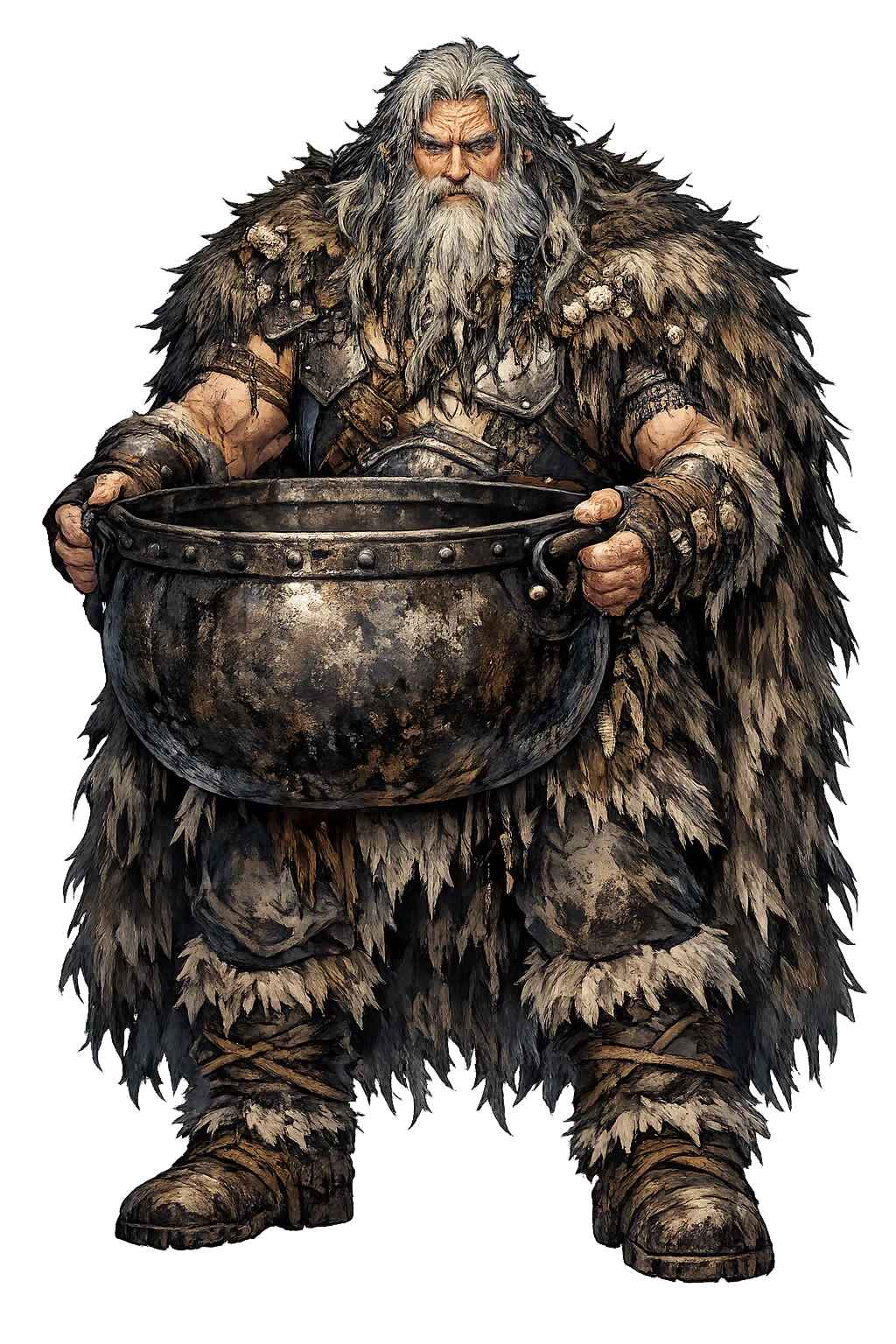
From Younger Futhark to Unicode: the journey of Hymir
Long before it was a domain, this name traveled through scripts. Hymir begins in Younger Futhark, passes through scholarly transliteration, and ends — for now — inside the punycode machinery of the global DNS. Each stage of that journey preserves some information and loses some, and the craft of restoration is knowing exactly which marks matter. This post follows the name stage by stage: the original script, the reconstructed pronunciation, the mythological record, the material evidence, and finally the Unicode form that carries all of it into the address bar. Think of it as a biography of a name, told through its spelling.
At a Glance
- Restored name: Hymir
- ASCII form: hymir
- Meaning: "Dark one"
- Domain of influence: Giant, Owner of Cauldron
- Pantheon: Norse
- Classification: Tier 2
- Original script: ᚼᚢᛘᛁᚱ (Younger Futhark)
Overview
Hymir (hymir) — Giant, Owner of Cauldron · the Dark One of Heaven's End — is the sea-giant of Hymiskviða: the fierce host east of the Élivágar whose hall stands on his herd of cattle, whose treasure is the mile-deep cauldron Ægir demands for the brewing of the gods' ale, and whose fishing-trip with Þórr becomes the most famous of all the thunder-god's adventures.
The etymology is uncertain: the name is usually connected with Old Norse hum ‘darkness, dusk’, whence the traditional gloss ‘dark one’. The poem makes him Týr's father — a filiation the corpus elsewhere contradicts, since Snorri counts Týr among Óðinn's sons — and gives him the Edda's fullest portrait of a giant household: a loathsome nine-hundred-headed grandmother, a golden-browed mother who hides the guests under the great kettle, three oxen for supper, and a crystal cup no pillar can crack.
PuniCodex restores the name as Hymir — identical to the ASCII input, because normalized Old Norse writes no diacritic in this name. The mechanical rule therefore places it in Tier 2: the restoration preserves nothing the ASCII form loses, a statement about orthography and never about the figure. No domain is claimed: the plain-ASCII hymir.com is registered to a third party outside the collection and is watched for release.
The Name
The name is attested in Old Norse as Hymir (nominative; genitive Hymis). Its etymology is genuinely uncertain: the standard line, registered by Cleasby-Vigfusson and carried by Simek, connects it with Old Norse hum ‘darkness, dusk, twilight gloom’, yielding ‘dark one, dusky one’ — a fitting name for a frost-giant of the outer seas. The final -r is the Old Norse nominative ending. Because the name is pure ASCII, the fallback hymir loses nothing but the capital.
The name is not only a theonym-by-episode: the metrical þulur keep Hymir among the ordinary giant-heiti, the roster of names skaldic poets carried for the jötnar, which suggests the tradition treated him as a giant-type as much as a single character.
The letter-by-letter transformation runs:
- h → H — Same, capitalized
- y → y — Same
- m → m — Same
- i → i — Same
- r → r — Same
No domain is held for this name: the plain-ASCII hymir.com belongs to a third party outside the collection and is watched for release. The Unicode restoration Hymir is classified Tier 2 because it preserves nothing the ASCII form loses — the y the name carries is a letter ASCII shares with Old Norse.
The Original Script
The name is preserved in medieval Icelandic manuscripts in the Latin alphabet as Hymir — Old Norse (North Germanic), attested 13th c. CE in the Codex Regius of the Poetic Edda, recording a poem whose matter the ninth-century shield-poetry shows to be centuries older. Before the Latin bookhand, Old Norse names were carved in the younger futhark; no runic attestation of this name survives, so the manuscript form is the primary witness.
The scholarly rendering proceeds step by step:
- The name is a simplex, usually connected with Old Norse hum ‘darkness, dusk’, with the nominative singular ending -r.
- In the Younger Futhark it would have been carved ᚼᚢᛘᛁᛦ (h-u-m-i-R): the ᚢ rune covers the rounded vowel y, and ᛦ writes the final nominative -r.
- The y is the close front rounded vowel /y/ — Old Norse marks it with a distinct letter, and ASCII happens to share it, so nothing is lost in transit.
- The Unicode restoration Hymir is therefore identical to the input but for the capital; the name is Tier 2 by the mechanical rule, and the record stays honest about it: no domain form of the name is held in the collection.
Pronunciation
The reconstructed pronunciation of the name is /ˈhy.mir/ — Old Norse Reconstruction.
Phoneme by phoneme:
- H- — Voiceless glottal [h], fully sounded as in English hill
- -y- — Short close front rounded [y], the vowel of German ü or French tu: round the lips as for ‘oo’ while the tongue says ‘ee’; one of the Old Norse sounds English later unrounded and lost
- -mir — Voiced bilabial nasal [m], short [i], and the final nominative trill [r], lightly sounded after the vowel
For the modern speaker, the closest approximation is: ‘HÜ-mir’ — stress on the first syllable, as in every Old Norse word, and the final r kept light.
Kindred and historical forms of the name:
- Old Norse — Hymir, the giant of Hymiskviða and Gylfaginning
- The þulur — Hymir, carried as an ordinary giant-heiti in the skaldic name-lists
- Skaldic tradition — the unnamed giant of Bragi's Ragnarsdrápa (9th c.), Þórr's companion in the fishing-boat, conventionally identified as Hymir
- Modern Icelandic — Hymir, unchanged in spelling
Hymir is Tier 2 because the restoration preserves nothing ASCII loses: no diacritic, no distinctive letter, no marked vowel length. The tier is a report on the name's orthography, not a judgment on the giant's standing in the mythology.
Mythology
Hymir's mythology is a single great poem and its prose retelling: Hymiskviða, the lay of the cauldron-quest, and Gylfaginning 48, where Snorri gives the fishing-trip its sea-cold detail.
The Demand for the Cauldron (Hymiskviða 1–13)
The Æsir had hunted and taken auguries from the blood, and saw that Ægir — called also Gymir — had brew-stuff in plenty. Þórr ordered him to brew ale for the gods; Ægir, to be rid of the demand, set an impossible price: first let them bring a cauldron a mile wide. Týr knew where one stood: east of the Élivágar, at heaven's end, lives the shrewd Hymir — and ‘my fierce father owns the roomy kettle, a mile deep’. Þórr and Týr drove to the hall, met the loathsome nine-hundred-headed grandmother and the golden-browed mother, and were hidden under the great cauldron, for Hymir was often cruel to guests.
The Host Comes Home (Hymiskviða 13–16)
Hymir came in from the hunting with the ice rattling in his beard; the pillar his gaze fell on burst apart, eight cauldrons crashed from the broken beam, and one hard-forged kettle came down whole. The hall fed the guests: three oxen were slaughtered, and Þórr alone ate two before he slept. In the morning the giant eyed his thinned herd and told his guest they must fish for the next day's meal.
The Fishing for the Serpent (Hymiskviða 17–27; Gylfaginning 48)
Asked for bait, Þórr wrenched the head from the black bull Himinbrjótr. Hymir rowed hard, then harder, past his own grounds into water he called unsafe, where the serpent lies; he pulled up two whales at once, while Þórr cast the ox-head overboard. The Miðgarðsormr gaped on the bait, the hook caught, and Þórr braced his feet through the bottom of the boat and hauled the serpent's head to the gunwale — the two glaring, the boat nearly swamped — until the hammer struck and the serpent sank back into the sea. Hymir rowed home in gloomy silence.
The Cup, the Skull, and the Carrying-Off (Hymiskviða 28–39)
On land Hymir set the proof of strength: break his crystal cup. Twice Þórr hurled it through the stone pillars and twice it came back unbroken — until the fair counsellor whispered to strike it on Hymir's own skull, harder than any cup. The cup shattered, and Hymir mourned it: he could no longer say over it ‘ale is brewed’. Then he yielded the wager — take the cauldron, if you can carry it out. Týr heaved twice and could not shift it; Þórr hoisted it over his head and strode off with the rim ringing at his heels. Looking back, he saw Hymir coming from the caves with a troop of many-headed giants, set down the cauldron, and slew the whole host with Mjöllnir. One of Þórr's goats went lame on the road — Loki's doing, the poem says — but the cauldron came to Ægir, who brews in it for the Æsir ever after.
Elsewhere in the Corpus
Beyond the lay, Hymir lives in the name-lists and the shield: the þulur keep him among the giant-heiti, and Bragi's ninth-century Ragnarsdrápa paints the fishing-scene — the ox-head bait, the hooked serpent, the terrified giant at the gunwale — centuries before the manuscripts. Within the corpus his closest relations are Ægir, whose feast demands the cauldron, Týr, whom the poem makes his son, and Þórr, the guest his hall could not digest.
Symbols & Iconography
The iconography of Hymir is narrative rather than cultic — the corpus gives him no regalia, but the cauldron-quest fixed a small set of objects no retelling can omit:
- The mile-deep cauldron — the roomy kettle Týr names as his father's: the vessel of plenty kept in the giant-house until the gods carry it off on Þórr's head, its rim ringing at his heels
- The ox-head bait — the head of the black bull Himinbrjótr (Snorri's Himinhrjóðr), torn off for the fishing: the herd's finest traded for the serpent that girdles the world
- The crystal cup — the treasure no pillar could crack, shattered at last on the one harder thing in the hall: the giant's own skull, at the whispered counsel of Týr's golden-browed mother
- The nine-hundred-headed grandmother — the monstrous ancestry of the house, set in the poem's first stanzas against the fair counsellor who hides the guests
- The two whales — Hymir's own catch, hauled up at once on his hooks: the measure of the giant's strength, dwarfed by what rose to the ox-head
- The lame goat — one of Þórr's team lamed on the road home, which the poem lays at Loki's door: the quest's small lasting scar
Archaeology & Evidence
Hymir is a textual figure: his attestations are the Codex Regius of the Poetic Edda (c. 1270), which alone preserves Hymiskviða, and the manuscripts of Snorri's Edda; the þulur keep his name among the giant-heiti. The myth's antiquity, however, is proven by verse and stone. Bragi Boddason's Ragnarsdrápa (9th c.), composed for a painted shield, describes the fishing-scene — the ox-head bait, the hooked serpent, the hammer raised — with the giant aboard conventionally identified as Hymir: the story is centuries older than its manuscripts.
The picture-record follows. The Altuna runestone (U 1161, Uppland) shows the angler with his foot braced through the boat's bottom and the serpent on the line; the Gosforth Cross fishing-panel in Cumbria shows two figures in the boat — the angler and his giant companion. No cult site, toponym, or inscription names Hymir himself: he belongs to the world of poetry and the pictures poetry kept alive.
Realm & Domain
Hymir is catalogued under Giant, Owner of Cauldron — and the sources earn both terms: he is the Edda's most fully drawn giant householder, and his cauldron is the poem's whole cause.
The Giant
Hymir is the jötunn at the eastern edge of heaven, east of the Élivágar: fierce, shrewd, often cruel to guests, descended from a nine-hundred-headed ancestress — yet a working householder with a byre, a boat, and fishing-grounds he rows to himself.
The Sea
His domain is the cold outer water where the serpent lies: he pulls up two whales at once, and it is on his fishing-ground that Þórr hooks the Miðgarðsormr.
The Cauldron
The roomy, hard-forged kettle ‘a mile deep’ is the only vessel in the world large enough to brew for all the Æsir — which is why the gods must come for it, and why the giant counts its loss beside the cup's.
Hospitality and Its Price
The poem's real subject: the host who slaughters three oxen for his guests and tallies every mouthful, who frames the wagers himself and loses both the cup and the cauldron on them.
Across Cultures
Hymir's poem has drawn comparatists for a century because the cauldron-quest is one of the old travelling stories of the North Atlantic: a vessel of plenty, kept by a grudging power beyond the sea, won for the feast of the gods. Scholars since Dumézil have set Hymiskviða beside the Celtic cauldron-quests — the Welsh Preiddeu Annwfn, where Arthur sails for the cauldron of the Head of Annwn, and the Irish cauldrons that no company leaves unsatisfied — and beside the Indo-European complex of the winning of the gods' drink.
The fishing scene travels its own trail: the thunder-god's combat with the sea-serpent belongs with the wide dragon-fight pattern, and the Norse corpus itself repeats the expedition with a different host — in Þórsdrápa the giant is Geirröðr, and the primordial deep the serpent haunts is the one the gods built from Ymir's body. Inside the corpus the neater tension is genealogical: Hymiskviða makes Hymir Týr's father, while Snorri elsewhere counts Týr among Óðinn's sons — two filiations the tradition never reconciled, and a standing exhibit in the study of how Eddic poems and Snorri's systematizing prose diverge.
Cultural Legacy
Hymir's afterlife is carried almost entirely by the fishing-trip, which became the most retold of all Þórr's adventures: the Kearys' The Heroes of Asgard (1857) and every handbook since keeps the ox-head, the glaring serpent, and the giant rowing home in silence.
In scholarship the poem holds a double distinction: it is the fullest portrait of a giant household in the Edda — the grandmother, the golden-browed mother, the counted oxen — and the standing northern exhibit in the comparative study of the cauldron-quest. The name itself stayed where the þulur put it: a giant-name, rarely borrowed, surfacing in modern fantasy and games chiefly as the surly host of the world's most famous fishing story.
The Scholarly Record
The account of Hymir given in this edition rests on the witnesses and reference works listed below. Hymiskviða supplies the narrative; Gylfaginning 48 the prose retelling; Ragnarsdrápa and the þulur the early and skaldic witnesses; the lexica and dictionaries secure the name's uncertain etymology.
- Hymiskviða (Poetic Edda), trans. Carolyne Larrington, The Poetic Edda, 2nd ed. (Oxford: Oxford University Press, 2014).
- Snorri Sturluson, Edda, Gylfaginning 48, ed. and trans. Anthony Faulkes (London: Everyman, 1987).
- Bragi Boddason, Ragnarsdrápa, stanzas preserved in Skáldskaparmál, trans. Faulkes (1987).
- Snorri Sturluson, Edda, Skáldskaparmál, þulur of the jötnar, ed. and trans. Anthony Faulkes (London: Viking Society for Northern Research, 1998).
- Cleasby, Richard, and Guðbrandur Vigfússon, An Icelandic-English Dictionary, 2nd ed. (Oxford: Clarendon Press, 1957), s.v. Hymir, hum.
- Zoëga, Geir T., A Concise Dictionary of Old Icelandic (Oxford: Clarendon Press, 1910), s.v. Hymir.
- Simek, Rudolf, Dictionary of Northern Mythology, trans. Angela Hall (Cambridge: D. S. Brewer, 1993), s.v. Hymir.
- Orchard, Andy, Cassell's Dictionary of Norse Myth and Legend (London: Cassell, 1997), s.v. Hymir.
- Lindow, John, Norse Mythology: A Guide to the Gods, Heroes, Rituals, and Beliefs (Oxford: Oxford University Press, 2001), s.v. Hymir, Hymiskviða.
- Dumézil, Georges, Mythes et dieux des Germains: essai d'interprétation comparative (Paris: Leroux, 1939).
- Keary, Annie, and Eliza Keary, The Heroes of Asgard (London: Macmillan, 1857).
A Meditation
Hymir is the Edda's portrait of hospitality under strain: the host who slaughters two oxen for his guest and counts the cost, who rows farther than he means to because pride will not let him ship his oar first, who frames both wagers himself — the cup, the cauldron — and loses both.
The poem never makes him a monster. It gives him a monstrous ancestry and a working farm, a mother who counsels against him and a treasure he genuinely mourns, and lets the comedy and the cold do the work. What the story measures is not his failure but the difference between keeping plenty and sharing it: the cauldron that now brews for all the gods spent its best years in a hall where even a guest's supper was tallied.
The Unicode Restoration
Hymir is classified as Tier 2: the restoration needs no distinctive letters or diacritics its ASCII form would lose. The ASCII fallback hymir still resolves everywhere, but it is the restored form that carries the name's full information. That is the whole thesis of this temple: the marks are the message.
Why This Restoration Matters
Every stage of the journey from Younger Futhark to Unicode was an act of care: the scribe who first wrote the name, the lexicographer who glossed it, the engineer who taught the DNS to carry it. The PuniCodex restoration is the latest stage, not the last word — the Scholarly Edition is revised as the evidence improves. What does not change is the principle: a name deserves to be written the way its own tradition wrote it. Hymir in the address bar is that principle, made routable.
Explore Further
This post is one doorway into the temple. The home page carries the full character breakdown and the ambient canvas; the lore page tells the myths in long form; the Scholarly Edition preserves the sources, pronunciation data, and revision history; and the patron wall supports the restoration directly. For the wider map, browse the Lexicon, explore the Pantheon, or return to the PuniCodex blog.
Related Names
Sources
The full scholarly apparatus — every citation, revision, and review — lives in the Scholarly Edition. Key references for this post:
- Hymiskviða (Poetic Edda), trans. Carolyne Larrington, The Poetic Edda, 2nd ed. (Oxford: Oxford University Press, 2014).
- Lindow, John, Norse Mythology: A Guide to the Gods, Heroes, Rituals, and Beliefs (Oxford: Oxford University Press, 2001), s.v. Hymir, Týr.
- Cleasby, Richard, and Guðbrandur Vigfússon, An Icelandic-English Dictionary, 2nd ed. (Oxford: Clarendon Press, 1957), s.v. Hymir, hum.
- Cleasby & Vigfússon, An Icelandic-English Dictionary, 2nd ed. (Clarendon Press, 1957), s.v. Hymir, hum; Simek, Rudolf, Dictionary of Northern Mythology, trans. Angela Hall (Cambridge: D. S. Brewer, 1993), s.v. Hymir.
- Lexicon authorities for this entry: Poetic Edda, Cleasby-Vigfusson.