PuniCodex

Extended Lore

Hymir — The Deeper Record

Etymology · Orthography · Cult · Iconography · Reception · Sources

ASCII-equivalent form Hymir
Hymir — Giant, Owner of Cauldron
01

At a Glance

Hymir — every fact links to its home

PantheonNorse
DomainGiant, Owner of Cauldron
Original Scriptᚼᚢᛘᛁᛦ →
Primary Sources3 cited →
02

Etymology & Word Family

From original script to canonical restoration — the full etymology page →

Original Script ᚼᚢᛘᛁᛦ Hymir — "Dark one"
Canonical Restoration Hymir Canonical scholarly spelling — ASCII-identical
Modern ASCII hymir Plain-ASCII fallback

The name Hymir reaches the modern world through scholarly transliteration of the norse tradition. Because the conventional spelling uses only Latin letters, its canonical and ASCII forms coincide — the tradition it carries is in the name itself, not in diacritics.

03

Character breakdown

Character-by-character philological analysis

CharacterUnicodeNameBlockPhonetic Role
HU+0048Latin Capital Letter HBasic LatinSame, capitalized
yU+0079Latin Small Letter YBasic LatinSame
mU+006DLatin Small Letter MBasic LatinSame
iU+0069Latin Small Letter IBasic LatinSame
rU+0072Latin Small Letter RBasic LatinSame

This restoration reflects fidelity to the attested tradition, not recovered diacritics: every character of Hymir already survives in ASCII. What the restoration preserves is the canonical spelling itself — the form scholarship standardised.

04

Cult & Worship

How the sacred was kept — rites, sanctuaries, remains

The Cult

No cult attached to Hymir, and none is claimed for him: no sanctuary, toponym, festival, or votive names the giant, and his hall at heaven's end exists only inside a poem. The one honest near-neighbour of cult is comparative — scholars since Dumézil have set his cauldron-quest beside the Celtic voyages for vessels of plenty, reading the story as an old North Atlantic inheritance rather than a local devotion. Within the Norse world his presence was narrative: the skalds assumed their hearers already knew the fishing-trip, which is a claim about storytelling, not about worship. The record, plainly, is literary.

In the Earth

Hymir is a textual figure: his attestations are the Codex Regius of the Poetic Edda (c. 1270), which alone preserves Hymiskviða, and the manuscripts of Snorri's Edda; the þulur keep his name among the giant-heiti. The myth's antiquity is proven by skaldic verse: Bragi Boddason's Ragnarsdrápa (9th c.) describes the fishing-scene on a painted shield — the ox-head bait, the hooked serpent, the hammer raised — with the giant aboard conventionally identified as Hymir. The picture-record follows: the Altuna runestone (U 1161, Uppland) shows Þórr with his foot braced through the boat's bottom and the serpent on the line, and the Gosforth Cross fishing-panel shows two figures in the boat — the angler and his giant companion. No cult site, toponym, or inscription names Hymir himself.

05

Iconography

How Hymir was imaged across the ages

The Image

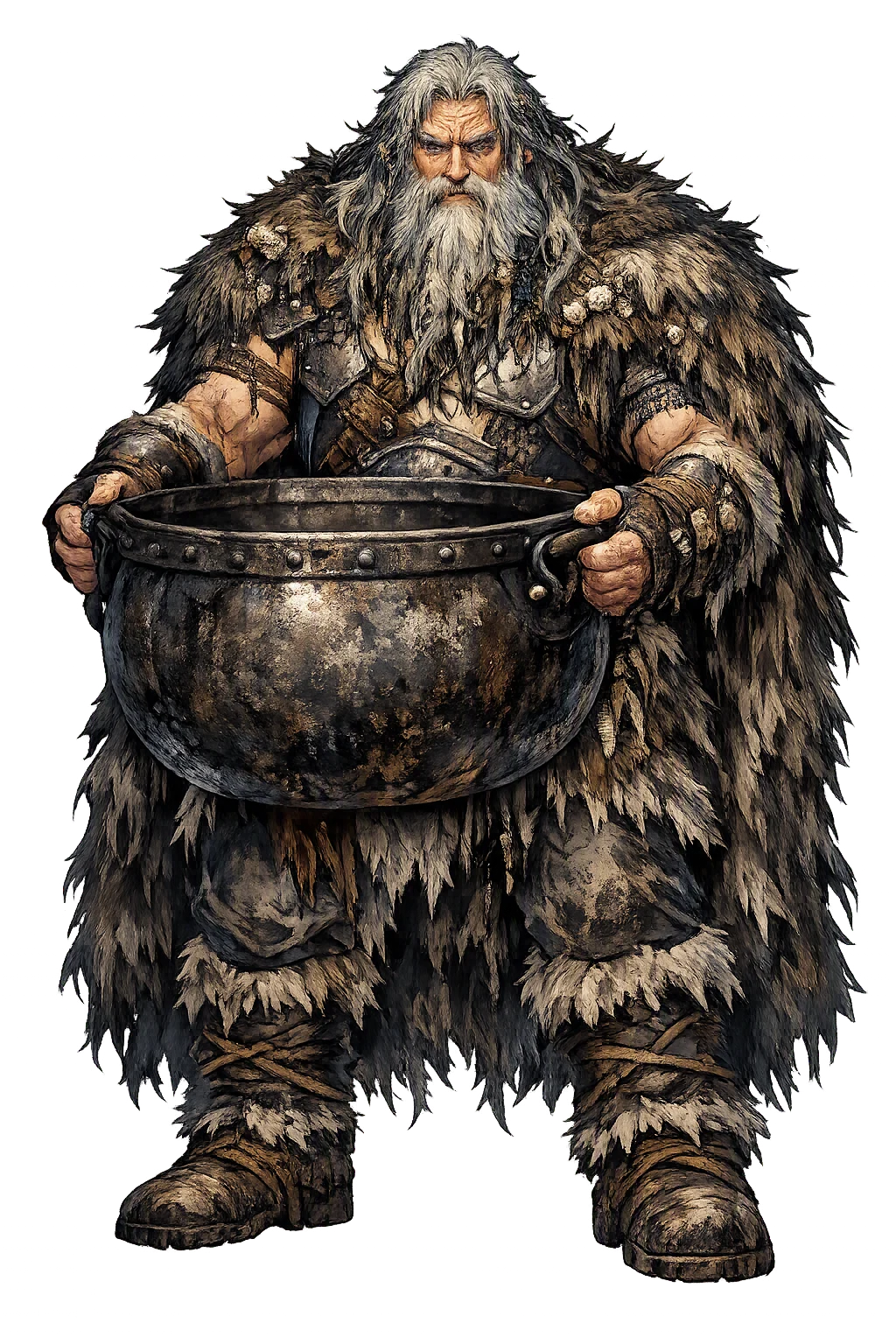
Hymir is among the best-imaged giants in the corpus, though always as the setting of Þórr's fight. The earliest witness is Bragi Boddason's Ragnarsdrápa, a ninth-century shield-poem describing a painted shield — ox-head bait, the hooked serpent, the hammer raised, and the terrified giant at the oars; the shield is lost, the verses Snorri quotes are not. In stone, two monuments carry the scene: the Altuna runestone (U 1161, Uppland, eleventh century), where Þórr stands with a foot punched through the boat's bottom while the serpent hangs on the line, and the Gosforth Cross in Cumbria, tenth century, whose fishing panel shows two figures in the boat — the angler and, by the standard reading, his giant companion. Hymir's own attributes are household and monstrous at once: the mile-deep cauldron, the herd that feeds his hall, the crystal cup no pillar could crack, and the ice rattling in his beard when he comes in from the hunting.

06

Reception & Transformation

The name after its own age — transmission, translation, survival

Afterlives

Hymir's reception is the reception of one poem, and the poem had a near-death experience: Hymiskviða survives solely in the Codex Regius of the Poetic Edda (c. 1270) — lose that single manuscript and the cauldron-quest, the ox-head, and the giant rowing home in silence are gone entirely. Around that slender thread the medieval tradition wrapped its commentary: Snorri retold the fishing in Gylfaginning 48 with his own stagecraft, and the þulur filed Hymir's name among the giant-heiti, a working poet's wordlist. The antiquity of the scene was proven from within — Bragi's Ragnarsdrápa, a century before the codex and four before Snorri, describes it already fixed on a painted shield — so scholarship has always held two independent witnesses, verse and stone, for the image, and only the poem for the tale. The modern afterlife is comparatist: since Dumézil the cauldron-quest has been the standing exhibit in the debate over Celtic–Norse kinship, set beside the Welsh Preiddeu Annwfn and its Vedic analogues, and the poem's giant household — the nine-hundred-headed grandmother, the golden-browed mother hiding the guests — remains the fullest portrait of a giant's family the North preserved.

Identifications Across Traditions

Hymir's poem has drawn comparatists for a century because the cauldron-quest is one of the old travelling stories of the North Atlantic: a vessel of plenty, kept by a grudging power beyond the sea, won for the feast of the gods. Scholars since Dumézil have set Hymiskviða beside the Celtic cauldron-quests — the Welsh Preiddeu Annwfn, where Arthur sails for the cauldron of the Head of Annwn, and the Irish cauldrons that no company leaves unsatisfied — and beside Vedic parallels for the winning of the gods' drink. The fishing scene has its own comparative trail: the thunder-god's combat with the sea-serpent belongs with the wide Indo-European dragon-fight. Inside the Norse corpus the neater tension is genealogical: Hymiskviða makes the giant Týr's father, while Snorri elsewhere counts Týr among Óðinn's sons — two filiations the tradition never reconciled.

Modern Legacy

Hymir's afterlife is carried almost entirely by the fishing-trip, which became the most retold of all Þórr's adventures: Victorian mythographies made it a set-piece, modern handbooks open their Þórr chapters with it, and every popular retelling keeps the ox-head, the glaring serpent, and the giant rowing home in silence. In scholarship the poem holds a double distinction — it is both the fullest portrait of a giant household in the Edda and the standing exhibit in the debate over the cauldron-quest's Celtic kin. The name itself stayed where the þulur put it: a giant-name, rarely borrowed, carried into modern fantasy and games chiefly as the surly host of the world's most famous fishing story.

07

The Original Script Note

What the written record preserves — and what it does not

Original Script

The normalized Old Norse form is Hymir — already plain ASCII, with no diacritic or distinctive letter for the restoration to recover; in the Younger Futhark the name would have been carved ᚼᚢᛘᛁᛦ (h-u-m-i-R, the ᚢ rune covering the rounded y and ᛦ writing the final nominative -r). Because the name is pure ASCII, its domain was registered in the ordinary way: hymir.com is held by a third party outside the PuniCodex collection and is watched for release — no form of the name is currently owned, and this temple claims none.

08

The Meditation

What Hymir means — beyond the dictionary

Hymir is the Edda's portrait of hospitality under strain: the host who feeds his guests two oxen and counts the cost, who rows farther than he means to because pride will not let him ship his oar first, who wagers his treasures on contests he frames himself — and loses both. The poem never makes him a monster; it makes him a householder with a monstrous ancestry and a mile-deep kettle, and lets the comedy and the cold do the work. What the story measures is not his failure but the difference between keeping plenty and sharing it: the cauldron that brews for all the gods spent its best years in a hall where even a guest's supper was tallied.

09

Frequently Asked Questions

Deep-dives into the cult, attestation, reception, and sources of Hymir

01How do we know how Hymir was worshipped?

Hymir is a textual figure: his attestations are the Codex Regius of the Poetic Edda (c. 1270) The full cult record →

02Where do the earliest attestations of Hymir come from?

The record rests on Hymiskviða (Poetic Edda), Prose Edda (Gylfaginning 48; Skáldskaparmál), Ragnarsdrápa (Bragi Boddason), among 8 cited works. The full source apparatus →

03How did later traditions reinterpret Hymir?

Hymir's reception is the reception of one poem, and the poem had a near-death experience: Hymiskviða survives solely in the Codex Regius of the Poetic Edda (c. 1270) Reception & transformation →

04What do the surviving images of Hymir actually show?

Hymir is among the best-imaged giants in the corpus, though always as the setting of Þórr's fight. The iconography →

05What does the written record of Hymir actually preserve?

The normalized Old Norse form is Hymir — already plain ASCII, with no diacritic or distinctive letter for the restoration to recover; in the Younger Futhark the name would have been carved ᚼᚢᛘᛁᛦ (h-u-m-i-R, the ᚢ rune covering the rounded y and ᛦ writing the final nominative -r). The Original Script note →

10

Scholarly Sources

The philological foundations of the record

Every claim on this page is grounded in established scholarship. The orthographic restorations follow disciplinary convention. The etymological chain follows the best available reference works. This is not invention — it is resurrection through scholarship.

◈

Lexicography & Philology

  • Cleasby-Vigfusson
◎

Primary Texts

  • Poetic Edda
  • Hymiskviða (Poetic Edda)
  • Prose Edda (Gylfaginning 48; Skáldskaparmál)
◉

Archaeology & Art History

  • Foote, P., & Wilson, D. M. The Viking Achievement; Graham-Campbell, J. Viking Art.
✦

Religious Studies

  • Ragnarsdrápa (Bragi Boddason)
  • Cleasby-Vigfusson
  • Zoëga
  • Simek, Dictionary of Northern Mythology
  • Orchard, Cassell's Dictionary of Norse Myth and Legend
  • Lindow, Norse Mythology: A Guide
Return

The Surface Awaits

You have traced the name from its earliest attestation to its canonical restoration. Now return to the myth. The story is where the name lives.

Back to Lore
Hymir mascot