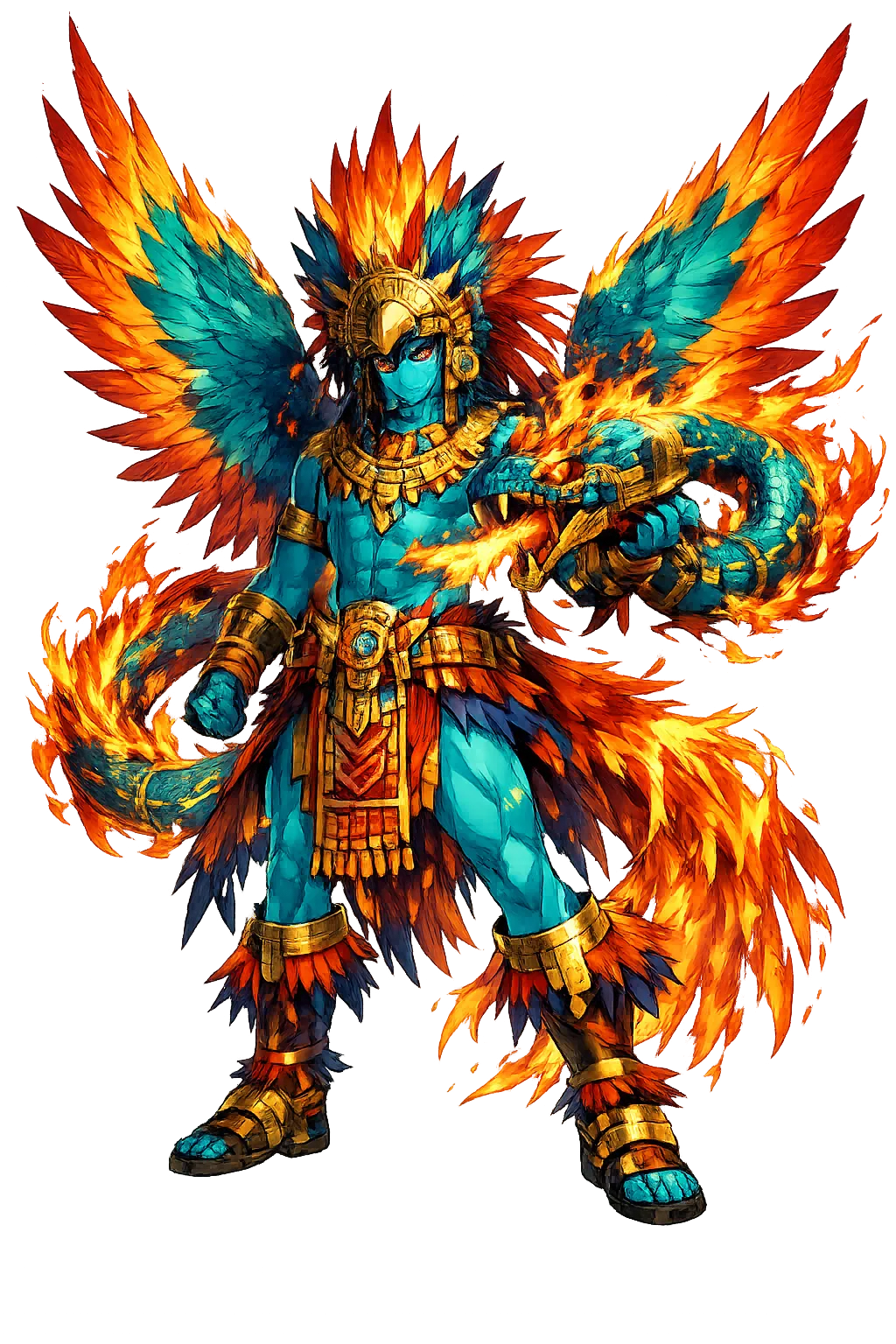
Stories of Huītzilōpōchtli
Huītzilōpōchtli's mythology is inseparable from the origin story of the Mexica people. He is the divine ancestor who led the migration, chose the site of Tenochtitlan, defeated the lunar forces arrayed against his mother, and buried an enemy's heart beneath the founding sign of the city.
Cōātlīcue, 'She of the Serpent Skirt,' conceived while sweeping the temple on Coatepec, 'Serpent Mountain': a ball of hummingbird feathers drifted down and she tucked it into her waistband. Her daughter Coyolxāuhqui, 'She of the Golden Bells', and her four hundred brothers, the Centzōn Huītznāhua, were shamed by the unexplained pregnancy and attacked their own mother, Coyolxāuhqui leading the charge with bells ringing on her cheeks. As they closed in, Huītzilōpōchtli sprang from Cōātlīcue's womb fully armed, his face painted, his left leg slender, the xiuhcoatl fire-serpent blazing in his hand (Florentine Codex III). He struck off his sister's head and shattered her body at the mountain's foot — her head he hurled into the sky as the moon, her brothers scattering as the stars. The myth reads like a charter for Mexica sovereignty: the new sun is born by dismembering the old night, and the temple where it happened was rebuilt at the center of Tenochtitlan.
The migration legend has a dark twin. Copil, son of the sorceress Malinalxōchitl, had sworn vengeance on the Mexica for the wrongs done to his mother; he shadowed the wandering tribe and reported its movements to its enemies, so that everywhere it settled it was attacked. Huītzilōpōchtli ordered his priests to seize the spy, and Copil was sacrificed and his heart cut out. By the god's own command the heart was buried in the reeds of Lake Texcoco — and from it grew a great nopal cactus where no cactus should be, an eagle perched upon it devouring a serpent. That was the sign the god had promised generations before, marking the island of Tenochtitlan (Florentine Codex III; Crónica Mexicayotl). The myth ties the founding sign to a buried enemy: the city's emblem grows out of a heart once set against it — a compact image of how Mexica order converted opposition into ground. The Templo Mayor was raised beside that marsh exactly, and its stairway staged the Coatepec battle in stone.
The Mexica left their ancestral home of Aztlān, 'the Place of the Herons', under Huītzilōpōchtli's direct guidance. The god spoke through his priests and in omens, instructing the people to call themselves Mēxihcah and to search for a promised sign: an eagle perched on a cactus devouring a snake. The wander lasted generations — through Tollan, through the years of servitude at Azcapotzalco, through every settlement that proved not yet the one — and the god's demands grew fiercer as the journey lengthened, the priests carrying his image and voice ahead of the people (Anales de Cuauhtitlan; Crónica Mexicayotl). At last the sign appeared on a small island in Lake Texcoco, and there Tenochtitlan was founded, traditionally in 1325 CE. The myth's logic is the logic of chosen peoples everywhere: suffering on the road is proof of the destination, and the god who made you wander is the god who tells you when to stop. What distinguishes the Mexica version is its candor about the cost — the wandering god is a war god, and the promised land arrives with its altar already built.
Huītzilōpōchtli is identified with the sun in its southern strength — his very name points south — the star that rises each morning after a night-long passage through the underworld, where the stars and the dead mass against it. To arm him for that battle the Nahua offered the most precious food they possessed: human hearts, 'the nourishment that makes the sun move' (Florentine Codex VI). The warrior who died in battle or on the sacrificial stone was honored above all others: he accompanied the sun from the east for four years and then returned to earth as a hummingbird or a butterfly, sipping nectar forever; the woman who died in childbirth, the cihuapipiltin, marched the opposite escort westward and became a feared spirit. The theology binds biology, warfare, and astronomy into one economy: every birth, every battle, every dawn is the same transaction paid in blood. To feed the sun is to join it — and the hummingbird, iridescent and tireless, is the soldier's final rank.
Sun, War, and the Mexica Patron
Huītzilōpōchtli is the southern sun in his hummingbird form, the god who led the Mexica out of Aztlān and guided them to the island where Tenochtitlan would rise. He is the warrior's reward and the warrior's demand: the fallen soldier becomes a hummingbird in his paradise, but the sun itself requires human hearts to rise again. In him, tribal patronage, solar theology, and imperial militarism became inseparable.
He is the sun in its rising and midday strength, the southern brilliance that drives away the stars.
Dead warriors accompanied the rising sun from the east and were reborn as hummingbirds and butterflies; the cihuateteo, women who died in childbirth, escorted the sun toward the west as feared spirits.
He appeared to the Mexica leaders in dreams and omens, directing the long migration to the promised land.
The sun's daily battle against darkness required nourishers of blood and hearts; Huītzilōpōchtli was the hungry sun itself.
From the original script to the living URL
Huītzilōpōchtli
The name survives only in scholarly transliteration. Huītzilōpōchtli is the standard Nahuatl romanisation, documented in academic sources — “Left-handed hummingbird”. Its macron-length vowels preserve distinctions lost in plain ASCII.
No indigenous writing system is securely attested for individual nahuatl names. The form shown is a modern scholarly transliteration.
huitzilopochtli
Reduced to plain huitzilopochtli, the name loses everything that made it specific: macron-length vowels. What remains is an ASCII string that machines can parse but that no longer speaks with its original voice.
Huītzilōpōchtli
The Unicode restoration recovers what ASCII flattened. Huītzilōpōchtli restores macron-length vowels, returning the name to its original written dignity. The domain encodes to Punycode, but the browser displays the truth.
Huītzilōpōchtli.com → xn--hutzilpchtli-u2b49bb.com
The non-ASCII characters in Huītzilōpōchtli are encoded while the ASCII remains visible. To the DNS, it is Punycode. To humanity, it is Huītzilōpōchtli.
Owned, ideal, and ASCII forms of Huītzilōpōchtli
Huītzilōpōchtli
The live temple domain — huītzilōpōchtli.com.
huitzilopochtli
The plain ASCII fallback — what DNS and legacy systems see.
How Huītzilōpōchtli was spoken
How Huītzilōpōchtli is preserved in writing
No indigenous writing system is securely attested for individual nahuatl names. The form shown is a modern scholarly transliteration.
Contribute scholarly provenance →The lore you have read is the living myth. Extended Lore opens the scholarly vault beneath it: the cult and its material remains, a history of the image, the name after antiquity, a meditation on what the name still means, and the full scholarly apparatus — etymology, orthography, sources.
Enter Extended Lore