
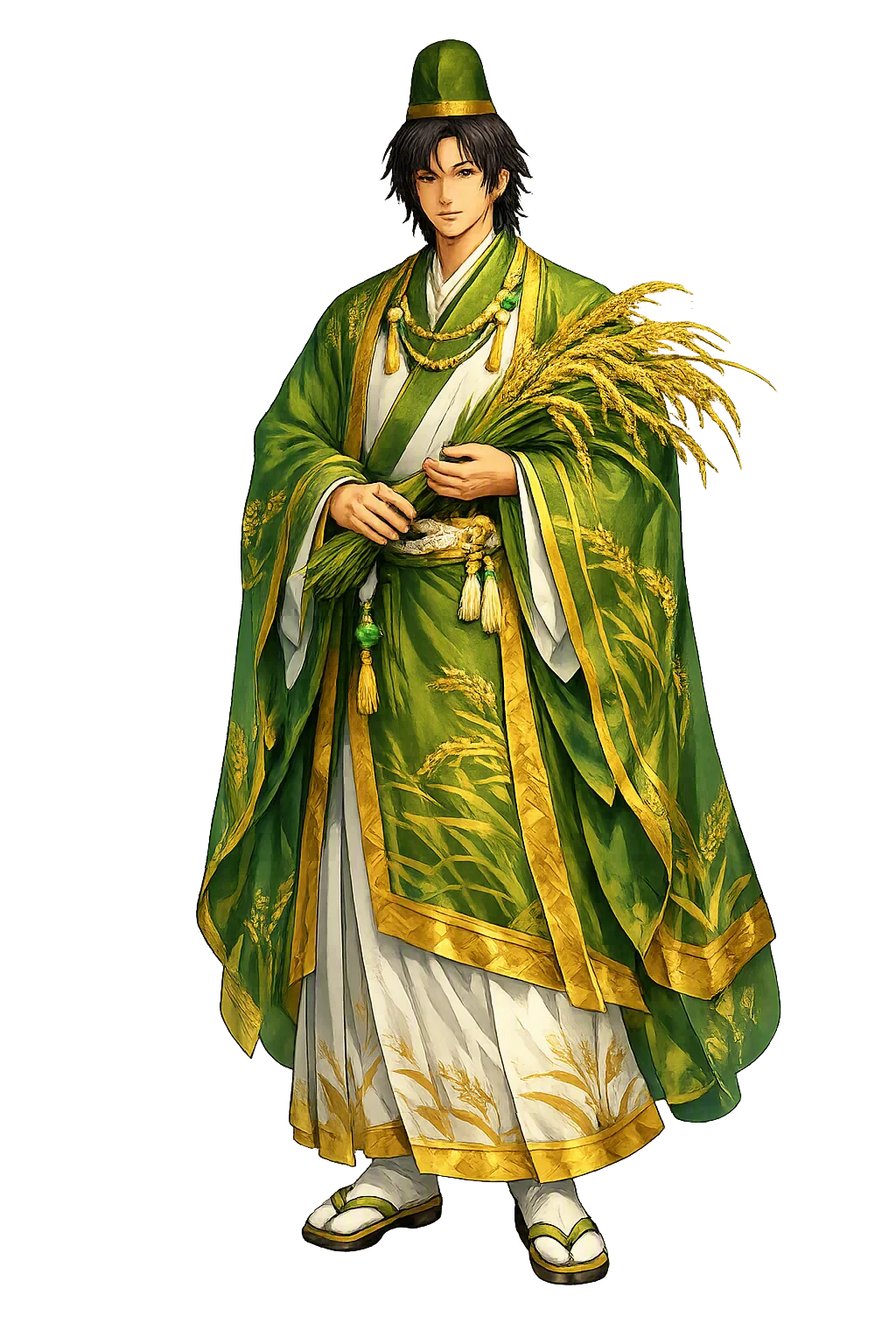
Why Hoori is spelled that way — and what it costs to get it right
There is a version of this name the early internet had to settle for: hoori. This is the file on how Hoori replaced it.
Hoori's mythology is the bridge between the heavenly descent of Ninigi and the earthly reign of Emperor Jimmu: a story of exchanged tools, a lost hook, a voyage to the dragon palace, a broken promise, and a line of kings. It is told in the Kojiki and repeated, with variations, in the Nihon Shoki.
At a Glance
- Restored name: Hoori
- ASCII form: hoori
- Meaning: "Fire-subduing"
- Domain of influence: Agriculture, Hunter
- Pantheon: Japanese
- Classification: Tier 2
- Original script: 火折命
- Series: The Restoration Files, No. 215 of 548
The Name Before the Marks
The name is attested as 火折命, as Kojiki I (Hoori–Hoderi cycle; Aston, tr. I; Philippi, tr.) and Nihon Shoki I (parallel genealogy) preserve it. On the evidence, it means "Fire-subduing".
Spoken, the name runs `/hoː.ɾi/` — 'HOH-ree' — hold the first syllable long; the 'r' is a light tap.
The Temple That Stands Now
The restored name is not a plaque; it is an address. The temple of Hoori lives at /hoori/, with its mythology in the lore halls, its peer-reviewed record in the Scholarly Edition, and its place in the pattern atlas on the patterns floor.
The restoration keeps one feature the ASCII form drops. One is enough to matter, and the label says so plainly: Tier-2.
Where the Name Stood First
Hoori has no shrine and no image, but his story is anchored in real ground. The Kojiki and Nihon Shoki place the action in the Yamato basin: Jimmu's traditional tomb, the Unebi kofun, lies by Kashihara in Nara Prefecture, and Kashihara Jingū — founded in 1890 — marks the traditional site of Kashihara-no-miya, the palace from which Jimmu set out eastward. His narrative survives materially in the Shinpukuji-bon, the early thirteenth-century manuscript of the Kojiki kept at Shinpuku-ji in Nagoya, the sole complete copy of the lost 712 original. At the foot of Mount Miwa, the Ōmiwa shrine preserves the sacred landscape in which the Jimmu-cycle myths were first localized. The evidence is commemorative rather than contemporary — but for an eighth-century state charter, that is precisely the point. The temple on the web is the newest of these addresses — the first one that fits in a pocket.
The Archetype at Work
The pattern atlas seats this temple in 3 industries, each match argued and weighted: Agriculture, Food & Harvest (the fire-subduing hunter and agricultural kami; the field and the hunt are his twin harvests.); Forestry, Conservation & Outdoor Industries (the hunter of the high places; the wild wood and the chase are his realm.); Sports, Fitness & Competition (the hunter whose skill with bow and field defines the athletic chase.). The Resonance File reads those seats through the myths themselves.
In the Sacred Texts
The Japanese tradition is not a vibe; it is a library. The Sacred Texts collection holds Kojiki and Nihon Shoki — the primary sources the temple's scholarship is built on. The temple is the argument; the texts are the evidence.
The File Continues
The temple's founding dispatch tells the name's story; its Resonance File reads the myths into the industries; the blog index holds the whole archive.
Continue the series — previous file: Honshū (read it here) · next file: Ḥr (read it here).
The Restoration Files are written from the same canonical record as the temples themselves: the lexicon, the lore catalog, the pattern atlas, and the cited scholarly sources. If a file ever disagrees with its temple, the temple is right — tell us, and the file will be corrected.