The Living Myth
Marriage, Women, Queen of Gods · The Golden-Throned · Guardian of Marriage
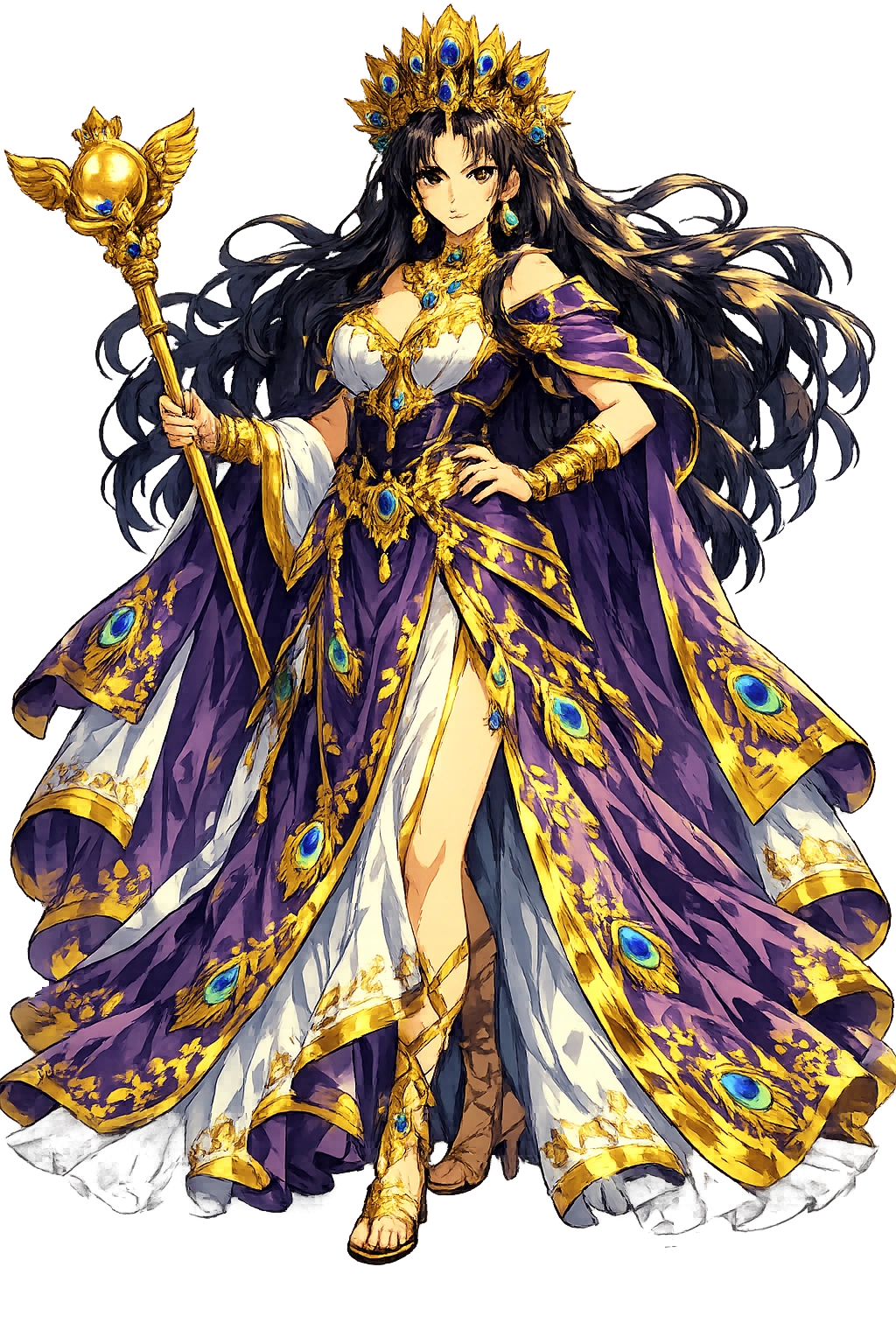
Stories of Hēra
Hēra's myths are almost all variations on one theme: the wronged wife defending her throne. She cannot overthrow Zeús, but she can punish his lovers and their children with relentless ingenuity — and beneath the vengeance the sources preserve traces of a far older, cosmic Hēra.
Greek tradition set the wooing of Hēra at Plataea in Boeotia. Pausanias (9.2.7–9.3.8) describes the local festival of the Daedala, at which wooden images were dressed as brides and burned on Mount Cithaeron — reenacting, the Plataeans said, the very origin of marriage: Zeús, unable to win the angry, aloof Hēra, had a wooden image dressed and carried in wedding procession; Hēra stormed up to tear the bride apart, found an oak instead — and laughed, and was reconciled. Elsewhere the wooing is told with a cuckoo: Zeús first approached her in bird form, and she cradled him in her lap (a tale preserved in the Byzantine scholia). Hēra's marriage to Zeús was the cosmos's founding contract — the hieros gamos that every Greek wedding ritually repeated — and the myths insist it began in deception before it became the pillar of order.
Hēra's most famous feud is with Hēraklēs, living proof of Zeús's adultery with the mortal Alkmene. She sent two serpents to his cradle, and the infant strangled both (Pindar, Nemean 1.33–72). Years later she drove him to the madness in which he killed his own wife and children, and it was her will, working through Eurystheus, that imposed the Twelve Labors (Euripides, Heracles; Apollodorus 2.4.12). Yet the feud is also the making of him: each labor forces the hero past mortal limits until, burned alive on Oeta, he is taken up to Olympus — where, in the Odyssey's quiet ending (11.601–604), he has for his wife Hebe of the beautiful ankles, given him by Hēra herself. The persecutor crowns her enemy. The myth turns vengeance into the engine of apotheosis: without Hēra's hatred there is no Hēraklēs.
When Zeús desired the Argive princess Io, Hēra could not punish her husband — so she punished the beloved. Zeús turned Io into a cow; Hēra took the cow and set it under guard, and the guard she chose was Argos Panoptês, 'the all-seeing' — a giant with a hundred eyes that never all slept at once (Apollodorus 2.1.3; Ovid, Metamorphoses 1.568–723). Zeús sent Hermês, who lulled the hundred eyes with the long, wandering tale of Syrinx's transformation, struck off the head with his sword, and freed Io. Hēra collected the hundred eyes and set them in the tail of her sacred bird, the peacock (Ovid 1.721–723), so that Argos's vigilance survives, reassigned to her own service. The queen's grief is the more terrible for being constitutional: she can never touch Zeús, so her vigilance falls outward — and the sky rains transformations.
The Iliad preserves, almost in passing, the most radical thing ever said about Hēra. Threatened with Zeús's violence over the Trojan War, she answers that she remembers when she, Poseidôn, and Athēnâ had actually bound Zeús (1.396–406) — a plot whose possibility implies a Hēra far older and more powerful than the wronged wife of epic. The story has a sequel: Thetis, summoned by the hundred-handed Briareos — whom the gods call Aigaion — came up to Olympus and sat beside Zeús, and the gods, in awe, abandoned their chains. Homer offers no theology of the episode; he needs it to explain why Thetis could sway the king of gods. But it survives as a fossil of a pre-Olympian order: before she was consort, Hēra was a cosmic sovereign, and Zeús's throne was once contested by her faction and held only with the help of the oldest power in the sea.
A cluster of late-antique star-myths gave Hēra's milk a permanent place in the sky. Hēraklēs, hidden by Athēnâ at Hēra's breast so that suckling would make him immortal, bit too hard; the goddess flung him off, and her milk spurted across the heavens — the Milky Way (Eratosthenes, Catasterisms fr. 44; Hyginus, Astronomica 2.43). The tales are playful, but their premise is the myth's own: Hēra is the nurse of immortality itself. Every Olympian apotheosis runs through her — Hēraklēs receives her daughter Hebe as his bride; the hero's immortality is her final gift; the king's legitimacy is her dowry. Where her milk touches, mortality ends; where she withholds it, heroes remain men. Even the galaxy, in this tradition, is a trace of her body. A myth that makes the Milky Way a spill of the queen's milk is a myth about the reach of legitimacy: everything above the earth, it says, once depended on her breast.
Marriage, Sovereignty, Women, and the Ritual Year
Hēra is the queen of the gods by marriage, and her mythology is the mythology of what that costs. She defends the legitimacy of the Olympian order — marriage, kingship, sworn oaths — with a ferocity born of defending it constantly against her own husband.
Patron of the wedded state; the gamos, or sacred marriage, is her rite.
Queen of gods and men; kingship legitimized through her partnership with Zeús.
Eileithyia, goddess of childbirth and her own daughter, acts at her command to protect women in labor.
The hundred-eyed Argos, her faithful watcher, set into the tail of her sacred bird (Ovid, Met. 1.721–723).
From the original script to the living URL
Ἥρα
The name in its original Greek form. Hēra (Ἥρα) is attested in the source tradition — “Lady, mistress (possibly related to ἥρως)”. Its acute accents carry the full phonetic and orthographic weight of the source tradition.
hera
Reduced to plain hera, the name loses everything that made it specific: acute accents. What remains is an ASCII string that machines can parse but that no longer speaks with its original voice.
Hēra
The Unicode restoration recovers what ASCII flattened. Hēra restores acute accents, returning the name to its original written dignity. The domain encodes to Punycode, but the browser displays the truth.
Hēra.com → xn--hra-3qa.com
The non-ASCII characters in Hēra are encoded while the ASCII remains visible. To the DNS, it is Punycode. To humanity, it is Hēra.
Owned, ideal, and ASCII forms of Hēra
Hēra
Restores Ἥρα. The live temple domain — hēra.com.
Hḗra
Restores Ἥρα. Stacked macron+acute on the stressed long vowel, matching Greek Ἥρα; philologically ideal but often untypeable on phones.. Not in the PuniCodex collection.
hera
Flattens Ἥρα. The plain ASCII fallback — what DNS and legacy systems see.
How Hēra was spoken
How Hēra travels from ancient script to the modern URL
Greek Ἥρα; possibly related to ἥρως “hero, lord" or to a pre-Greek substrate; queen of the gods.
Marriage, Women, Queen of Gods
The Unicode restoration Hēra preserves Greek stress and length; the ASCII form hera loses these features.
The lore you have read is the living myth. Extended Lore opens the scholarly vault beneath it: the cult and its material remains, a history of the image, the name after antiquity, a meditation on what the name still means, and the full scholarly apparatus — etymology, orthography, sources.
Enter Extended Lore