The Living Myth
Fire, Forge, Craftsmen · The Lame-Smith · Worker of Wonder
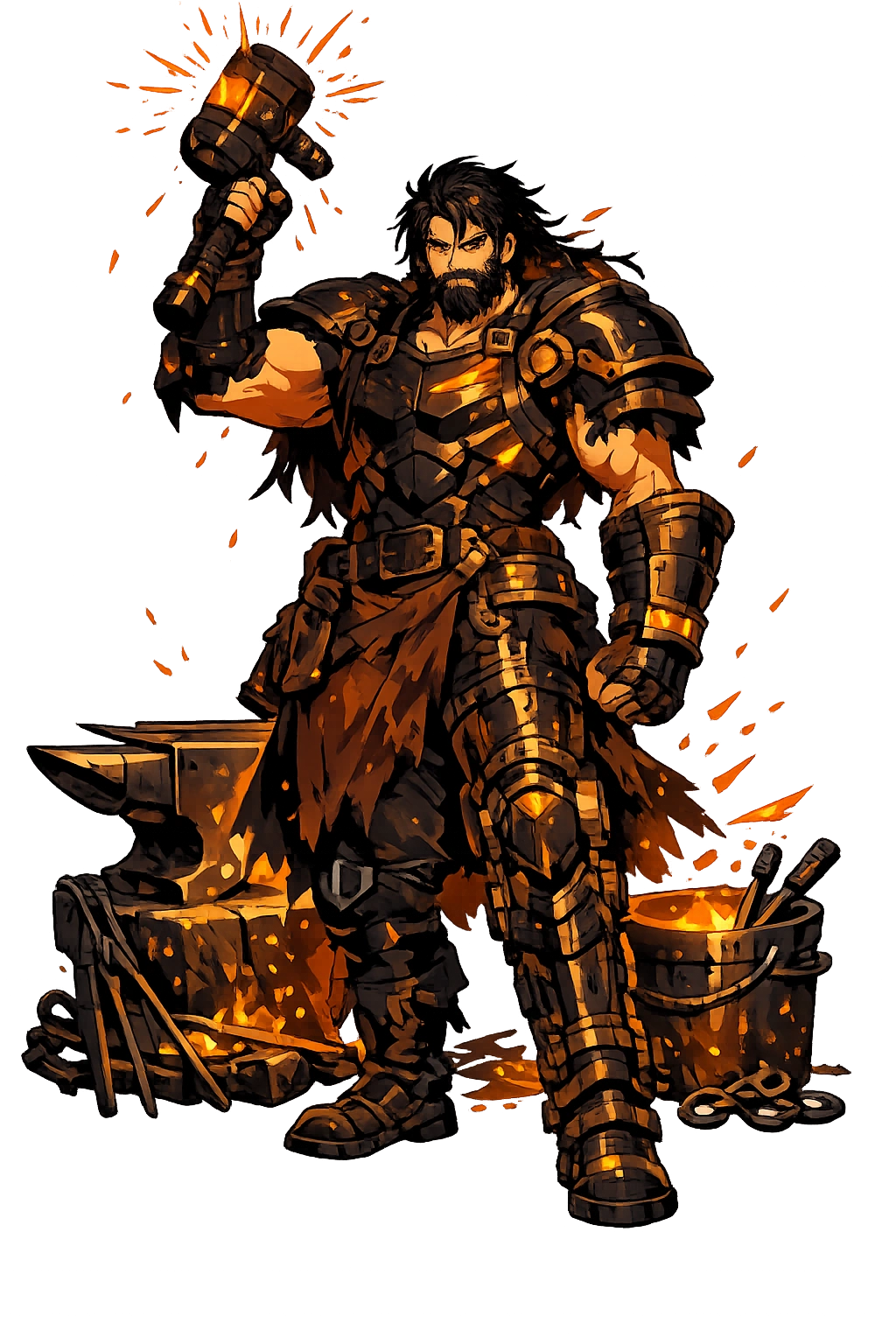
Stories of Hēphaistos
Hēphaistos's myths turn disability into mastery. Thrown from heaven for being imperfect, he returns to Olympus as the indispensable artisan — and exacts, one masterpiece at a time, the recognition he was denied.
The sources disagree about who threw Hephaistos and why, and the disagreement is itself instructive. Hesiod's account has Hera bear him alone, in jealous rivalry of Zeus's parthenogenetic production of Athena — and reject the lame child (Theogony 927–929). The Iliad tells it from the smith's own mouth: it was Zeus who hurled him, when Hephaistos tried to shield Hera from the god's anger, and he fell 'all day long' from heaven to earth, landing in the sea of Lemnos, where his life was saved and his craft learned (Iliad 1.590–594; 18.394–405). In the sea the goddesses Thetis and Eurynome received him and hid him nine years in a cave, where he worked at the bellows 'making cunning things' — brooches, necklaces, earrings — while his mother back on Olympus had no idea where he was. The two traditions agree on the wound and the refuge: rejection is the forge in which the smith is made, and the sea that receives the outcast is the one that will bring him home in glory.
Hephaistos came back to Olympus on his own terms. In the tale as later mythographers preserve it, he sent his mother Hera a gift — a golden throne of incomparable craftsmanship — and when she sat down, invisible bonds of adamant held her fast (the story is summarized in the later tradition, Pseudo-Apollodorus Bibliotheca 1.3.5; its comic machinery survives on vase paintings). No force in heaven could release her until the smith was brought home; Dionysus made him drunk on wine, loaded him on a mule, and led the laughing, stumbling god back up to Olympus, where Hephaistos freed Hera on the terms he chose. Homer compresses the return differently: the lame god pours the gods' nectar while they laugh at his limping gait, and he answers their laughter with equanimity and with the finest golden cups ever made (Iliad 1.571–600). The throne is the masterstroke of the excluded: the one who was thrown away builds the seat from which no one can rise without him.
When Patroclus fell and Achilles resolved to return to the war, his divine mother Thetis went down to Hephaistos's forge, built beside the volcano with its 'sparking flame' of twenty bellows working of their own accord, and begged new armor for her son (Iliad 18.368–617). The smith laid aside the twenty tripod-wheeled vessels he was making — tripods that could move themselves to the assembly and back — and forged, beyond all price, the great shield. Its five concentric bands carry the whole world in miniature: a city at peace with weddings and lawsuits, a city at siege; ploughing, harvest, and vintage under a golden sun and moon; herds, lions, and dancing youths and maidens; and around everything, the mighty Ocean. Aeneas's shield and all the cosmic shields of later epic descend from it. The passage is the longest single description in Homer, an ecphrasis that pauses the war for a hundred lines. Its claim is the god's own: the maker sees the whole world at once, because the world is what he makes.
Zeus married Hephaistos to Aphrodite, the union of craft and beauty that the gods toasted — and that failed almost at once. Ares won the goddess, and the lame smith, who sees everything from his forge, discovered the adultery and contrived his revenge: a net of chains so fine as to be invisible, thrown over the bed, which sprang shut on the lovers at the crucial moment (Homer, Odyssey 8.266–366 — the song of Demodocus at Alcinous's court, the earliest telling and the one every later version follows). Hephaistos summoned the gods to witness, demanded his bride-gifts back, and Poseidon talked him down with a wager that the adulterer would pay the fine. The gods, in Homer's immortal scene, laughed 'an unquenchable laughter' — Hermes confiding to Apollo that he would gladly change places even in the net for a night with such a goddess. The comedy is real, but so is the hurt: the maker of the world's finest objects cannot manufacture the one thing he was owed — a marriage that works.
When Zeus resolved to punish mankind for Prometheus's theft of fire, he needed a new thing in the world, and he commissioned it from the only god who could build it: Hephaistos, at Zeus's command, 'mixed earth with water and fashioned the lovely shape of a maiden,' while Athena taught her weaving, Aphrodite poured grace and longing over her, Hermes gave her the mind of a thief and the power of speech, and the gods named her Pandora, 'All-Gifted,' because every god had contributed a gift — a bane to men who earn their bread (Hesiod, Works and Days 60–104; Theogony 570–589, where she is the condition of Zeus's punishment rather than its instrument). Hephaistos's role is easy to miss and crucial: the first woman in Greek myth is a manufactured object, assembled by a male craft-god, dressed by Athena, animated by the gods' collective investment — a calibration of blame so exact that it has been debated ever since. Pandora is the masterpiece that proves his art has no limits, and the commission that proves his art serves whoever commands it.
Fire, Craft, Metalwork, and Volcanoes
Hēphaistos is the only ugly Olympian, the only crippled one, and the only one who works for a living. His craft gives the gods their weapons and armor, and his forges lie beneath the volcanoes of the Aegean. He is the god who proves that making is a form of divinity.
The elemental fire that shapes metal; his workshops lie under Lemnos, Etna, and Hiera.
Armorer to the gods; maker of Achilles' shield, Athena's aegis, and countless automata.
His lame gait matches the earth's limp; every eruption is his forge at work.
He builds self-moving tripods, golden maidens, and unbreakable chains — the first robots in Western literature.
From the original script to the living URL
Ἥφαιστος
The name in its original Greek form. Hēphaistos (Ἥφαιστος) is attested in the source tradition — “Unknown; possibly pre-Greek”. Its aspirated consonants, diphthongs, and acute accents carry the full phonetic and orthographic weight of the source tradition.
hephaistos
Reduced to plain hephaistos, the name loses everything that made it specific: aspirated consonants, diphthongs, and acute accents. What remains is an ASCII string that machines can parse but that no longer speaks with its original voice.
Hēphaistos
The Unicode restoration recovers what ASCII flattened. Hēphaistos restores aspirated consonants, diphthongs, and acute accents, returning the name to its original written dignity. The domain encodes to Punycode, but the browser displays the truth.
Hēphaistos.com → xn--hphaistos-bhb.com
The non-ASCII characters in Hēphaistos are encoded while the ASCII remains visible. To the DNS, it is Punycode. To humanity, it is Hēphaistos.
Owned, ideal, and ASCII forms of Hēphaistos
Hēphaistos
Restores Ἥφαιστος. The live temple domain — hēphaistos.com.
Hḗphaistos
Restores Ἥφαιστος. Stacked macron+acute on the stressed long vowel, matching Greek Ἥφαιστος; philologically ideal but often untypeable on phones.. Not in the PuniCodex collection.
hephaistos
Flattens Ἥφαιστος. The plain ASCII fallback — what DNS and legacy systems see.
How Hēphaistos was spoken
How Hēphaistos travels from ancient script to the modern URL
Greek Ἥφαιστος; of unknown, probably pre-Greek origin; the smith-god.
Fire, Forge, Craftsmen
The Unicode restoration Hēphaistos preserves Greek stress and length; the ASCII form hephaistos loses these features.
The lore you have read is the living myth. Extended Lore opens the scholarly vault beneath it: the cult and its material remains, a history of the image, the name after antiquity, a meditation on what the name still means, and the full scholarly apparatus — etymology, orthography, sources.
Enter Extended Lore