
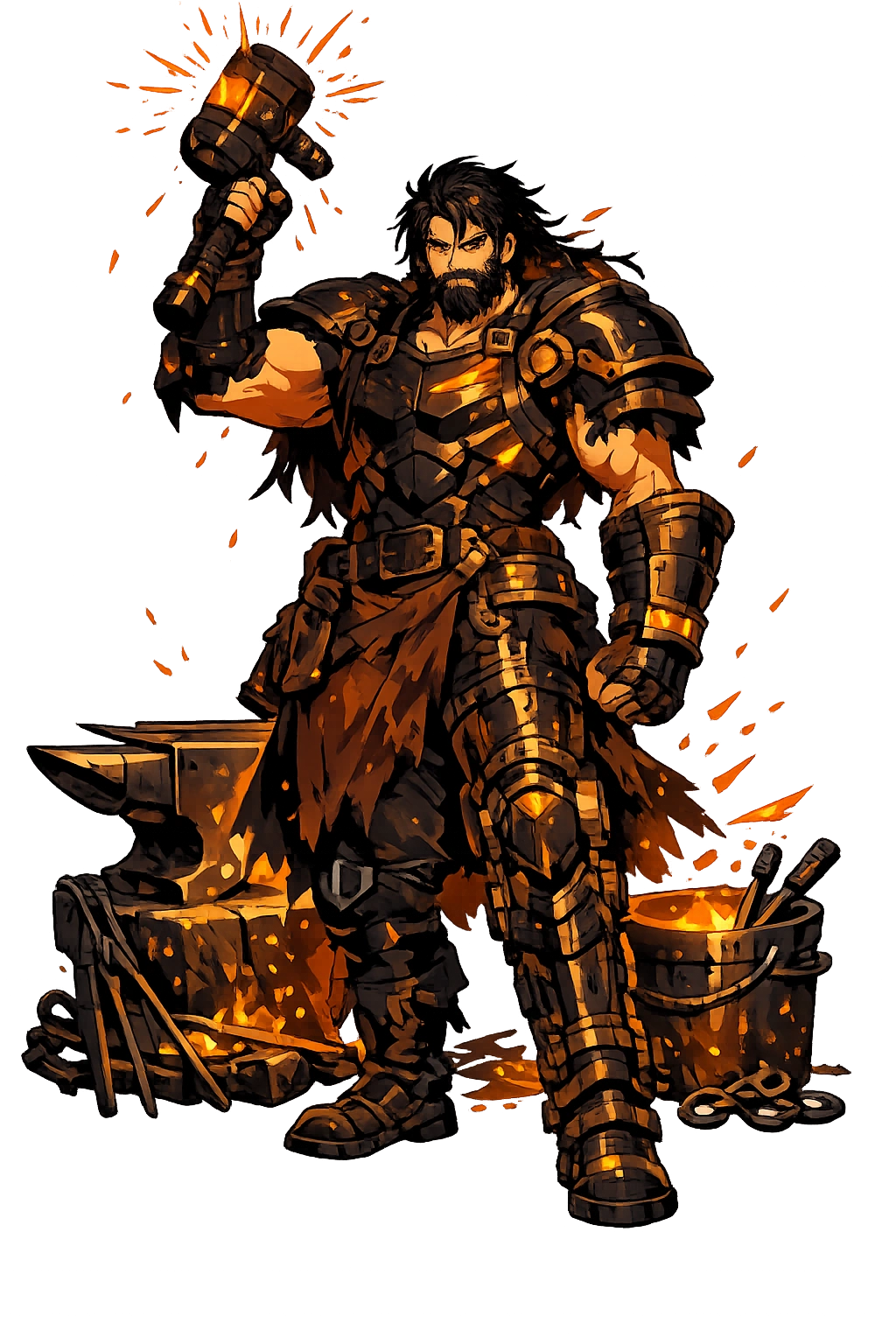
Hēphaistos: the stories first, then the spelling
You cannot weigh an accent without knowing what it carries. Here is what Hēphaistos has been carrying.
The Stories That Carry the Name
Thrown from Olympus. The sources disagree about who threw Hephaistos and why, and the disagreement is itself instructive. Hesiod's account has Hera bear him alone, in jealous rivalry of Zeus's parthenogenetic production of Athena — and reject the lame child (Theogony 927–929). The Iliad tells it from the smith's own mouth: it was Zeus who hurled him, when Hephaistos tried to shield Hera from the god's anger, and he fell 'all day long' from heaven to earth, landing in the sea of Lemnos, where his life was saved and his craft learned (Iliad 1.
The Golden Throne. Hephaistos came back to Olympus on his own terms. In the tale as later mythographers preserve it, he sent his mother Hera a gift — a golden throne of incomparable craftsmanship — and when she sat down, invisible bonds of adamant held her fast (the story is summarized in the later tradition, Pseudo-Apollodorus Bibliotheca 1. 3.
The Shield of Achilles. When Patroclus fell and Achilles resolved to return to the war, his divine mother Thetis went down to Hephaistos's forge, built beside the volcano with its 'sparking flame' of twenty bellows working of their own accord, and begged new armor for her son (Iliad 18. 368–617). The smith laid aside the twenty tripod-wheeled vessels he was making — tripods that could move themselves to the assembly and back — and forged, beyond all price, the great shield.
And Here Is What the Spelling Preserves
Against those stories, the attestation: Ἥφαιστος, in the attestation Homer, Iliad 1.571–600; 18.368–617 and Homer, Odyssey 8.266–366 give us. The name means "Unknown; possibly pre-Greek".
The restoration keeps one feature the ASCII form hephaistos cannot show:
- e → ē — Eta: long epsilon: how long the vowel is held.
A storyteller pronouncing the name would restore every one of them by instinct. The file only writes down what the voice already knows.
At a Glance
- Restored name: Hēphaistos
- ASCII form: hephaistos
- Meaning: "Unknown; possibly pre-Greek"
- Domain of influence: Fire, Forge, Craftsmen
- Pantheon: Greek
- Classification: Tier 1
- Original script: Ἥφαιστος
- Series: The Restoration Files, No. 205 of 546
The Name Travels
The Romans identified Hēphaistos with Vulcanus, a god of destructive fire whose festival, the Vulcanalia of 23 August, propitiated the furnace-heat of late summer; the equation shifted emphasis from craftsmanship to volcano, and Etna became Vulcan's forge in Latin literature. The hypothetical intra-Mercurial planet 'Vulcan,' hunted by nineteenth-century astronomers, borrowed his fiery name.
The Address It Earned
The temple of Hēphaistos stands at /hephaistos/ — lore, scholars, patterns — because a name carrying this much story deserves more than a parking page. What survives here cannot be shown in ASCII: a feature of the original that the fallback alphabet flattens. That is the Tier-1 test, and this name passes it without argument.
The Sources Are Open
The myths above are retold from the temple's record; the primary voices are in the Sacred Texts: Theogony, Homeric Hymns, and Works and Days. Nothing in this file outranks them.
The File Continues
Read the founding dispatch for the name's full story, the Resonance File for the archetype at work — or the whole archive in one sitting.
Continue the series — previous file: Hén (read it here) · next file: Hēra (read it here).
The Restoration Files are written from the same canonical record as the temples themselves: the lexicon, the lore catalog, the pattern atlas, and the cited scholarly sources. If a file ever disagrees with its temple, the temple is right — tell us, and the file will be corrected.