
Hēméra: the stories first, then the spelling
Before the spelling, the story. Hēméra earns its restoration the old way — through what was actually told.
The Stories That Carry the Name
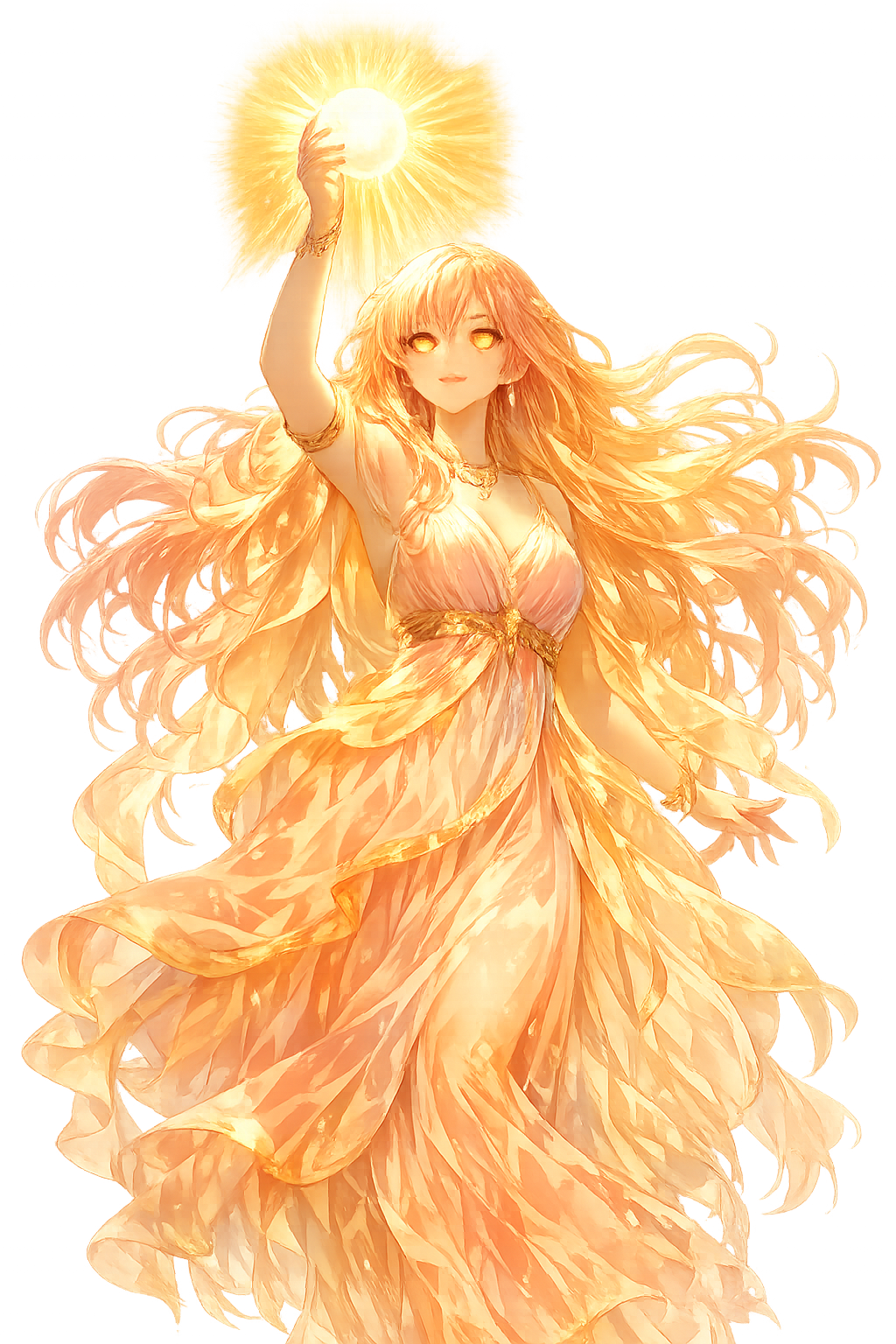
Born from Darkness. Hesiod's Theogony gives her the purest possible pedigree: from Cháos came Érebos and black Nyx; from Nyx, paired with Érebos, came Aithḗr and Hēméra (Theogony 123–125). The genealogy is a small machine of logic — out of the gap comes darkness, and out of darkness, by pairing, the bright upper air and the day itself. She is therefore only two generations from the beginning of things, a luminous granddaughter of the void, born not from a mother alone but from darkness embracing darkness.
The House Beyond the Bronze Threshold. The Theogony's other Hēméra-passage is its most atmospheric (744–757). Beyond Atlas, where the rim of heaven meets the earth, stand the house and threshold of bronze that belong to Night and to Hēméra. The two draw near and greet one another as they pass it — the one going out as the other comes in — and the house never holds them both: one is always outside, crossing the earth, while the other waits within for her own going-forth, 'and one holds for the other in turn the house they share'.
The Latin Family Tree. Rome adopted the personification and re-drew the pedigree. Hyginus, in the preface to his Fabulae, derives from Caligo — Mist — a first family of Chaos, Nox, Dies, Erebus, and Aether: Day (Dies) now the sibling of Night and the dark powers, not Night's daughter. Roman religious thought generally preferred the abstraction to the goddess — dies fastus, dies nefastus, the lawful and the forbidden day — and the calendar's dies religiosi were marked with more care than any cult statue of the Day.
And Here Is What the Spelling Preserves
Against those stories, the attestation: Ἡμέρα, on the evidence Hesiod, Theogony 123–125 (birth of Aithḗr and Hēméra) and 744–757 (the bronze threshold of Night and Day) and Aristophanes, Birds 693–703 (the birds' cosmogony) set down. The name means "Day".
The restoration keeps 2 features the ASCII form hemera cannot show:
- e → ē — Macron: long vowel: how long the vowel is held.
- e → é — Acute on e: where the voice peaks.
A storyteller pronouncing the name would restore every one of them by instinct. The file only writes down what the voice already knows.
At a Glance
- Restored name: Hēméra
- ASCII form: hemera
- Meaning: "Day"
- Domain of influence: Day
- Pantheon: Greek
- Classification: Tier 1
- Original script: Ἡμέρα
- Series: The Restoration Files, No. 203 of 546
The Name Travels
The Romans personified the day as Dies, though she never achieved a developed mythic personality like the Greek Hēméra; Roman religion preferred the abstraction — dies fastus, nefastus — to the goddess. Hēméra was increasingly conflated in later thought with Eos/Aurora, the dawn, and with Hēlios/Sol, the sun, because all three bring light; but Hesiod's grammar keeps them distinct — Eos is the morning's edge, Hēlios the sun's body, Hēméra the whole bright interval.
The Address It Earned
The temple of Hēméra stands at /hemera/ — lore, scholars, patterns — because a name carrying this much story deserves more than a parking page. Tier-1 is not a compliment; it is a measurement. This restoration keeps something the ASCII form provably loses, and the measurement is repeatable.
The Sources Are Open
The myths above are retold from the temple's record; the primary voices are in the Sacred Texts: Theogony, Homeric Hymns, and Works and Days. Nothing in this file outranks them.
The File Continues
Read the founding dispatch for the name's full story, the Resonance File for the archetype at work — or the whole archive in one sitting.
Continue the series — previous file: Hēlios (read it here) · next file: Hén (read it here).
The Restoration Files are written from the same canonical record as the temples themselves: the lexicon, the lore catalog, the pattern atlas, and the cited scholarly sources. If a file ever disagrees with its temple, the temple is right — tell us, and the file will be corrected.