PuniCodex

Extended Lore

Ἑκάτη Hekátē

Etymology · Orthography · Cultural Legacy · Reception · Primary Sources

Tier-1 Tier-2 Hekátē.com · Hekatē.com
Hekátē — Magic, Crossroads, Moon
01

Quick Facts

Essential information about Hekátē, Magic, Crossroads, Moon

Original ScriptἙκάτη
Unicode RestorationHekátē
Reconstructed Pronunciation/he.ká.tɛː/
PantheonGreek
DomainMagic, Crossroads, Moon
MeaningShe who works from afar (from ἑκάς)
ClassificationDual-Tier
Primary DomainHekátē.com
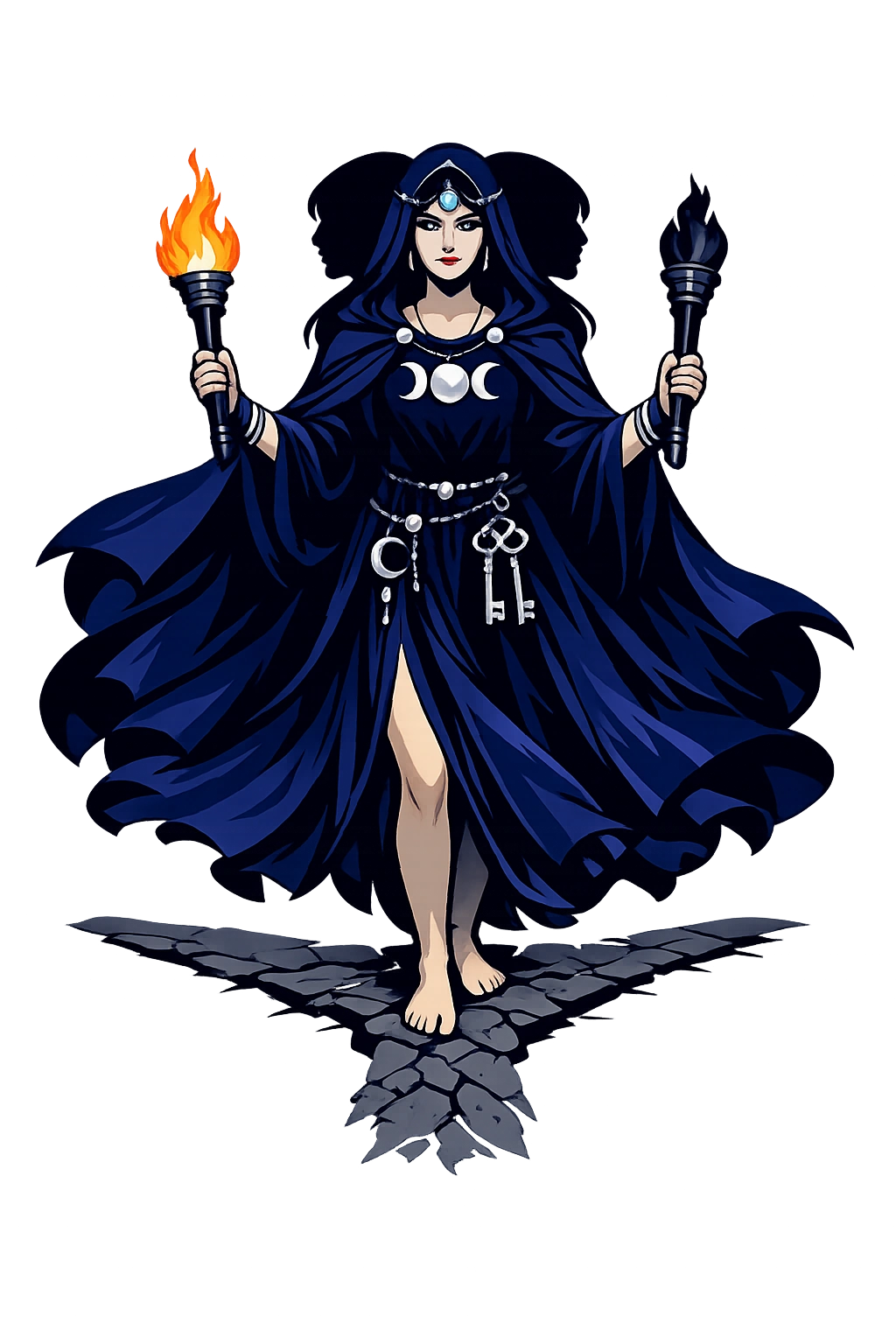
Sacred SymbolsTwin torches, Key, Dagger, Black dog, Pole-star
02

Etymology & Word Family

From original script to Unicode restoration

Proto-indo-european *seh₂k- to work, to do
Original Script Ἑκάτη Hekátē — "She who works from afar (from ἑκάς)"
Unicode Restoration Hekátē Restored stress, length, and script
Modern ASCII hekate Plain-ASCII fallback

Possibly from ἑκάτη "far-shooting", or pre-Greek. Associated with magic and crossroads.

03

Unicode Character Breakdown

Character-by-character philological analysis

CharacterUnicodeNameBlockPhonetic Role
HU+0048Latin Capital Letter HBasic LatinRough breathing
eU+0065Latin Small Letter EBasic LatinShort epsilon
kU+006BLatin Small Letter KBasic LatinKappa
áU+00E1Latin Small Letter A with AcuteLatin-1 SupplementAcute on alpha
tU+0074Latin Small Letter TBasic LatinTau
ēU+0113Latin Small Letter E with MacronLatin Extended-AEta: long epsilon

The dual-tier nature of Hekátē arises because the original carries both stress and vowel length and history has handed down more than one defensible Unicode spelling — each variant is a real, attested restoration, and both live as owned domains.

04

Cultural Significance

From ancient cult to modern memory

Hekátē in Later Traditions

Hekátē absorbed many minor deities of thresholds, ghosts, and night. In Roman religion she was identified with Trivia, the goddess of crossroads, and fused with the lunar Diana and the underworld Proserpina into the famous 'triple Hecate' of later art — three bodies back to back, facing down three roads. In Egypt she was associated with Isis and Nephthys as a goddess of magic. The Hellenistic and Roman world saw her cult spread through household rituals and curse tablets; her name appears in hundreds of magical papyri. In modern Neopaganism she is perhaps the most widely worshipped Greek goddess, embodying feminine magical autonomy — a continuity of practice spanning two and a half millennia, from the triodos of a Greek village to the altar of a twenty-first-century witch.

Modern Legacy

Hekátē's legacy is the persistence of magic itself. Shakespeare's witches in Macbeth answer to her; she appears in Marlowe's Doctor Faustus, in Goethe's Faust, in the poetry of Baudelaire, and in countless works of fantasy. The word 'Hecate' became an adjective for witchcraft ('hecatian' rites), and her triple form — three faces looking down three roads — is one of the most enduring images of the uncanny in Western art. Restoring Hekátē in Unicode honors not only a Greek goddess but the long, often persecuted tradition of liminal knowledge that she represents.

In the Earth

The great Carian sanctuary of Hekatē at Lagina (near Stratonicea) produced a sculptured frieze depicting her myth and annual festival; excavations revealed the propylon and the sacred way. In Athens and Selinous, inscribed lead curse tablets (defixiones) invoke Hekate for binding enemies — thousands survive. Pausanias (2.30.2) describes Alkamenes' triple-bodied Hekatē Epipyrgidia on the Athenian Acropolis, and marble reliefs from the Agora and Piraeus show the goddess carrying torches, keys, and daggers beside crossroad pillars. Small household shrines (hekataia), triple-figured herms set at doorways, are common finds across the Greek world.

05

The Meditation

What Hekátē means — beyond the dictionary

Hekátē is the goddess of the in-between: not day, not night; not Olympian, not chthonic; not alive, not dead. She stands at the crossroad where three paths meet and no direction is obviously right. That is why she belongs to magic: magic is the art of operating at boundaries, of making something happen by standing in the threshold.

In a culture obsessed with clarity and categories, Hekátē is unsettling because she refuses them. She is powerful precisely where definitions fail. To restore her name is to admit that the ancient world knew something we often forget: that the most important places are the ones between.

06

Frequently Asked Questions

Common questions about Hekátē, Magic, Crossroads, Moon, and Unicode restoration

01How do you pronounce Hekátē?

In reconstructed pronunciation, Hekátē is /he.ká.tɛː/ — approximately 'he-KAH-tay' — the second syllable rises in pitch, and the final 'ay' is held long like the 'a' in 'say' stretched out.

02What does Hekátē mean?

Hekátē means She who works from afar (from ἑκάς) in the greek tradition.

03What are the symbols of Hekátē?

Hekátē is associated with Twin torches (Light in darkness and the guide between worlds), Key (She holds the keys to the underworld and to locked mysteries), Dagger (Used in magical rites and as protector of doorways), Black dog (The Hecatean hound, associated with her nocturnal processions), Pole-star (Her celestial guide for sailors and night-travelers).

04Why are there different spellings of Hekátē?

Each form is a historically attested restoration rather than a mistake: Hekatē is the macron-only form (LSJ convention: length only, no acute). PUNICODEX registers the full set so the tradition is preserved under every defensible spelling.

05Why restore Hekátē in Unicode?

Plain ASCII hekate strips the stress, length, and script that make the name specific. Unicode restoration returns the name to its original written dignity.

06What is the most important myth about Hekátē?

“Daughter of Persês, Honored Above All Titans” — Hekátē's mythology is small in scale but vast in implication. Hesiod gives her a Titan's birth and Zeus's exceptional favor; the Homeric Hymn to Demeter makes her Persephonē's torch-bearing ally; and the curse tablets, magical papyri, and Chaldean Oracles of later antiquity multiply her into every crossroads of the known and unknown. She is the rare god whose importance grew as her myths thinned — a boundary-goddess whose true biography was written by her worshippers. The full telling lives on the lore page.

07

Scholarly Sources

The philological foundations of this restoration

Every claim on this page is grounded in established scholarship. The orthographic restorations follow disciplinary convention. The etymological chain follows the best available reference works. This is not invention — it is resurrection through scholarship.

Lexicography & Philology

  • Liddell, H. G., Scott, R., & Jones, H. S. A Greek-English Lexicon. Oxford: Clarendon Press, 9th ed. 1996.
  • Pape, W., & Benseler, G. E. Wörterbuch der griechischen Eigennamen. Braunschweig: Vieweg, 1884.
  • Beekes, R. S. P. Etymological Dictionary of Greek. Leiden: Brill, 2010.

Primary Texts

  • Hesiod, Theogony 404–452
  • Homeric Hymn to Demeter (2), lines 24, 51–59, 438–440
  • Pausanias, Description of Greece 2.30.2 (the Hekatē Epipyrgidia of Alkamenes)

Archaeology & Art History

  • Material evidence — iconography, inscriptions, and temple archaeology — for Hekátē and related cults.

Religious Studies

  • Apollonius Rhodius, Argonautica 3.860–866, 1191–1224
  • The Chaldean Oracles (ed. Majercik, 1989)
  • Beekes, Etymological Dictionary of Greek, s.v. Ἑκάτη
Return

The Surface Awaits

You have traced the name from its earliest attestation to its Unicode restoration. Now return to the myth. The story is where the name lives.

Back to Lore
Hekátē mascot