The Living Myth
Magic, Crossroads, Moon · The Torch-Bearer · Queen of Ghosts
Stories of Hekátē
Hekátē's mythology is small in scale but vast in implication. Hesiod gives her a Titan's birth and Zeus's exceptional favor; the Homeric Hymn to Demeter makes her Persephonē's torch-bearing ally; and the curse tablets, magical papyri, and Chaldean Oracles of later antiquity multiply her into every crossroads of the known and unknown. She is the rare god whose importance grew as her myths thinned — a boundary-goddess whose true biography was written by her worshippers.
Hesiod (Theogony 404–452) makes Hekátē the daughter of the Titan Persês and the starry nymph Asteria, and then interrupts his own genealogy for an astonishing digression: no other child of a Titan, he says, was honored by Zeus so much. Zeus gave her a share in the earth and in the barren sea, and though she is an only child, she holds sway even in starry heaven; for the kings she favors she sits beside as a beautiful goddess, and she stands by horsemen and by athletes and by fishermen hauling their long nets, granting what she wills, for hers is the power to make any endeavor prosper. The passage is unique in archaic epic — a hymn inside a genealogy — and it advertises a cult far wider than her meager mythic résumé: Hekátē is the goddess of all the small thresholds where human effort meets fortune.
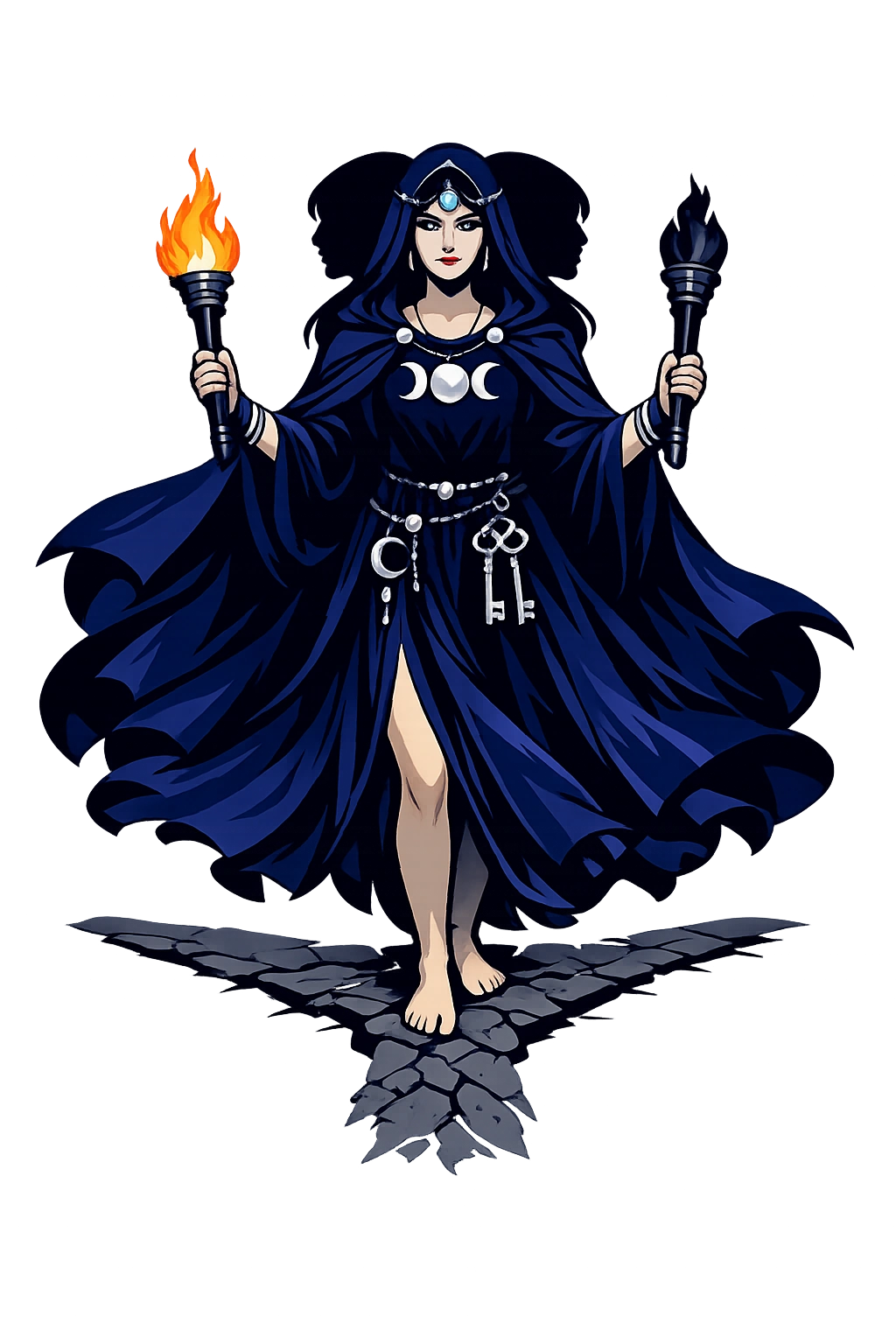
When Hádês burst from the earth and carried off Persephonē, only two heard the cry: Hēlios, whose eye is everywhere, and Hekátē, who heard it from her cave and came at once with torches to Dēmētēr, the girl's mother, wandering nine days in grief. The Homeric Hymn to Demeter (24, 51–59, 438–440) then makes the two goddesses a pair: together they approach Hēlios, together they learn the truth, and in the hymn's closing tableau Hekátē becomes Persephonē's permanent companion — her propolos, attendant — going before her and bearing torches in the night whenever the Maiden visits the upper world. The myth explains her most familiar image: the torch-bearer is not a huntress or a witch but an escort, lighting the road between the realm of the dead and the light of the living.
Hekátē's lineage reaches back to the generation before Zeus. Her mother Asteria — sister of Leto, and so aunt of Apóllōn and Artemis — fled Zeus's pursuit by leaping into the sea in the shape of a quail, became the free-floating island Asteria, and was fixed in place as Delos when Leto, heavy with the twins, touched its soil (Theogony 404–410; Callimachus, Hymn to Delos). Callimachus even derives the island's old name Ortygia — 'Quail Island' — from the very shape Asteria took in her leap. Hekátē is thus cousin to the two most luminous Olympians, yet she keeps to the dark: the starry family of Leto walks the daylit heavens, while the daughter of the starry one patrols the night. The genealogy reads like an argument about how families divide an inheritance — light to one branch of the house, its absence to the other.
In the Argonautica of Apollonius Rhodius, Medea performs her night rites to Hekátē — the Brimō she invokes, the goddess who hears the prayers of those who stand at the meeting of three roads and of those at the tombs of the newly dead (3.860–866, 1191–1224). The same Hekátē commands the kolossoi, the dolls of curse magic, and on thousands of surviving lead curse tablets (defixiones) from Athens, Selinous, and the whole Greek world her name, alongside those of the underworld powers, binds lovers, rivals, and enemies. The mythic corpus is thin here, deliberately: hers is an art practiced rather than narrated. She presides over the magic that works at boundaries — between the living and the newly dead, the willing and the bound, the road taken and the road refused.
In the second and third centuries CE, the Chaldean Oracles lifted Hekátē from the crossroads to the cosmos, making her the synthemis, the intermediary between the intellectual fire of the highest god and the material world below — the lunar goddess whose light is the last intelligible thing before matter's darkness. The theurgists who used the oracles in ritual aimed at precisely her borderland: the place where the descending soul becomes body. Through the Neoplatonists — and through the Renaissance editors who recovered them — this cosmic Hekátē passed into the grimoire tradition and, eventually, into modern witchcraft, where she is still invoked as maiden, mother, and crone at the three-way crossroads. Late antiquity did not distort her; it completed her — the boundary-goddess raised to the boundary of the universe itself.
Magic, Crossroads, Ghosts, and the Moon
Hekátē is the most liminal of the Greek gods. She stands at crossroads, doorways, and the boundary between living and dead. Unlike the Olympians who shine in public cult, she belongs to night, household ritual, and secret knowledge.
Crossroads (trioditis) are her sacred places; offerings were left at three-way intersections.
She carries torches to guide Persephonē from the underworld and to light nocturnal rites.
She rules phantoms and sends nightmares; the baying of dogs announces her approach.
Patron of pharmakeia and binding spells; Medea and Circe invoke her power.
From the original script to the living URL
Ἑκάτη
The name in its original Greek form. Hekátē (Ἑκάτη) is attested in the source tradition — “She who works from afar (from ἑκάς)”. Its long vowels and acute accents carry the full phonetic and orthographic weight of the source tradition.
hekate
Reduced to plain hekate, the name loses everything that made it specific: long vowels and acute accents. What remains is an ASCII string that machines can parse but that no longer speaks with its original voice.
Hekátē
The Unicode restoration recovers what ASCII flattened. Hekátē restores long vowels and acute accents, returning the name to its original written dignity. The domain encodes to Punycode, but the browser displays the truth.
Hekátē.com → xn--hekt-7na51a.com
The non-ASCII characters in Hekátē are encoded while the ASCII remains visible. To the DNS, it is Punycode. To humanity, it is Hekátē.
Owned, ideal, and ASCII forms of Hekátē
Hekátē
Restores Ἑκάτη. The live temple domain — hekátē.com.
Hekatē
Restores Ἑκάτη. A second live spelling — hekatē.com.
hekate
Flattens Ἑκάτη. The plain ASCII fallback — what DNS and legacy systems see.
How Hekátē was spoken
How Hekátē travels from ancient script to the modern URL
Greek Ἑκάτη; from ἑκάς “far", hence “she who works from afar"; a goddess of magic and crossroads.
Magic, Crossroads, Moon
The Unicode restoration Hekátē preserves Greek stress and length; the ASCII form hekate loses these features.
The lore you have read is the living myth. Extended Lore opens the scholarly vault beneath it: the cult and its material remains, a history of the image, the name after antiquity, a meditation on what the name still means, and the full scholarly apparatus — etymology, orthography, sources.
Enter Extended Lore