Stories of Hebe
The stories of Hebe are short, and all Olympian housekeeping: she pours for the gods, loses her office, marries the burned hero, and keeps a single small temple. Yet the homeliness is the point — youth, in this mythology, is not a protagonist but a substance the gods drink.
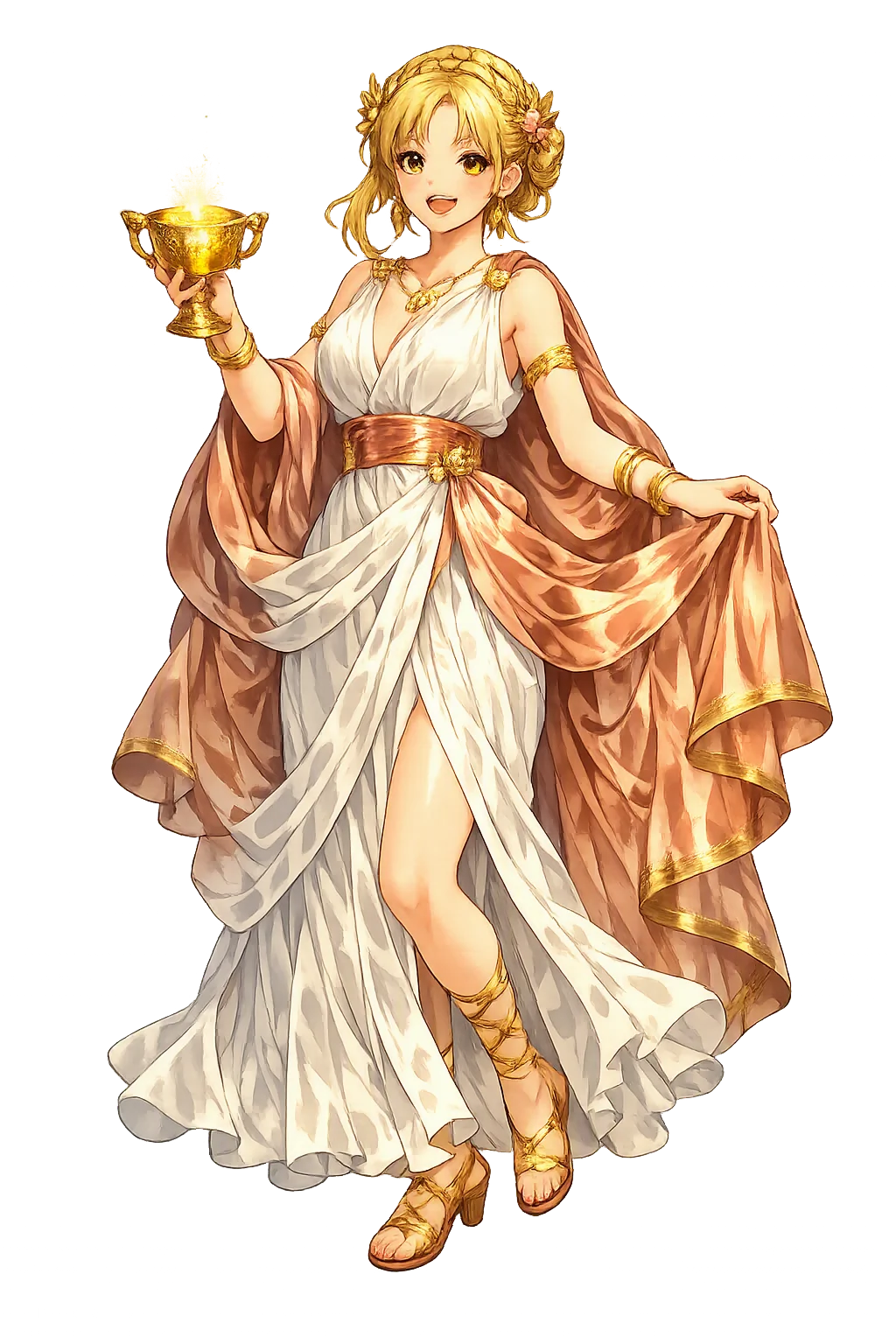
On Olympus the youngest of the goddesses had the oldest of duties. Hebe — her very name means 'Youth' — poured nectar and ambrosia for the gods at their golden tables and kept their cups filled through quarrels, weddings, and feasts. Homer gives her the homelier tasks too: after Ares staggers back from the field with a spear-wound the size of a fist, it is Hebe who bathes him and dresses him again in fine clothing (Iliad 5.904–906). On Attic vases she appears again and again in this role, oinochoe in one hand, phiale in the other, forever refilling the cup that keeps the immortals immortal. The myth encodes a simple economy: on Olympus, even the food of eternity must be served — and it is served by youth itself, because only the young have the inexhaustible hands.
Late sources tell why Hebe lost her office, and they are honest enough to admit the tale is not Homer's. While serving at a ceremony on Olympus — the scholiasts and Eustathius place the episode at Olympia during the founding rites — Hebe fell. Some say she stumbled, some that the fall stripped her bare, and the humiliation cost her the cupbearer service; Zeus gave the office to the beautiful Trojan prince Ganymede, 'for his beauty's sake, to be among the immortals and pour wine' (Iliad 20.231–235). The same late commentators preserve a stranger detail: from her magic girdle the Eleans drew rites against old age. The story is a parable of how fragile even a divine job can be — youth serves at the table only until it trips, and the cup passes to a newer face.
When Herakles had burned away his mortal part on the pyre at Oita, the divine portion of him was carried up to Olympus, and there he received the reward no other hero won: Hebe. 'He made Hebe, with her beautiful ankles, daughter of great Zeus and of Hera of the golden sandals, his wife' (Odyssey 11.601–604); Hesiod sets the wedding among the unions that settled the divine order (Theogony 950–955). By her the hero — now wholly a god — fathered the twin guardians Alexiares and Aniketos, 'Averter of Evil' and 'Unconquered' (Apollodorus, Bibliotheca 2.7.7). The marriage closes the greatest career of Greek myth with its most radical promise: that youth itself can be the prize of endurance, and that the man who burned could still be given forever.
For a goddess so close to the throne of Zeus, Hebe received remarkably little civic worship — one city excepted. At Phlius in the northeastern Peloponnese stood her sanctuary, with an ancient cult image, and the Phliasians were known throughout Greece for honoring the daughter of Zeus and Hera where other cities neglected her (Pausanias 2.13.3). The choice of Phlius is telling: a small, conservative city guarding one archaic cult exactly as it had received it — no Panhellenic games, no oracle, no treasure, just a single temple where youth, the most fleeting of the gods' gifts, was given a permanent address. Pausanias adds the local pride: the Phliasians said their Hebe was honored there from the earliest times, and they tended her image with the stubborn care of a family heirloom. The cult quietly argues the theology of her name: what passes fastest deserves the shrine most.
Youth
Hebe is youth in its most literal Greek sense — ἥβη, the bloom of early strength — made goddess: cupbearer of Olympus, wife of the deified Herakles, and the only figure in the pantheon whose name is her domain. Hers is a small mythology with a large office: keeping the immortals fed, and keeping the idea of youth itself enthroned.
As cupbearer she poured the gods' immortal food — the office shown on countless vases with oinochoe and phiale.
Her name means 'Youth' (ἥβη): the bloom of early strength that peaks, passes, and never returns.
After his labors the hero ascended to Olympus and made her his wife — the one apotheosis Greece awarded (Odyssey 11.601–604).
She held the cupbearer office before Zeus gave it to the Trojan prince Ganymede (Iliad 20.231–235).
From the original script to the living URL
Ἥβη
The name in its original Greek form. Hebe (Ἥβη) is attested in the source tradition — “Youth (from ἥβη)”. Its long vowels and acute accents carry the full phonetic and orthographic weight of the source tradition.
hebe
The plain hebe form is identical to the Unicode restoration. Because this name is already written in Latin letters, no diacritics, stress, or script information were lost — only capitalization differs.
Hebe
The Unicode restoration does not need to recover lost marks for Hebe. Its value is canonical spelling and consistent cataloguing, not the reconstruction of erased orthography. The domain is readable as-is to both DNS and humanity.
Hebe.com
This restoration is written entirely in ASCII letters — no Punycode encoding stands between Hebe and the DNS. The domain reads identically to machines and to human eyes.
Owned, ideal, and ASCII forms of Hebe
Hebe
Restores Ἥβη. The full Unicode restoration. hebe.com is not in the PuniCodex collection — it is watched for release; if it drops, this temple upgrades to an owned flagship.
Hḗbe
Restores Ἥβη. Stacked macron+acute on the stressed long vowel, matching Greek Ἥβη; philologically ideal but often untypeable on phones.. Not in the PuniCodex collection.
How Hebe was spoken
How Hebe is preserved in writing
A bespoke provenance study for Hebe is being prepared by the PUNICODEX scholarly team.
Contribute scholarly provenance →The lore you have read is the living myth. Extended Lore opens the scholarly vault beneath it: the cult and its material remains, a history of the image, the name after antiquity, a meditation on what the name still means, and the full scholarly apparatus — etymology, orthography, sources.
Enter Extended Lore