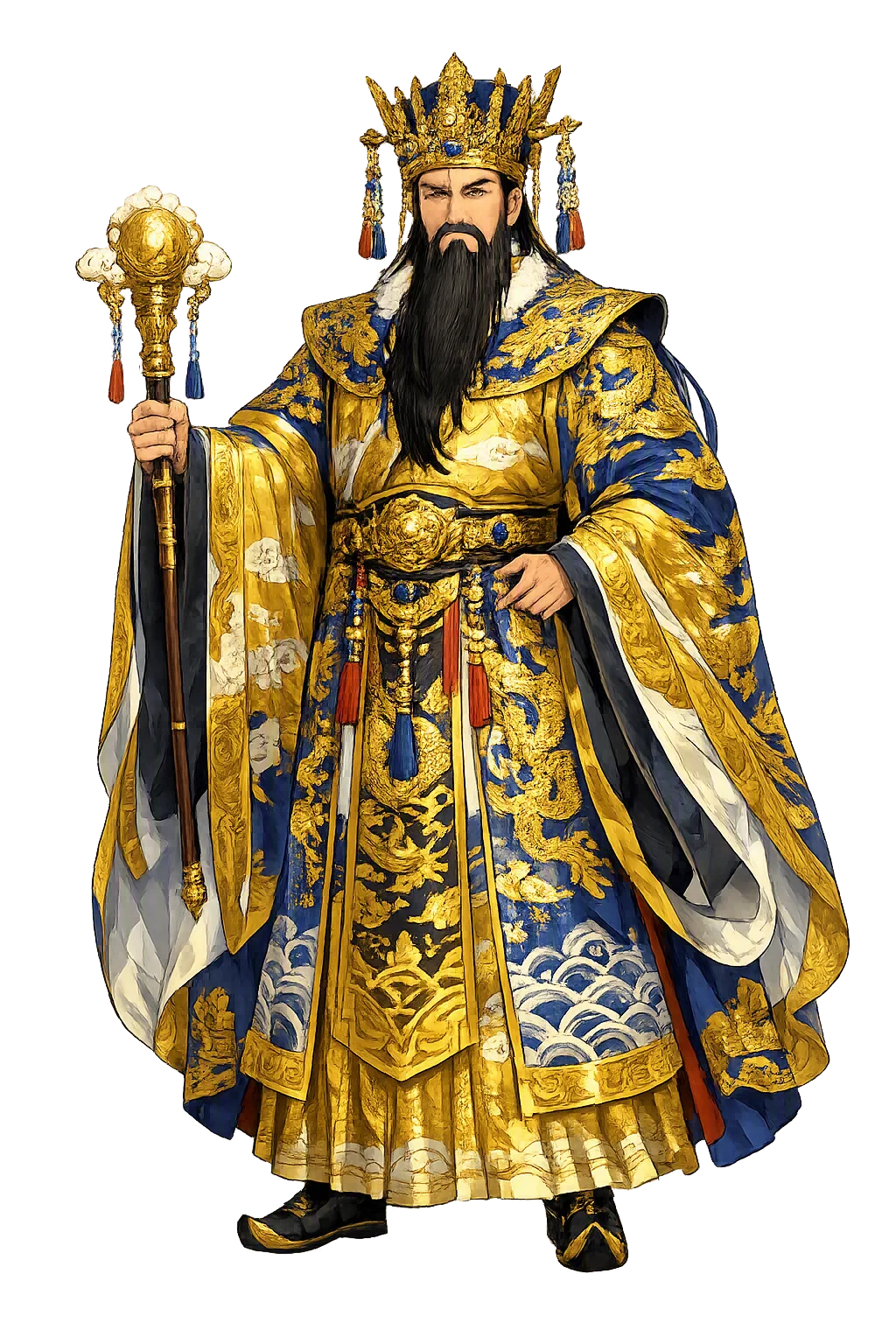
Stories of Hwanin
The mythology of Hwanin survives in a single late masterpiece: the Samguk Yusa ('Memorabilia of the Three Kingdoms') of the monk Iryeon, compiled in 1281 CE from much older Korean and Chinese materials. In it, Hwanin — explicitly identified with Indra, the Buddhist lord of heaven — sends his son Hwanung down beneath a sandalwood tree, and from that descent flow the tiger-and-bear transformation, the birth of Dangun, and the whole legitimating myth of Korea's foundation.
Iryeon's Samguk Yusa opens the Korean story with Hwanin, 桓因, whom the text itself glosses as Indra — the Buddhist Śakra, lord of the thirty-three heavens. When his son Hwanung, 桓雄, gazed down upon the human world and asked to rule it, Hwanin looked down in turn, chose the fairest spot under heaven, and fixed there the sacred altar. He gave his son three heavenly seals and a retinue of three thousand, and Hwanung descended beneath a sandalwood tree on Taebaeksan, bearing the tokens of rule, the arts of law, grains, and medicine. (Iryeon, Samguk Yusa, 'Gojoseon' chapter, trans. Ha and Mintz, pp. 32–41.) The myth is striking because heaven is bureaucratic as well as holy: authority travels downward from father to son, sealed and documented, so that Korean kingship arrives on earth already carrying heaven's warrant.
Living beneath the sandalwood tree, Hwanung was approached by a tiger and a she-bear who begged him to make them human. The god gave them twenty cloves of garlic and a bundle of mugwort and set a single condition: eat only this and shun the sunlight for one hundred days. The tiger could not endure the discipline and fled back to the wilds; the bear persevered, and on the twenty-first day she shed her fur and became a woman, Ungnyeo — the bear-woman. Childless, she prayed beneath the tree, and Hwanung took her as his wife. She bore a son, Wanggeom, 'the prince of the sandalwood,' whom heaven chose as the first king of the Korean people: Dangun. (Samguk Yusa, 'Gojoseon.') The tale ranks patience above strength: the beast that submits to law and time becomes the ancestress of a nation, while the stronger animal is forgotten.
Dangun Wanggeom, child of the bear-woman and the son of heaven, founded Gojoseon — 'Old Joseon' — in 2333 BCE by the myth's traditional dating, and ruled for fifteen hundred years. When his time on earth was done he did not die as mortals die: he returned to the mountains and became a god of the peaks, Asadal, the spirit who still presides over the land he governed. Iryeon adds that Dangun's priests, the Jeceon, 'worship heaven' at his shrine, tying the ancestral cult directly to the heaven that sent him. The myth's grand claim is easy to miss: Korean kingship is not a human invention or a conquest but a family inheritance, carried down through Hwanin and Hwanung and never surrendered — its founder still holds the mountains in trust for his descendants.
A second layer of the story shows the myth being rewritten by each age that tells it. On the page of the Samguk Yusa, Hwanin is Indra — the Sanskrit Śakra — so the heavenly father of the Korean foundation arrives wearing Buddhist cosmology. Later readers re-dressed the same descent in Confucian costume as a model of ethical hierarchy, and in 1909 the nationalist religion Daejonggyo installed Dangun, and through him the heaven that sent him, at the center of a modern faith. Twentieth-century scholarship treated the tale as a charter myth of Gojoseon, while North and South Korea both canonized it — in schoolbooks and on National Foundation Day — as the beginning of the nation. The myth survives precisely by surrendering its details: every generation re-clothes the same descent of heaven's authority in the costume of its own dominant thought.
the supreme source of the Dangun founding myth
Hwanin is the supreme celestial figure who rules from heaven in the Dangun founding myth in Korean tradition. The name means "Lord of Heaven" and belongs to the domain "Supreme God, Heaven." In the Samguk Yusa, Hwanin is the ruler of heaven who answers his son Hwanung's wish for the earth by choosing the sacred site and sending him down with three thousand retainers and the heavenly seals of authority. Hwanin is not a creator in the biblical sense; he is the apex of a celestial hierarchy that authorises the descent of culture and law to the Korean peninsula.
Hwanin sits at the apex of the Korean celestial order, the source from which legitimate authority descends.
Heaven is imagined as a court with ministers, retainers, and an ethical law that mirrors human government.
Hwanin authorises the descent that makes possible the birth of Dangun and the founding of Korea.
The myth encodes the belief that rulers and peoples are accountable to a higher heavenly standard.
From the original script to the living URL
하나님
The name in its original Korean form. Hwanin (하나님) is attested in the source tradition — “Lord of Heaven”. Its original diacritics and script distinctions carry the full phonetic and orthographic weight of the source tradition.
hananim
The plain hananim form is identical to the Unicode restoration. Because this name is already written in Latin letters, no diacritics, stress, or script information were lost — only capitalization differs.
Hwanin
The Unicode restoration does not need to recover lost marks for Hwanin. Its value is canonical spelling and consistent cataloguing, not the reconstruction of erased orthography. The domain is readable as-is to both DNS and humanity.
Hwanin.com
This restoration is written entirely in ASCII letters — no Punycode encoding stands between Hwanin and the DNS. The domain reads identically to machines and to human eyes.
Owned, ideal, and ASCII forms of Hwanin
Hwanin
Restores 하나님. The full Unicode restoration. hwanin.com is not in the PuniCodex collection — it is watched for release; if it drops, this temple upgrades to an owned flagship.
hananim
Flattens 하나님. The plain ASCII fallback — what DNS and legacy systems see.
How Hwanin was spoken
How Hwanin travels from ancient script to the modern URL
The lore you have read is the living myth. Extended Lore opens the scholarly vault beneath it: the cult and its material remains, a history of the image, the name after antiquity, a meditation on what the name still means, and the full scholarly apparatus — etymology, orthography, sources.
Enter Extended Lore